
Brands can now target sophisticated audiences, automate media buying, track conversions, and collect more campaign data than ever before.
None of that fixes an ad people ignore.
That is the problem performance creative is designed to address.
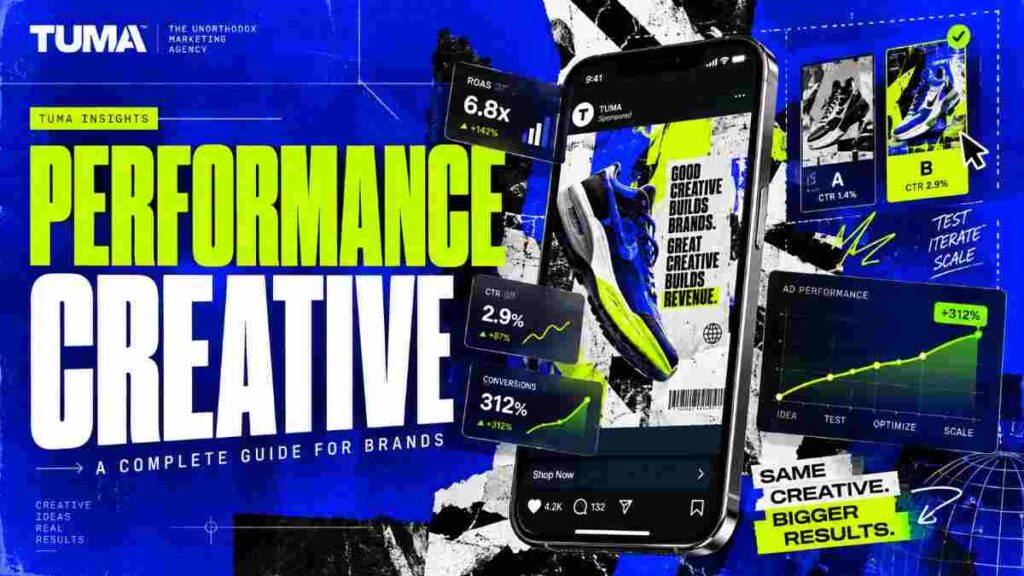
Performance creative connects creative thinking with measurable marketing performance. Instead of treating an advertising asset as finished once it has been designed, performance creative treats every campaign as an opportunity to learn what audiences respond to, what messages create action, and what should be tested next.
What is performance creative?
Performance creative is a data-informed approach to advertising that combines creative strategy, audience insight, paid media, testing, and performance analysis. Creative assets are launched, measured, analyzed, and iterated so campaign data can influence future creative decisions while creative choices contribute to measurable marketing outcomes.
It is not creativity replaced by spreadsheets.
It is creativity given a feedback loop.
What Is Performance Creative?
The simplest performance creative meaning is creative developed and continuously improved with measurable campaign performance in mind.
A performance creative process typically brings together:
Audience research → Creative strategy → Creative concepts → Paid media → Performance data → Analysis → Iteration
Traditional advertising may develop a central campaign concept and run it across a defined campaign cycle. Performance creative tends to operate more continuously.
A creative team might develop several hooks, messages, visuals, offers, formats, or storytelling approaches. Those creative assets enter paid media campaigns. Performance data then helps the marketing team understand which ideas deserve further investment, which need modification, and which should be replaced.
The goal is not merely to produce an attractive ad.
It is to understand why particular creative decisions affect audience behavior and campaign performance.
That distinction matters.
An ad can look excellent and fail to generate qualified traffic. Another can generate high engagement but poor sales. A third may perform extremely well for several weeks before declining because the audience has seen it too many times.
Performance creative creates a framework for understanding those differences.
How Does Performance Creative Work?
A useful way to think about performance creative is as a continuous learning cycle:
Research → Hypothesis → Creative → Launch → Data → Analysis → Learning → Iteration
Research comes first.
Brands study customer behavior, pain points, motivations, objections, previous campaigns, competitors, first-party data, sales conversations, reviews, platform signals, and market trends.
Those insights inform a hypothesis.
For example:
“If our opening focuses on the frustration customers experience before introducing the product, the ad may attract more qualified attention than a product-first opening.”
The creative team then produces assets designed to test that hypothesis.
The campaign launches through paid media.
Performance data begins revealing how audiences interact with the creative. Marketers analyze the results against the original campaign goal, identify useful patterns, and build the next iteration.
This creates the central performance creative feedback loop:
Creative → Launch → Data → Analysis → Iteration → New Creative → Testing → Improved Learning
Notice the final word: learning.
Not every test wins. Performance creative is valuable partly because failed tests can still teach the team what not to repeat.
Google Ads itself recommends a repeatable testing framework built around hypotheses, controlled variations, sufficient data, documented findings, and continued experimentation. That is closely aligned with the logic behind a disciplined performance creative process.
Google Ads: Test and optimize creative messages
Performance Creative vs Traditional Creative Advertising
Performance creative and traditional creative advertising are not enemies.
Both rely on ideas, audience understanding, messaging, visual communication, storytelling, and creative judgment. The biggest difference is usually how rapidly performance data enters the decision-making process.
| Factor | Traditional Creative | Performance Creative |
| Primary focus | Brand idea or campaign concept | Measurable outcomes + creative effectiveness |
| Decision making | Research + creative judgment | Research + creative judgment + performance data |
| Testing | May be limited or campaign-specific | Usually continuous |
| Iteration | Often campaign-cycle based | More frequent |
| Media relationship | Can operate separately | Closely connected |
| Measurement | Brand and campaign metrics | Creative, media and conversion metrics |
| Creative lifespan | Often longer | Changes according to performance and fatigue |
Traditional creative can build powerful brands, distinctive narratives, and memorable campaigns.
Performance creative adds another discipline: systematic experimentation.
The strongest brands do not necessarily choose one approach over the other. They can use a strong brand idea while testing how different expressions of that idea perform across audiences, formats, placements, and funnel stages.
Performance Creative vs Performance Marketing
These terms are related but not interchangeable.
Performance marketing is the broader marketing discipline focused on measurable outcomes such as leads, purchases, registrations, bookings, app installs, or revenue.
It can include:
- Media strategy
- Audience targeting
- Media buying
- Campaign optimization
- Budget allocation
- Conversion tracking
- Attribution
- Reporting
- Landing-page optimization
- Performance measurement
Performance creative is the creative strategy, development, testing, and optimization layer inside that broader system.
A simple relationship is:
Performance Marketing
→ Media Strategy
→ Audience Targeting
→ Measurement
→ Campaign Optimization
→ Performance Creative
Media teams can optimize audiences, bids, budgets, and placements.
But if the creative fails to earn attention or communicate a compelling reason to act, there is a limit to what media optimization alone can achieve.
That is why creative has become an increasingly important lever in paid acquisition.
Why Performance Creative Matters for Brands
Digital advertising creates an unusual environment: brands can measure enormous amounts of behavior while competing for extremely limited attention.
Users move quickly through feeds. Competitors can enter auctions at any time. Platforms behave differently. Creative eventually becomes familiar. Customer motivations change. Offers change.
One advertisement rarely solves all of those problems indefinitely.
Performance creative gives brands a structured way to respond.
Instead of asking:
“Do we like this ad?”
teams can also ask:
- Did the audience stop?
- Did they understand the message?
- Did qualified users click?
- Did the landing page convert those visitors?
- Which angle performed differently?
- Was the offer clear?
- Did one audience respond differently?
- Is performance declining because of creative fatigue or another factor?
- What should we test next?
That moves creative discussion from subjective preference toward informed creative judgment.
The Key Elements of Performance Creative
Audience Research
Effective creative starts before production.
Market research and audience research help brands understand who they are speaking to, what customers want, what frustrates them, what objections slow a purchase, and how those motivations change across the customer journey.
Useful inputs can include:
- First-party customer data
- Reviews
- Customer interviews
- Sales conversations
- Search behavior
- Previous campaign performance
- Customer support questions
- Competitor research
- Social comments
- Platform audience signals
- Industry trends
Demographics matter, but demographics alone rarely explain why someone buys.
Psychographics, buying intent, awareness stage, pain points, preferences, previous experiences, and purchase motivations usually produce richer creative insights.
Those insights influence the entire advertisement:
Audience insight → Hook → Message → Offer → Visual → CTA → Channel
Creative Strategy
Creative strategy translates research into ideas worth testing.
The strategy should determine:
- Which audience problem matters
- Which value proposition to emphasize
- Which objection to address
- Which proof point to show
- Which emotional or rational angle to explore
- Which creative format suits the message
- Which funnel stage the creative serves
A clear strategy prevents creative production from becoming an endless stream of disconnected assets.
Hooks and Messaging
The hook earns the next second of attention.
It might be:
- A customer problem
- A provocative observation
- A demonstration
- A question
- An unexpected visual
- A specific benefit
- Social proof
- A recognizable situation
But the hook cannot carry the entire ad.
The message still needs to establish relevance, communicate the value proposition, provide enough evidence, and create a logical path toward the CTA.
Creative Production
Performance creative may include:
- Static ads
- Short-form video
- UGC-style content
- Founder videos
- Testimonials
- Product demonstrations
- Animations
- Motion graphics
- Carousels
- Comparison ads
- Educational creatives
- Web banners
- Social video
There is no universal winning format.
UGC is not automatically better than polished production. Short videos are not automatically better than long ones. Founder ads are not automatically more persuasive.
The right format depends on the platform, audience, message, offer, product, and campaign objective.
Paid Media Alignment
An effective creative asset must make sense where it appears.
A TikTok ad should not necessarily be a television commercial cropped vertically.
A YouTube ad may require a different opening structure from a Meta feed ad. Google Display, Instagram Stories, Reels, Facebook feeds, TikTok, YouTube, and programmatic placements each create different viewing environments.
Think of performance as an interaction:
Creative × Audience × Channel × Timing
Platform behavior can affect:
- Video length
- Hook style
- Aspect ratio
- Pacing
- Message density
- Sound
- Captions
- Visual language
- CTA placement
TikTok, for example, currently encourages platform-native vertical creative and structures video around a hook, body, and close, reinforcing why creative should be designed for the environment in which people experience it rather than mechanically resized across platforms.
Which Performance Creative Metrics Matter?
There is no single performance creative metric that tells the whole story.
The correct KPIs depend on the campaign objective, platform, funnel stage, format, audience, and business model.
Attention and Video Metrics
Hook rate, thumb-stop behavior and early retention can indicate whether the opening successfully earns attention.
Hold rate can help teams understand whether viewers continue watching after the initial hook.
Video completion rate shows how frequently viewers reach the end.
These signals are useful for diagnosing video creative, but strong viewing behavior does not automatically mean the campaign is profitable.
Traffic Metrics
CTR can indicate whether the creative generates enough interest for someone to click.
CPC shows how much the campaign is paying for those clicks.
CPM represents the cost of delivering 1,000 impressions and is influenced by more than creative alone, including the auction, targeting, market demand, placement, and competition.
Conversion Metrics
Conversion rate measures how frequently users complete the desired action after entering the conversion path.
Cost per lead matters for lead-generation businesses.
CPA measures the cost of acquiring a defined action.
CAC considers the broader cost of acquiring a customer and can be more relevant to business economics than an advertising-platform CPA alone.
ROAS, or return on ad spend, compares advertising revenue with advertising spend.
A campaign can have excellent CTR and poor ROAS.
That may indicate the creative attracts curiosity without enough buying intent, or the problem may exist elsewhere in the journey.
Metrics should therefore be interpreted together.
How to Build a Performance Creative Strategy
Step 1: Define the Business Objective
Start with the actual outcome.
Is the campaign intended to generate:
- Awareness
- Engagement
- Leads
- Purchases
- App installs
- Sign-ups
- Bookings
Without a clear objective, teams cannot determine what successful creative should accomplish.
Step 2: Understand the Audience
Study customer needs, objections, reviews, previous campaign data, sales conversations, feedback, first-party data, buying behavior, competitor strategies, and market context.
Identify not only who the audience is but why they might act.
Step 3: Define Creative Hypotheses
Every meaningful test should answer a question.
For example:
If we lead with the customer’s main frustration instead of the product feature, qualified engagement may improve.
Another hypothesis could compare social proof against product demonstration or price-led messaging against value-led messaging.
Step 4: Develop Creative Angles
Potential angles include:
- Problem/solution
- Product benefit
- Demonstration
- Testimonial
- Social proof
- Comparison
- Educational
- Founder story
- Lifestyle
- Objection handling
- Truthful before/after
- Offer-focused messaging
Different angles explore different customer motivations.
Step 5: Produce Creative Variations
Within a concept, marketers can test:
- Hooks
- Headlines
- Opening scenes
- Copy
- Visuals
- Value propositions
- Offers
- CTAs
- Pain points
- Benefits
- Testimonials
- Creators
- Formats
- Length
- Pacing
- Tone
When controlled learning matters, changing one meaningful variable can make results easier to interpret.
But not every test needs to be incremental.
Sometimes the correct question is not:
“Should this button say Shop Now or Learn More?”
It is:
“Should we replace this entire concept?”
Brands need both controlled variations and genuinely different creative ideas.
Step 6: Launch
Match creative to the appropriate:
Audience + Channel + Placement + Funnel stage
Step 7: Measure
Evaluate the KPIs connected to the campaign objective rather than selecting metrics because they look impressive.
Step 8: Diagnose
If the campaign struggles, identify where the problem may exist.
Is attention weak?
Is CTR poor?
Are users clicking but not converting?
Is the offer uncompetitive?
Has the audience become saturated?
Is the landing page failing?
Has the auction changed?
Is tracking reliable?
Diagnosis should happen before creative teams blindly produce more variations.
Step 9: Iterate
Translate campaign learning into the next creative batch.
That might mean:
- New hooks
- Different proof
- Stronger demonstrations
- New creators
- Different pacing
- Better objection handling
- New concepts entirely
Step 10: Scale Winning Concepts
A winning advertisement is useful.
A repeatable creative principle is more useful.
If a particular problem-solution concept succeeds, build intelligently around the underlying insight instead of producing ten nearly identical copies and expecting the same result forever.
Performance Creative Examples
The following performance creative examples are hypothetical. They demonstrate the process rather than claiming specific campaign results.
Example 1: E-commerce Product
Hypothesis:
Problem-first storytelling may generate stronger qualified attention than immediately showing the product.
Variation A:
A polished product video opens with the product.
Variation B:
A UGC-style video opens with the customer problem.
Metrics:
Hook rate, CTR, conversion rate, CPA.
Learning:
If the problem-first creative attracts more qualified conversions, the pain point may be a stronger opening angle.
Next iteration:
Test several problem-focused hooks while retaining the same core value proposition.
Example 2: SaaS Product
Hypothesis:
Customers may respond more strongly to the operational problem than to a list of software features.
Variation A:
Feature-led advertisement.
Variation B:
Pain-point-led advertisement showing the workflow problem first.
Metrics:
CTR, landing-page conversion rate, cost per lead, qualified lead rate.
Learning:
If pain-point messaging generates stronger qualified leads, future creative can build around the business problem rather than the feature list.
Next iteration:
Test different pain points or demonstrate how the software resolves the strongest one.
Example 3: Service Business
Hypothesis:
Proof may reduce uncertainty more effectively than generic claims about service quality.
Variation A:
“Professional service you can trust.”
Variation B:
Customer testimonial or specific evidence explaining the experience.
Metrics:
CTR, lead conversion rate, CPL, qualified inquiries.
Learning:
If proof-driven creative produces more qualified inquiries, credibility may be a major decision factor.
Next iteration:
Test testimonials, process demonstrations, reviews, and objection-handling creatives.
Example 4: Travel or Hospitality Brand
Hypothesis:
Experience-driven storytelling may create stronger intent than destination imagery alone.
Variation A:
Beautiful destination montage.
Variation B:
Story-driven video showing what a guest actually experiences during the trip.
Metrics:
Video retention, CTR, booking-page visits, booking conversion rate, CPA.
Learning:
If experience-focused creative generates more qualified traffic, audiences may need help imagining themselves in the destination rather than merely seeing it.
Next iteration:
Explore different traveler motivations such as relaxation, food, adventure, culture, or family experience.
What Is Creative Fatigue?
Creative fatigue occurs when advertising performance may decline as audiences repeatedly encounter the same creative.
The ad itself has not necessarily become objectively worse.
It has become familiar.
Repeated exposure can reduce curiosity, attention, and responsiveness.
Possible signals include declining:
- Attention
- CTR
- Engagement quality
- Conversion efficiency
alongside increasing exposure or frequency.
But frequency should never be the only diagnosis.
Performance can also deteriorate because of:
- Audience changes
- New competition
- Seasonality
- Auction dynamics
- Offer changes
- Pricing
- Landing-page issues
- Tracking changes
- Budget shifts
- Market demand
The correct response to genuine fatigue is not always another tiny variation.
Changing a headline while keeping the same opening, footage, argument, and structure may create a new asset without creating a genuinely new experience.
Brands need a mixture of creative variations and fresh concepts.
Performance Creative Across the Marketing Funnel
Customer journeys are rarely perfectly linear, but the funnel remains useful for thinking about creative intent.
Top of Funnel
The goal is usually attention and introduction.
Creative may focus on:
- Problems
- Category education
- Cultural relevance
- Strong storytelling
- Brand introduction
- Awareness-stage benefits
Middle of Funnel
The audience may already understand the problem.
Creative can deepen consideration through:
- Product demonstrations
- Benefits
- Testimonials
- Comparisons
- Educational content
- Social proof
Bottom of Funnel
The priority becomes reducing uncertainty and making the decision easier.
Creative may emphasize:
- Offers
- Proof
- Objection handling
- Product details
- Guarantees where applicable
- Clear CTAs
A strong creative strategy therefore considers not just who the audience is, but what that person likely needs to understand next.
How Performance Creative Can Influence ROAS
Better creative can improve paid advertising economics, but the relationship is not automatic.
One possible pathway is:
Stronger creative
↓
More relevant attention
↓
Potentially stronger engagement and CTR
↓
More opportunities for qualified conversion
↓
Potential improvement in CPA or ROAS
The word potentially matters.
Creative cannot guarantee:
- Lower CPM
- Lower CPC
- Lower CPA
- Higher ROAS
- More sales
Results also depend on:
- Audience targeting
- Competition
- Media strategy
- Product-market fit
- Pricing
- Offer
- Landing page
- Tracking
- Budget
- Market demand
- Sales process
Performance creative is a major lever.
It is not the only lever.
Common Performance Creative Mistakes
One common mistake is making attractive ads without defining what they are supposed to test. Without a hypothesis, teams accumulate content rather than learning.
Another is optimizing for vanity metrics. An advertisement generating thousands of reactions may still attract few qualified customers.
Brands also create confusion by changing too many variables simultaneously. If the hook, offer, creator, visuals, CTA, audience, and landing page all change, identifying what caused the result becomes difficult.
The opposite problem is testing insignificant variations. Changing one word or background color repeatedly does not replace genuine concept development.
Other frequent problems include ignoring audience research, separating media reporting from creative decisions, duplicating the exact creative across every platform, killing tests before sufficient information exists, relying indefinitely on a single winning ad, ignoring creative fatigue, or changing the brand identity every time a new test launches.
Another particularly dangerous assumption is:
“UGC performs better.”
Sometimes it does.
Sometimes a polished demonstration, testimonial, animation, founder video, comparison ad, static graphic, or product film works better.
Performance creative replaces these universal assumptions with testing.
Should Creative and Media Teams Work Together?
Yes, closely.
A traditional silo can look like this:
Creative team → Assets → Media team → Campaign
When performance information stops with the media department, creative production loses access to some of its most valuable feedback.
That can create:
Creative and media silos → Disconnect → Weak learning → Lower campaign efficiency
A stronger system is:
Creative + Media → Shared objective → Campaign launch → Performance reporting → Creative learning → Iteration
This requires:
- Shared briefs
- Common campaign objectives
- Clear hypotheses
- Regular communication
- Accessible performance reporting
- Shared responsibility for learning
The creative team needs to understand what happens after an ad launches.
The media team needs to understand what the creative is designed to communicate and test.
Collaboration does not guarantee higher ROAS.
It does make the feedback loop significantly more useful.
Does Performance Creative Replace Branding?
No.
Performance creative should not turn a recognizable brand into a different personality every week.
Brand identity, visual communication, brand narrative, messaging strategy, tone, values, and positioning still matter.
What changes is how the brand expresses those elements.
A company can maintain consistent brand foundations while testing:
- Hooks
- Offers
- Proof points
- Messages
- Formats
- Creators
- Benefits
- Story structures
- Creative angles
Think of the relationship as:
Brand strategy + Performance data = More informed creative decisions
Distinctive brands still need experimentation.
Performance-driven brands still need identity.
The strongest work understands both.
How Much Does a Performance Marketing Agency Typically Cost?
There is no reliable universal price for a performance marketing agency.
Pricing can vary substantially depending on scope, geography, agency model, advertising budget, campaign complexity, and production requirements.
Common structures include:
- Monthly retainers
- Project-based fees
- Creative production packages
- Percentage-of-ad-spend pricing
- Hybrid models
- Performance-based components in appropriate situations
Costs may also change according to the number of platforms managed, creative volume, video requirements, UGC production, reporting, landing pages, strategy involvement, testing cadence, geographic scope, and whether paid media management is included.
Instead of asking only “How much does the agency charge?”, ask what the fee actually includes.
Does the agency simply launch campaigns?
Or does it research audiences, develop hypotheses, produce creative, manage media, analyze results, identify fatigue, and create new testing cycles?
Those are very different scopes.
What Should You Look for in a Performance Creative Agency?
A strong performance creative partner should understand both the advertisement and the system surrounding it.
Ask:
- Does the agency create clear creative hypotheses?
- How frequently are new concepts tested?
- Who reviews campaign performance?
- Do creative and media teams communicate?
- Which metrics influence creative decisions?
- How is creative fatigue evaluated?
- How are winning concepts expanded?
- How are unsuccessful tests translated into learning?
- What reporting is provided?
- Who owns the raw creative assets?
- Which services are included and which are billed separately?
Production capacity matters.
But strategic learning matters just as much.
An agency producing 40 ads every month without knowing why it is producing them may provide more volume without providing more insight.
Performance Creative at TUMA
At TUMA, we believe marketing should deliver results without becoming forgettable.
Performance thinking does not require creative work to become predictable, generic, or engineered entirely around spreadsheets.
And being bold does not excuse creative that has no strategic purpose.
Our approach brings together the areas that increasingly need to work as one system: creative strategy, social media marketing, video advertising, content creation, branding, paid advertising creative, and performance-focused experimentation.
That fits naturally with what we mean by Unapologetically Unorthodox.
Not different for the sake of being different.
Different when a stronger idea, sharper message, unexpected hook, better format, or new testing direction gives the brand something meaningful to learn.
Creative should attract attention.
It should communicate something worth remembering.
And once it goes live, the results should help shape what comes next.
If your brand needs a creative system built around both distinctiveness and measurable performance, talk to TUMA about the next campaign.
Conclusion
Performance creative is not about replacing creativity with spreadsheets.
It is about building a system where:
Creative generates data → Data generates insight → Insight shapes better creative
Audience research gives the team something meaningful to say.
Creative strategy turns that insight into ideas.
Paid media puts those ideas in front of real audiences.
Performance data shows what happened.
Testing turns those results into learning.
Iteration keeps the process moving.
Brands that understand that cycle are no longer asking only whether an advertisement looks good.
They are learning what earns attention, what communicates value, what influences action, and what should be created next.
That is where memorable creative and performance thinking meet.
And it is exactly where TUMA believes marketing gets interesting.
Frequently Asked Questions About Performance Creative
What is performance creative?
Performance creative is a data-informed advertising approach that combines creative strategy, audience insight, paid media, testing, and performance analysis. Creative assets are launched and measured, and the resulting data helps marketers refine messages, formats, hooks, offers, and future creative concepts.
What is the difference between performance creative and performance marketing?
Performance marketing is the broader discipline of generating and measuring marketing outcomes through activities such as media buying, targeting, campaign optimization, attribution, and measurement.
Performance creative is the creative strategy, production, testing, and iteration component that supports those performance marketing campaigns.
What are examples of performance creative?
Examples include testing a problem-first video against a product-first video, comparing testimonials with product demonstrations, testing benefit-led against feature-led SaaS advertising, or comparing destination imagery with experience-focused storytelling for a travel brand.
The defining feature is not the format. It is the testing and learning process around the creative.
What makes a good performance creative?
Good performance creative connects a relevant audience insight with a clear message, strong creative concept, appropriate platform format, defined campaign objective, and meaningful measurement plan.
It should communicate effectively while also creating useful performance signals that help marketers decide what to test next.
How do you test performance creative?
Start with a hypothesis, create meaningful creative variations, launch them under an appropriate testing structure, evaluate the metrics connected to the campaign objective, document the learning, and use that insight to create the next iteration.
Controlled tests may isolate one major variable, while broader testing can compare completely different concepts.
What metrics should you track for performance creative?
Relevant metrics can include hook rate, hold rate, video completion rate, CTR, CPC, CPM, conversion rate, CPA, CAC, cost per lead, ROAS, and engagement rate.
The right metrics depend on the platform, funnel stage, creative format, campaign goal, audience, and business model.
How often should brands refresh ad creative?
There is no universal refresh schedule.
Brands should monitor performance trends, audience exposure, campaign scale, creative fatigue signals, market conditions, and testing requirements. High-spend campaigns may require new creative more frequently than campaigns reaching smaller audiences.
Refresh creative because the data or strategy suggests a reason, not because an arbitrary number of days has passed.
How much does a performance marketing agency typically cost?
Agency pricing varies according to creative production, advertising platforms, media spend, strategy requirements, testing volume, video production, reporting, campaign complexity, geography, and media management.
Common models include monthly retainers, project fees, creative packages, percentage-of-ad-spend models, and hybrid arrangements. Brands should compare the exact scope and deliverables rather than relying on a universal price benchmark.