
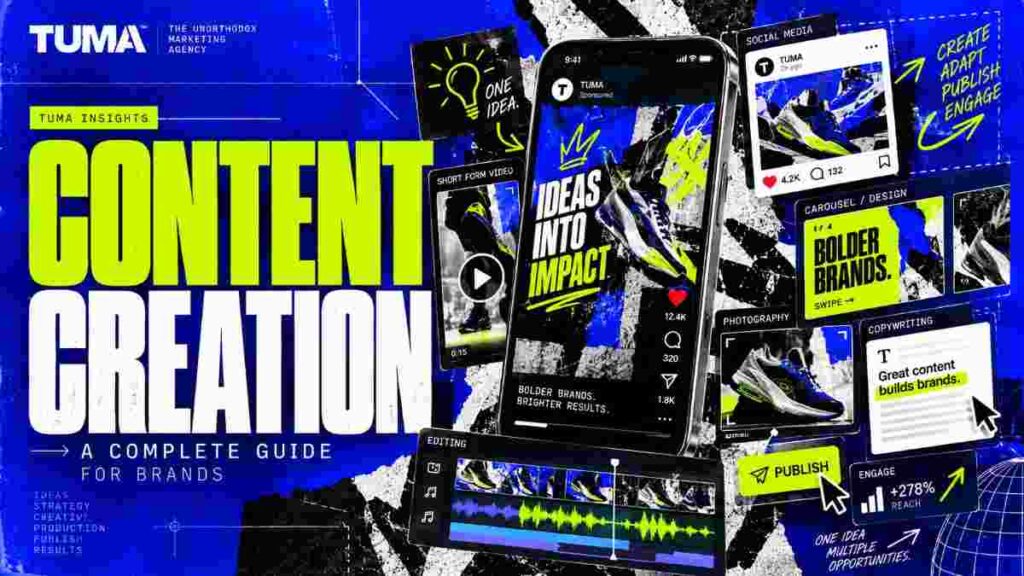
Brands don’t have a shortage of places to publish. They have a shortage of content worth paying attention to.
Instagram, TikTok, LinkedIn, YouTube, websites, blogs, email newsletters, and digital advertising platforms give businesses countless opportunities to communicate with their audiences.
But having more channels doesn’t automatically mean having better content.
A brand can publish every day and still struggle to communicate what makes it different. Another might create fewer pieces of content but build stronger recognition, earn trust, generate qualified leads, and influence purchasing decisions.
The difference is rarely posting frequency alone.
It’s the strategy behind the content.
Effective content creation connects audience research, creative thinking, production, distribution, and performance measurement into one continuous process.
Research + Strategy + Creative + Production + Distribution + Measurement
This guide explains what content creation means, how the process works, which formats brands should consider, how AI and modern tools fit into production, and how businesses can turn content into a more effective marketing system.
What Is Content Creation?
Content creation is the strategic process of researching audience needs, developing ideas, planning, producing, publishing, distributing, and optimizing content to inform, entertain, inspire, or persuade a specific audience. It includes written, visual, video, audio, and interactive formats designed to communicate a message, strengthen brand relationships, and support measurable business objectives.
In practice, content creation can mean writing an educational blog, producing a product demonstration, designing a carousel, filming a brand video, developing an advertising concept, or creating a useful downloadable resource.
But content creation is not simply the act of making something.
It involves understanding why the content should exist, who needs it, where they will encounter it, and what should happen after they engage with it.
For brands, successful content creation connects three essential elements:
- Audience value: The content answers a question, solves a problem, or provides a meaningful experience.
- Brand relevance: The message reflects the brand’s expertise, positioning, and identity.
- Business purpose: The content contributes to awareness, engagement, consideration, conversion, or retention.
Content becomes strategically valuable when these elements work together.
Content Creation vs. Content Strategy: What’s the Difference?
Content strategy and content creation are closely connected, but they serve different purposes.
Content strategy determines the direction. Content creation executes that direction.
| Content Strategy | Content Creation |
| Defines business objectives | Produces content supporting those objectives |
| Identifies the target audience | Develops audience-relevant messaging |
| Establishes content pillars | Generates ideas within those pillars |
| Determines channels and formats | Creates assets for those channels |
| Defines brand voice | Applies brand voice through copy and visuals |
| Establishes KPIs | Publishes, measures, and improves content |
For example, a skincare brand might identify customer education as a strategic priority.
The strategy determines that customers need clear explanations about ingredients, product selection, and application.
Content creation transforms that direction into educational videos, ingredient explainers, social media carousels, articles, and product demonstrations.
Without strategy, content risks becoming disconnected activity.
Without creation, strategy remains a plan that never reaches the audience.
Brands need both.
What Does a Content Creator Do?
A content creator is a professional who develops and produces material for a particular audience, platform, or communication objective.
Depending on the organization, a creator’s responsibilities can include:
- Researching audiences, topics, competitors, and trends.
- Developing creative concepts and content ideas.
- Writing scripts, captions, articles, and marketing copy.
- Filming videos or producing photography.
- Designing graphics, illustrations, and visual assets.
- Editing footage, audio, and written content.
- Preparing content for specific platforms.
- Publishing, scheduling, and promoting content.
- Interacting with audiences and communities.
- Reviewing performance data and improving future work.
Modern content creation is multidisciplinary.
A strong creator often needs to understand storytelling, audience behavior, visual communication, platform expectations, and brand positioning.
However, one person doesn’t need to master every production discipline.
Smaller businesses may rely on a versatile creator who writes, films, edits, and publishes content. Larger marketing departments often divide these responsibilities among copywriters, designers, videographers, editors, strategists, and social media teams.
The important distinction is that a content creator is responsible for more than producing attractive assets.
The work should communicate something meaningful to the intended audience.
Why Is Content Creation Important for Brands?
Content helps brands become visible, understandable, recognizable, and relevant.
When supported by research, execution, and distribution, content creation can provide several business benefits.
1. Building Brand Awareness
Educational articles, social videos, collaborations, and brand storytelling introduce businesses to people who may not know they exist.
2. Establishing Trust and Credibility
Useful explanations, practical demonstrations, authentic customer stories, and thoughtful insights can help audiences evaluate a brand’s expertise.
3. Supporting Search Visibility
Helpful website content may attract relevant organic search traffic by addressing questions customers are actively researching.
4. Improving Audience Engagement
Interactive posts, videos, community discussions, and culturally relevant creative can encourage meaningful interaction.
5. Generating Leads and Supporting Sales
Comparisons, product demonstrations, case studies, landing pages, and objection-handling content help customers make more informed decisions.
6. Strengthening Customer Relationships
Tutorials, onboarding resources, newsletters, and product education can continue delivering value after a purchase.
7. Differentiating the Brand
A distinctive point of view, recognizable visual identity, and consistent storytelling can make a business more memorable.
These outcomes are not guaranteed simply because a brand publishes content.
They depend on relevance, quality, distribution, consistency, and the connection between content and business objectives.
What Are the Different Types of Content Creation?
Content creation includes several formats, each with different strengths.
Choosing the right format depends on what the audience needs, where they consume information, and what the brand wants to achieve.
| Content Type | Common Formats | Most Useful For |
| Written content | Blogs, articles, guides, eBooks, case studies, landing pages, emails | Education, SEO, authority, lead nurturing |
| Social media content | Reels, TikToks, carousels, Stories, LinkedIn posts, memes, threads | Awareness, engagement, community |
| Video content | Tutorials, product demos, brand films, testimonials, explainers, video ads | Storytelling, demonstration, persuasion |
| Visual content | Photography, graphics, infographics, illustrations, motion graphics | Visual communication, brand recognition |
| Audio content | Podcasts, interviews, audio explainers | In-depth discussion, education, audience relationships |
| Paid advertising creative | Social ads, display assets, retargeting ads, direct-response videos | Acquisition, conversion, campaign testing |
| Interactive content | Quizzes, calculators, assessments, templates, tools | Participation, education, lead qualification |
These formats are not mutually exclusive.
A research-driven article can become a video script. A customer interview can generate several social posts. A product demonstration can support both organic social media and paid advertising.
The goal is not to use every format.
It’s to select formats that communicate the message effectively.
What Is the Content Creation Process?
The content creation process is a repeatable workflow that turns audience insights into published assets and performance-driven improvements.
A complete lifecycle follows:
Research → Ideation → Planning → Creation → Editing → Approval → Publishing → Distribution → Measurement → Optimization → Repurposing → Next Content Cycle
Each stage contributes to a different part of content quality.
Research establishes relevance. Planning creates direction. Production develops the message. Distribution helps it reach people. Measurement reveals what audiences actually respond to.
The process should not end when an asset goes live.
Brands learn from audience behavior, search performance, engagement, and conversions, then apply those insights to the next creative cycle.
Content → Data → Learning → Better Content
Here is how to build that process.
Step 1: Define Your Content Goals and Target Audience
Before producing anything, identify the business outcome the content should support.
Common goals include:
- Increasing brand awareness.
- Educating prospective customers.
- Generating qualified website traffic.
- Building engagement and community.
- Supporting lead generation.
- Improving conversions.
- Increasing customer retention.
Next, define the target audience beyond basic demographics.
Understand their motivations, frustrations, objections, preferred platforms, knowledge level, and buying behavior.
A founder researching software for a growing business may need detailed comparisons and implementation guidance.
A consumer discovering a lifestyle product may respond better to a quick demonstration or engaging visual story.
Both audiences consume content, but they need different messages.
A practical starting framework is:
Business Goal → Target Audience → Content Strategy
Every major content decision should connect back to these foundations.
Step 2: Research Topics and Content Opportunities
Effective content research combines audience understanding, search behavior, competitive analysis, and first-party business knowledge.
Search volume alone cannot tell a brand which content deserves investment.
A topic may attract considerable search traffic while having little relevance to the company’s products or services.
Another topic may have modest search demand but directly address an objection that prevents qualified customers from purchasing.
Where to Find Content Research Insights
Audience research: Interviews, surveys, social conversations, and customer behavior reveal what people care about.
Customer feedback: Reviews, support tickets, complaints, and sales conversations expose recurring questions and frustrations.
Keyword research: Search queries identify topics audiences actively research and the language they use.
Social listening: Comments, community discussions, Reddit conversations, and recurring questions reveal emerging interests and real-world concerns.
Competitor analysis: Reviewing competing content helps identify common topics, useful approaches, unanswered questions, and opportunities for differentiation.
Analytics: Search Console, website analytics, social media insights, and previous campaign results reveal existing audience demand.
Keyword Research and Search Intent
Keyword research should help brands understand the purpose behind a search.
Consider someone searching for “content creation tools.”
That person may be looking for software recommendations rather than a general explanation of content marketing.
Someone searching for “how to create Instagram Reels” probably wants a practical tutorial.
A useful framework is:
Keyword → Search Intent → Audience Problem → Content Format → Funnel Stage
Review relevant search results, People Also Ask questions, related searches, ranking pages, and missing information before choosing the content angle.
Keywords guide topic discovery and language selection. They should never dictate unnatural repetition.
How to Analyze Competitor Content
Competitor research should reveal opportunities rather than provide material to imitate.
Evaluate competing content through this sequence:
Topic → Search Intent → Entities Covered → Format → Depth → Missing Questions → Weaknesses → Information Gain → Differentiated Angle
For example, competitors may explain how to film product videos but overlook creative testing, audience objections, production workflows, or performance analysis.
A brand with practical expertise can contribute those missing perspectives.
The strongest research framework combines:
Audience Need + Business Relevance + Search or Platform Demand + Original Insight
This creates content that is more likely to serve a real purpose.
Step 3: Generate Content Ideas That Matter
Content ideation transforms research into specific concepts audiences might find valuable.
A useful process starts with a real customer problem.
Audience Problem → Question → Topic → Content Idea → Creative Angle
Consider a productivity software company.
Its customers struggle with disorganized team communication.
That insight might lead to several content concepts:
- An article explaining common workflow bottlenecks.
- A short video showing a messy workflow becoming organized.
- A LinkedIn carousel highlighting communication mistakes.
- A product demonstration addressing one specific problem.
- A customer story showing how a team approaches collaboration.
All five pieces start from the same audience need but communicate it differently.
Practical Content Creation Ideas by Objective
| Objective | Content Ideas |
| Awareness | Founder stories, educational short videos, trend commentary, behind-the-scenes, brand culture |
| Engagement | Polls, questions, carousels, interactive posts, relevant memes, community discussions |
| Consideration | Product demos, explainers, comparisons, testimonials, case studies |
| Conversion | Offers, FAQs, proof-driven videos, objection handling, direct-response creative |
| Retention | Tutorials, feature updates, customer education, product-use inspiration |
Before approving an idea, ask whether it is relevant to the audience, connected to the business, suitable for the platform, sufficiently differentiated, and realistic to produce.
One strong idea developed well often provides more value than several disconnected posts.
Step 4: Choose the Right Content Format
The format should support the message rather than dictate it.
Use written guides when readers need detailed explanations. Use video when showing a process is more useful than describing it. Use graphics when complex information benefits from visual organization.
A product feature might work best as a demonstration.
An industry perspective might work better as a thought-leadership article.
A simple question may only require a short post.
Also consider the customer’s stage in the buying journey.
Awareness content introduces an issue. Consideration content develops understanding. Conversion content reduces uncertainty. Retention content supports existing customers.
Buyer Journey Stage → Content Type → Message → CTA
Customer journeys are rarely linear, so brands should make relevant information accessible across different touchpoints.
Step 5: Plan Your Content Before Production
Planning connects a creative idea to the resources required to execute it.
Every meaningful content brief should establish:
- Business objective and target audience.
- Topic, creative angle, and core message.
- Funnel stage and search intent, where relevant.
- Format, platform, and distribution channel.
- Brand voice and visual direction.
- Production resources, budget, and timeline.
- Content owner and subject matter reviewer.
- Call to action and primary performance indicator.
A clear brief prevents avoidable revisions and helps teams make decisions consistently.
Content Pillars
Content pillars are recurring topic categories that a brand wants to become known for.
For a fitness brand, pillars might include training education, nutrition fundamentals, recovery, product knowledge, and community stories.
Pillars create thematic consistency without forcing every post to sound identical.
Content Calendars
A content calendar organizes production and publication.
It can track the topic, pillar, format, platform, owner, production status, publishing date, CTA, KPI, and repurposing opportunities.
However, a calendar should not become an obligation to publish low-value material.
The purpose is to coordinate useful content, not manufacture filler.
A practical planning sequence is:
Goal → Audience → Funnel Stage → Topic → Format → Platform → Distribution → KPI
Step 6: Create, Edit, and Approve the Content
Content production translates the brief into an asset audiences can experience.
This might involve copywriting, script development, design, photography, filming, animation, audio recording, or website development.
Regardless of format, quality control matters.
Review each asset for accuracy, clarity, creative execution, audience relevance, accessibility, brand consistency, and an appropriate call to action.
A video should have understandable audio and purposeful editing.
An article should be well-structured and fact-checked.
A social graphic should communicate its main idea without unnecessary complexity.
Content approval should also confirm permissions, rights to creative assets, and any applicable advertising or disclosure requirements.
The final question is not simply whether the content looks finished.
It’s whether the audience will understand why it matters.
Step 7: Publish, Distribute, and Promote Your Content
Publishing makes content available.
Distribution helps the intended audience discover it.
A complete content strategy accounts for three distribution categories.
Owned Media
Channels controlled by the brand, including its website, blog, email newsletter, social profiles, and YouTube channel.
Earned Media
Exposure generated through shares, relevant backlinks, mentions, community discussions, media coverage, and public recommendations.
Paid Media
Distribution purchased through paid social advertising, search advertising, sponsored content, native advertising, and retargeting campaigns.
Brands can also promote relevant content through creator partnerships, employee advocacy, communities, email campaigns, and content syndication.
Distribution should be considered before production begins.
A highly detailed research article may deserve email promotion, LinkedIn distribution, and several supporting social assets.
A product demonstration may be suitable for organic social media and paid testing.
The correct channel depends on the audience, format, objective, and buying stage.
Content without a distribution plan is an incomplete marketing strategy.
Step 8: Measure Content Performance
Once content is published, compare its performance against the intended objective.
An awareness video should not automatically be judged by the same standards as a conversion-focused landing page.
Similarly, a blog targeting early-stage research may contribute to brand discovery without generating immediate sales.
Review metrics that reveal whether the content achieved its purpose.
Use the results to identify strengths, friction points, unexpected audience behavior, and opportunities for improvement.
We will explore specific content KPIs later in this guide.
Step 9: Optimize, Update, and Repurpose
Content creation becomes more effective when businesses learn from existing work.
A blog may need updated information, stronger examples, or clearer formatting.
A video may benefit from a better opening, revised pacing, or more useful captions.
A campaign may need a different creative angle or message.
Successful ideas can also be repurposed across new formats and channels.
The objective is not to create endlessly.
It is to turn content performance into better creative decisions.
Content Creation for Social Media
Content creation for social media involves developing material specifically for the behaviors, formats, and expectations of social platforms.
A post can communicate the same idea across several platforms without looking or feeling identical.
Instagram supports visual storytelling through Reels, carousels, Stories, and photography.
Brands can combine educational carousels, product-focused videos, customer stories, and community interactions.
TikTok
TikTok content often benefits from immediate context, clear hooks, engaging demonstrations, creator-led storytelling, and platform-native editing.
A polished advertisement is not automatically more effective than an authentic-looking explanation.
LinkedIn can support professional education, founder perspectives, industry commentary, case studies, and business-focused video.
Specific insights and practical experience often provide stronger value than generic motivational statements.
YouTube
YouTube supports short-form and long-form video, including tutorials, product education, interviews, demonstrations, and deeper explanations.
The viewing experience, thumbnail, title, narrative structure, and audience retention all matter.
Facebook and X
Facebook can support community engagement, announcements, educational posts, and a variety of video and visual formats.
X can be useful for timely commentary, concise insights, discussion, and ongoing industry conversations where the intended audience is active.
Why Platform-Native Content Matters
The same creative concept may require different execution across channels.
Consider a brand explaining a product feature.
On TikTok, it might use a quick creator-led demonstration.
On Instagram, it could become a visually engaging Reel and carousel.
On LinkedIn, the brand might explain the underlying customer problem.
On YouTube, the concept might develop into a detailed walkthrough.
One Idea → Multiple Platform-Native Executions
Effective social content also considers opening hooks, aspect ratios, captions, on-screen text, pacing, accessibility, CTAs, and community interaction.
The goal is adaptation, not simply reposting an unchanged file everywhere.
Video Content Creation: From Idea to Finished Video
Video helps brands demonstrate products, communicate emotion, explain complicated ideas, and create memorable experiences.
However, production value alone does not determine effectiveness.
A beautifully shot video can fail if it communicates nothing relevant.
A simple talking-head video can be useful when it answers an important question clearly.
A practical video production workflow is:
Idea → Hook → Script → Storyboard → Shoot → Edit → Publish → Distribute → Analyze
Developing the Concept
Start with the intended audience response.
Should viewers understand a problem, remember a message, consider a product, or complete an action?
Build the concept around that objective.
Writing the Hook and Script
The opening should establish relevance quickly.
A hook might be a question, demonstration, surprising observation, familiar frustration, or compelling visual.
The script should then deliver the promised value.
Production and Creative Direction
Lighting, framing, sound, camera setup, performance, and B-roll should support the story.
A brand does not always need expensive equipment, but it does need intentional creative choices.
Editing and Optimization
Editing determines how information unfolds.
Pacing, captions, motion graphics, sound design, transitions, and visual emphasis should make the message easier to follow.
Finally, review thumbnails, titles, platform formats, and audience retention.
For a deeper explanation of formats, strategy, and measurement, explore TUMA’s video marketing guide.
Written Content Creation and SEO
Written content remains valuable when customers need detailed explanations, comparisons, technical information, or practical guidance.
A structured writing workflow follows:
Research → Search Intent → Outline → Draft → Edit → Optimize → Publish → Update
Good written content should answer the reader’s actual question while adding useful explanation, experience, evidence, or perspective.
How Content Creation Supports SEO
Search engine optimization helps relevant content become discoverable through organic search.
Important considerations include:
Search intent: Does the article satisfy what the searcher wants to accomplish?
Semantic relevance: Does it explain the topic comprehensively using meaningful concepts and related terminology?
Topic clusters: Are related articles organized around coherent subjects that help readers explore further?
Internal linking: Can visitors navigate logically between relevant resources?
Content quality: Does the page provide useful, accurate, original information?
Technical accessibility: Can search engines access and understand the page?
Structured data: Where appropriate, does the markup accurately describe the visible content?
E-E-A-T and Information Gain
Google’s people-first content guidance discusses experience, expertise, authoritativeness, and trustworthiness.
E-E-A-T is not a standalone ranking factor or a checklist that guarantees visibility.
For content teams, its practical value is encouraging trustworthy material with appropriate expertise, transparency, and evidence.
Information gain means contributing something useful beyond what readers can already find elsewhere.
That may include:
- Original examples or practical frameworks.
- First-hand experience and expert explanations.
- Original photography or demonstrations.
- First-party research and data.
- Better comparisons and useful templates.
- A distinctive but well-supported interpretation.
Simply rewriting competitors with different wording does not create meaningful differentiation.
Content Creation for AI Search
Google’s AI Overviews and AI Mode have added new ways for people to discover information.
However, Google’s AI search guidance says established SEO practices remain relevant and no special optimization is required specifically for these features.
Clear answers, accessible pages, relevant evidence, descriptive headings, and useful original material remain sensible editorial practices.
Schema markup, additional entities, or AI-focused terminology do not guarantee inclusion in AI-generated search experiences.
The priority should remain creating useful content for people first.
AI and Content Creation: Where Does It Fit?
Generative AI can assist content teams with ideation, research organization, drafting, transcription, localization, visual exploration, and asset variations.
It can make certain production tasks faster and help teams explore more creative directions.
But faster production does not automatically create better marketing.
Where AI Can Help
- Brainstorming topics, formats, and initial concepts.
- Organizing audience research and notes.
- Developing draft outlines and script alternatives.
- Generating visual concepts and mockups.
- Transcribing audio and assisting with captions.
- Producing variations for creative testing.
- Adapting approved content for different platforms.
- Supporting localization and repurposing workflows.
Where AI Falls Short
AI-generated material can contain fabricated information, weak reasoning, generic writing, inconsistent brand voice, and inaccurate visual details.
Teams also need to consider copyright, consent, likeness rights, confidential information, and the suitability of AI-generated claims or imagery.
Google’s guidance on generative AI content emphasizes accuracy, quality, relevance, and human fact-checking. Producing large amounts of automated content without added user value can also raise search spam concerns.
A Human + AI Content Workflow
A more reliable approach combines human direction with selective automation.
Human Strategy
↓
AI-Assisted Research and Ideation
↓
Human Creative Direction
↓
AI-Assisted Production Where Useful
↓
Human Editing and Fact-Checking
↓
Publishing and Distribution
↓
Performance Data
↓
Human Interpretation and Iteration
AI can accelerate production.
It should not replace original thinking, strategic judgment, accuracy, or creative direction.
Content Creation Tools and Software
Content creation tools support different parts of the workflow.
Rather than collecting as many applications as possible, businesses should choose software that solves actual production or operational problems.
| Purpose | Tool or Software Category | Typical Applications |
| Research | Search engines, keyword platforms, community research tools | Topic discovery, audience questions, SERP analysis |
| Writing | Document editors, collaborative writing software | Outlines, scripts, articles, copy editing |
| Design | Graphic design and image editing software | Social graphics, branding assets, infographics |
| Video | Editing, motion graphics, recording and captioning software | Video production, subtitles, animation |
| Publishing | CMS and social scheduling platforms | Website publishing, post scheduling |
| Collaboration | Project management, approval and asset management software | Production tracking, feedback, approvals |
| SEO | Search Console, keyword research and rank tracking tools | Search visibility, technical monitoring |
| Analytics | GA4, platform analytics, advertising dashboards | Engagement, traffic, leads, conversions |
| AI Assistance | Generative text, image, video and transcription tools | Ideation, drafting, variations, repurposing |
What Is Content Creation Software?
Content creation software refers to digital applications used to develop, manage, publish, or analyze content.
Common categories include content management systems, writing platforms, graphic design software, video editors, social media scheduling systems, project management tools, digital asset management platforms, analytics software, and AI-assisted production tools.
A small brand may only need a document editor, basic design and video software, a scheduling platform, and analytics.
A larger business may require centralized asset libraries, approval workflows, specialist editing tools, and integrated reporting.
The right stack depends on team size, budget, content volume, workflow complexity, and the formats being produced.
Software should support the process rather than determine the strategy.
Content Creation for Beginners: How to Get Started
Beginners do not need an expensive studio, a complete marketing department, or subscriptions to dozens of platforms.
A focused starting process is more useful.
- Choose one audience. Identify a specific group whose needs you understand.
- Set one business goal. Start with awareness, education, engagement, or lead generation.
- Pick three to five content pillars. Choose recurring themes relevant to your audience and business.
- Research audience questions. Use customer feedback, search queries, comments, and common objections.
- Select one or two platforms. Prioritize places where the intended audience already spends time.
- Build a manageable calendar. Plan a realistic production schedule.
- Create useful content. Focus on clarity, relevance, and execution rather than unnecessary complexity.
- Publish consistently enough to learn. Sustainable consistency matters more than arbitrary frequency.
- Review performance. Study engagement, traffic, retention, and meaningful audience actions.
- Improve your next content cycle. Expand successful ideas and revise weak approaches.
Start small enough to maintain quality.
As results and resources improve, introduce additional formats, platforms, and production capabilities.
How to Repurpose Content Across Multiple Platforms
Content repurposing means transforming an existing idea or asset into new formats that serve different audiences, channels, or communication goals.
Imagine a brand publishes a detailed article explaining a common customer problem.
That central topic could become:
One Core Idea → Blog → Long-Form Video → Reel → TikTok → YouTube Short → Carousel → LinkedIn Post → Email → Paid Ad
This is sometimes called content atomization: breaking a substantial topic into smaller, focused pieces.
However, repurposing is not copy-pasting.
A LinkedIn post may emphasize a professional insight.
An Instagram carousel may summarize the main lessons visually.
A short-form video may demonstrate one compelling example.
An email may connect the topic to an existing subscriber’s needs.
Content can also be adapted for different languages, regions, audience segments, and stages of the buying journey.
The best opportunities often come from strong existing content, particularly assets with useful information, sustained interest, or proven audience engagement.
Repurposing can improve production efficiency while maintaining relevance, provided each execution is genuinely adapted.
Performance Creative and Paid Content Creation
Content creation also plays an important role in paid advertising.
Organic content and paid creative may use similar storytelling techniques, but their objectives and measurement can differ.
Organic social content may prioritize community, education, and long-term brand relationships.
Paid creative is commonly developed around campaign objectives such as qualified traffic, leads, purchases, or registrations.
Performance creative connects audience insight, creative execution, testing, and campaign data.
A typical process is:
Creative → Launch → Performance Data → Insight → New Creative
Teams can test different hooks, messages, visuals, offers, calls to action, formats, or storytelling approaches.
For example, a product advertisement might compare a problem-first opening against a demonstration-first opening.
Metrics such as click-through rate, conversion rate, cost per acquisition, and return on ad spend can help evaluate the results.
Creative fatigue may require new messaging or concepts, but declining performance should also be assessed against audience changes, pricing, competition, landing pages, and tracking quality.
Learn more in TUMA’s complete guide to performance creative.
Content Creation Examples for Different Businesses
The following examples are hypothetical and illustrate how content formats can support different objectives. They are not claims about real campaigns or performance results.
| Business | Goal and Audience | Content Idea and Format | Platform | Primary KPIs |
| E-commerce brand | Introduce a product to potential buyers | UGC-style product demonstration | TikTok, Instagram | Watch time, CTR, conversions |
| B2B SaaS company | Generate qualified business leads | LinkedIn thought leadership and product walkthrough | LinkedIn, website | Qualified visits, leads, pipeline |
| Local business | Build trust among nearby customers | Customer testimonial and service demonstration | Website, Facebook, Instagram | Calls, bookings, qualified enquiries |
| Travel brand | Inspire destination discovery | Short-form storytelling focused on traveler experiences | Instagram, YouTube | Reach, saves, website visits |
| Professional service | Establish expertise | Educational guides and founder-led videos | Blog, LinkedIn | Organic traffic, enquiries |
| Consumer brand | Improve paid acquisition | Creative variations testing different product messages | Paid social | CTR, CPA, ROAS |
Notice that the format changes according to the audience and intended outcome.
A visually engaging video is not inherently better than a useful article.
The best format is the one that communicates the right message at the right stage.
How Do You Measure Content Creation Success?
Content creation success is measured by comparing performance indicators against the goals each asset is designed to achieve.
No single metric can evaluate every type of content.
| Objective | Important Metrics | What They Help Evaluate |
| Awareness | Reach, impressions, views, branded searches, brand lift | Exposure and brand recognition |
| Engagement | Watch time, completion rate, comments, shares, saves, engagement rate | Audience interaction and content consumption |
| Search Visibility | Search impressions, rankings, organic clicks, CTR, indexed pages | Organic discoverability |
| Lead Generation | Form submissions, email signups, MQLs, qualified enquiries | Audience progression toward a business opportunity |
| Conversion | Conversion rate, sales, CPA, CAC, revenue, ROAS | Acquisition efficiency and commercial outcomes |
| Retention | Repeat visits, renewals, repeat purchases, product adoption | Ongoing customer value |
Some metrics require context.
For example, watch time is influenced by video duration and platform reporting definitions.
A high CTR does not guarantee that the resulting traffic is qualified.
Search impressions can grow without a proportional increase in clicks.
And a high engagement rate may be less commercially meaningful than a smaller number of qualified enquiries.
A metric matters when it helps explain progress toward the intended business objective.
Content Monitoring and Analytics
Useful measurement tools include Google Search Console, Google Analytics 4, platform-native social analytics, video dashboards, and advertising reporting systems.
Google Search Console can show search impressions, clicks, CTR, and average position.
GA4 can help teams understand website behavior and track important business actions through key events.
Platform analytics can reveal video retention, reach, interactions, and content-specific performance.
Review the data with practical questions:
- Is the intended audience discovering the content?
- Are viewers staying long enough to understand the message?
- Which topics generate meaningful interaction?
- Are visitors moving toward the next relevant action?
- Where are users leaving the experience?
- Which content deserves further investment?
The objective is interpretation, not simply reporting numbers.
How to Measure Content ROI
Content return on investment compares the business value generated with the cost of creating and distributing content.
The process looks like:
Content Investment → Distribution → Audience Action → Business Outcome → ROI
Costs may include research, staff time, creative production, software, publishing, and paid promotion.
For directly attributable revenue, a simplified ROI calculation is:
Content ROI = [(Attributed Revenue − Content Costs) ÷ Content Costs] × 100
For a more meaningful profitability calculation, businesses can use attributed contribution profit rather than revenue, while applying a consistent cost definition.
Attribution is rarely perfect.
A customer might discover a brand through a Reel, read several articles, compare alternatives, and purchase weeks later.
That makes assisted conversions, qualified leads, brand research, and customer journey analysis important alongside direct revenue.
Awareness and trust-building content should not always be judged exclusively by last-click sales.
Why Content Audits and Optimization Matter
Content performance changes as audience expectations, products, search behavior, and competition evolve.
A content audit evaluates existing assets to determine what should remain, improve, or change.
Start with a content inventory.
Review traffic, rankings, engagement, conversions, content age, search intent, accuracy, internal links, duplication, and opportunities for improvement.
Also identify:
- Content decay: A meaningful decline in previously useful performance.
- Content gaps: Relevant questions or topics not adequately covered.
- Keyword cannibalization: Multiple pages competing for overlapping search intent without a clear purpose.
- Thin content: Material lacking sufficient usefulness for its intended audience.
- Outdated content: Information that no longer reflects current facts, products, or needs.
After evaluation, teams may choose to keep, update, expand, consolidate, repurpose, redirect, or remove content.
Low traffic alone is not a reason to delete a page.
Some content serves existing customers, supports sales, answers niche questions, or provides valuable context despite attracting limited search traffic.
Evergreen Content vs. Timely Content
Evergreen content addresses topics with continuing relevance.
Examples include how-to guides, foundational explanations, tutorials, and product education.
Timely content responds to developments such as industry news, cultural moments, product launches, events, and emerging trends.
Evergreen content can support long-term discoverability.
Timely content can create opportunities for relevant participation in active conversations.
A balanced strategy may use both.
The key is selecting timely opportunities that genuinely relate to the brand rather than chasing attention without purpose.
Brand Voice, Storytelling, and Differentiation
Content should help audiences recognize a brand even when the logo is not immediately visible.
That recognition develops through messaging, tone, creative direction, visual identity, storytelling, and a consistent point of view.
Competitor research can reveal useful market insights, but imitation rarely produces a distinctive identity.
A better approach is:
Competitor Insight → Information Gap → Brand Point of View → Differentiated Content
Two brands can discuss the same subject and still create entirely different experiences.
One may use technical education.
Another may use relatable humor.
A third may rely on visual storytelling and expert demonstrations.
The important question is whether the execution reflects what the brand stands for and what the audience needs.
Distinctiveness should be intentional, not merely unusual.
Common Content Creation Mistakes to Avoid
Even talented teams can create ineffective content when their workflows lack direction.
Here are common mistakes and why they matter.
| Mistake | Why It Matters |
| Creating without a strategy | Produces disconnected assets without a clear objective |
| Posting only to maintain frequency | Encourages filler instead of audience value |
| Ignoring audience research | Leads to messages people may not need |
| Copying competitors | Weakens originality and brand differentiation |
| Chasing every trend | Can disconnect the brand from its positioning |
| Keyword stuffing | Reduces readability and usefulness |
| Creating only for algorithms | Prioritizes perceived platform signals over actual audience needs |
| Reposting identical assets everywhere | Ignores platform behavior and expectations |
| Using weak hooks | Makes it harder to establish relevance quickly |
| Omitting useful CTAs | Leaves interested audiences without a logical next step |
| Ignoring distribution | Limits content discovery |
| Measuring vanity metrics alone | Creates an incomplete picture of effectiveness |
| Never updating content | Allows useful assets to become outdated |
| Failing to repurpose | Misses opportunities to extend strong ideas |
| Producing too many formats | Stretches resources and reduces consistency |
| Overusing AI without review | Introduces accuracy, originality, and brand-quality risks |
| Ignoring brand voice | Makes communication inconsistent and forgettable |
| Disconnecting content from business goals | Makes success difficult to evaluate |
The solution is not a more complicated workflow.
It is a clearer connection between strategy, execution, and learning.
Content Creation Jobs and Career Opportunities
Content creation jobs span creative production, strategy, marketing operations, and performance analysis.
Common roles include:
- Content Creator: Produces content across selected formats and platforms.
- Content Writer: Develops articles, guides, educational material, and website copy.
- Copywriter: Creates persuasive messaging for brands, campaigns, and advertisements.
- Social Media Content Creator: Produces platform-specific social assets.
- Social Media Manager: Oversees social planning, publishing, and community activity.
- Videographer and Video Editor: Capture and develop video assets.
- Graphic Designer and Motion Designer: Create visual communication and animation.
- UGC Creator: Produces creator-style content based on audience and product experiences.
- Content Strategist: Determines audience priorities, topics, channels, and measurement.
- Content Marketing Manager: Coordinates content programs and business objectives.
- SEO Content Specialist: Researches search demand and develops search-relevant content.
- Creative Strategist: Connects consumer insights with concepts and campaign testing.
- Creative Director: Oversees creative direction and quality across projects.
Research, storytelling, writing, editing, visual judgment, audience understanding, platform knowledge, analytics, and brand awareness are valuable across many of these careers.
A strong portfolio should demonstrate not only finished work, but also the problem each piece was designed to solve.
Content Creation at TUMA: Create Culture, Not Filler
At TUMA, we believe content should not exist just to fill a calendar.
It should communicate something worth remembering.
That means understanding the audience before developing the concept, connecting creative decisions to business goals, and choosing the right execution for the platform.
Sometimes the answer is a carefully developed brand story.
Sometimes it is a product demonstration, creator-led video, bold visual concept, or advertising idea worth testing.
The format changes.
The principle remains the same.
Great content should earn attention, communicate a meaningful idea, strengthen the brand, and give audiences a reason to engage or act.
TUMA brings together creative strategy, content creation and social media marketing, branding, video production, and performance-focused thinking.
Our approach is unapologetically unorthodox, but creativity is never an excuse to ignore business objectives.
Because marketing should deliver results.
Conclusion: Create Content With Purpose
Content creation is no longer just writing a blog, designing a social post, or filming a video.
It is a connected system that combines audience insight, strategy, ideation, creative execution, publishing, distribution, measurement, and optimization.
Brands that approach content as a repeatable learning process can make more informed decisions about what to produce, where to publish, and what deserves improvement.
The most useful question is not:
How much content can we make?
It is:
What can we create that genuinely matters to our audience and supports our business?
Start with the audience. Build around a meaningful idea. Execute with intention. Distribute intelligently. Learn from the response.
Don’t create content just to be seen. Create content worth remembering.
Frequently Asked Questions About Content Creation
1. What is content creation?
Content creation is the process of researching, planning, producing, publishing, distributing, and improving content for a specific audience. It includes articles, videos, social media posts, graphics, podcasts, advertising assets, and interactive resources that support communication and business objectives.
2. What are the different types of content creation?
The main types include written content, social media content, video, photography and visual design, audio, paid advertising creative, and interactive content. Each format serves different audience needs and marketing objectives.
3. What are the steps involved in content creation?
The core steps are audience research, ideation, planning, production, editing, approval, publishing, distribution, performance measurement, optimization, and repurposing. Together, they form a continuous content development lifecycle.
4. What are the benefits of content creation?
Effective content creation can improve brand awareness, customer education, search visibility, engagement, trust, lead generation, conversion support, and retention. Results depend on content quality, audience relevance, distribution, and strategy.
5. What tools are used for content creation?
Common tools include research platforms, document editors, graphic design software, video editing applications, content management systems, social scheduling platforms, analytics dashboards, and AI assistants. The right combination depends on the team’s needs and resources.
6. How do you measure the success of content creation?
Measure success using KPIs aligned with the objective. Awareness content may be evaluated through reach and impressions, while lead-generation content may be assessed through enquiries, conversions, and qualified leads. Website and campaign analytics provide supporting performance data.
7. What is social media content creation?
Social media content creation is the development of videos, graphics, posts, Stories, carousels, and other materials designed for social platforms. It combines audience research, platform-native creative execution, publishing, engagement, and performance analysis.
8. What is AI content creation?
AI content creation involves using artificial intelligence to assist with research, writing, imagery, video, transcription, ideation, and repurposing. Human oversight remains essential for strategy, fact-checking, originality, creative quality, and brand consistency.
9. What does a content creator do?
A content creator researches topics, develops ideas, writes or scripts material, produces and edits assets, and prepares content for publication. Depending on the role, creators may also manage distribution, community engagement, and performance analysis.
10. How can beginners start content creation?
Beginners should choose a clear audience, define one goal, identify recurring content themes, select suitable platforms, and start producing useful material with manageable resources. Consistent experimentation and performance review help improve skills and results.