
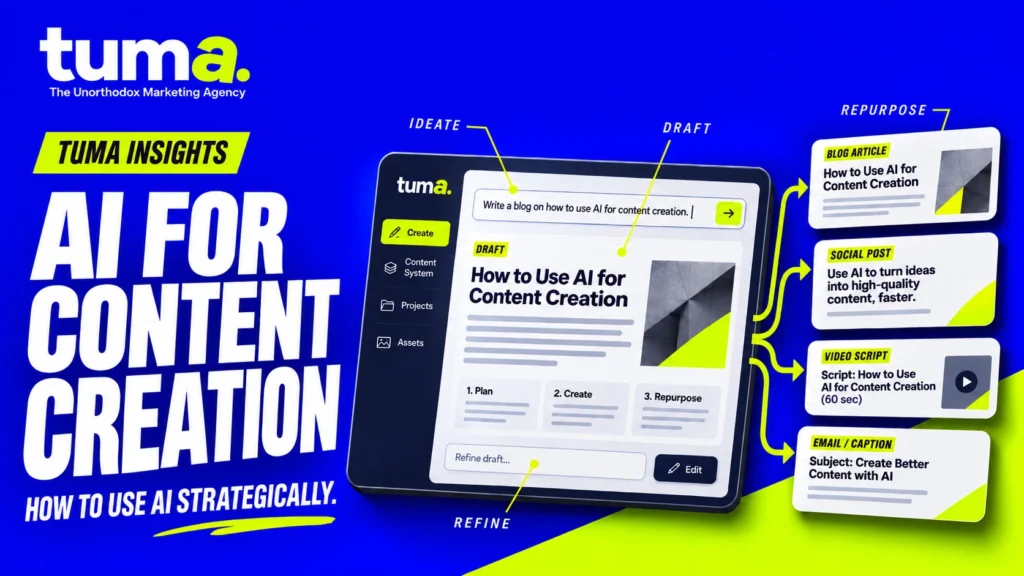
AI has made producing content easier than ever.
Generating a blog outline, drafting a social caption, summarizing research, or turning a long article into multiple posts can now take a fraction of the effort these tasks once required.
But producing content quickly and producing content worth reading are two different things.
A business can publish dozens of AI-generated articles without answering a customer question particularly well. A social media team can create hundreds of captions without developing a recognizable brand voice. And an AI-written guide can sound authoritative while containing inaccurate statistics, invented examples, or outdated information.
The problem isn’t necessarily that AI created the material.
It’s what went into creating it, what happens afterward, and whether the finished content serves a meaningful purpose.
AI should remove production friction, not remove thinking.
The strongest approach combines audience research, original insight, reliable evidence, creative direction, AI-assisted production, human editorial judgment, and performance measurement.
This guide explains how to use AI for content creation across blogs, SEO, social media, video, Claude, and WordPress while protecting accuracy, originality, and brand identity.
What Is AI Content Creation?
AI content creation involves using artificial intelligence to generate, transform, edit, or organize material such as text, images, video, and audio.
Generative AI systems can produce new material from instructions and context. However, the extent of automation varies significantly between workflows.
Three approaches are worth distinguishing.
AI-assisted content creation: Humans make strategic and editorial decisions while AI supports selected tasks such as research organization, ideation, drafting, editing, and repurposing.
AI-generated content: AI produces a substantial part of an asset, which may then undergo human review and modification.
Fully automated content creation: Software generates and potentially publishes content with little direct human involvement in individual pieces.
These approaches have different quality-control and governance requirements.
For most businesses creating educational, branded, or commercially important content, a human-led approach provides greater control over accuracy, brand fit, and the final message.
How Should You Use AI for Content Creation?
To use AI for content creation effectively, start by defining your business goal, target audience, and content objective. Collect reliable research and original insights, then develop a clear content brief. Use AI to organize information, generate ideas, outline, draft, edit, or repurpose material. Human editors should verify factual claims, add expertise, protect brand voice, approve publication, and measure performance to improve future content.
A complete workflow follows:
Business Goal → Audience Insight → Original Point of View → Research → Content Brief → AI-Assisted Production → Human Review → Fact-Checking → Publishing → Distribution → Performance Learning
This approach turns AI into part of a repeatable content operation instead of treating every assignment as a standalone prompt.
Start With a Content Strategy, Not a Prompt
Before opening an AI tool, decide why the content needs to exist.
A content strategy should connect business objectives with audience needs, relevant topics, publishing formats, and measurable outcomes.
Common objectives include increasing qualified organic traffic, supporting sales, educating existing customers, generating enquiries, building brand awareness, or improving social engagement.
For example, imagine a SaaS company whose sales team repeatedly receives questions about switching from spreadsheets to project management software.
Instead of asking AI to generate 30 unrelated productivity topics, the marketing team can focus on a specific customer problem.
It might develop:
- An educational article about common spreadsheet workflow limitations.
- A product demonstration addressing one recurring objection.
- A LinkedIn post featuring a founder’s perspective.
- A short tutorial showing how a particular task can be completed.
- An email linking customers to a relevant help resource.
Each asset serves a defined purpose.
Business Goal → Content Objective → Content Format
Understand the Audience
A useful content brief should answer who the audience is, what they already know, which problems they face, and what they are trying to accomplish.
For SEO content, search intent adds another layer.
An informational query usually calls for explanation or education. Commercial investigation may require comparisons and decision criteria. Transactional intent suggests the reader is closer to taking action, while navigational intent involves finding a particular destination.
Search Intent → Audience Need → Content Structure
Keywords can help identify relevant language and topics, but they should not dictate mechanical repetition.
Use Original Insights and Reliable Sources as AI Inputs
One of the biggest weaknesses of generic AI content is the absence of information that could only come from the business or its audience.
If every company asks a similar AI model the same question, the resulting articles may share similar structures, examples, and conclusions.
Better source material creates opportunities for more useful content.
Turn First-Party Information Into Content Ideas
Businesses often already possess valuable research inputs, including:
- Customer reviews and support conversations.
- Sales questions and recurring objections.
- Product documentation and usage information.
- Customer interviews and surveys.
- Search Console queries.
- Previous campaign results.
- Internal reports and subject matter expertise.
AI can help organize this information, identify recurring themes, and propose ways to communicate the findings.
For instance, an ecommerce team could analyze appropriately anonymized customer feedback to identify why customers hesitate before buying a product.
If questions repeatedly concern sizing, materials, or product maintenance, those issues can become useful content topics.
The process becomes:
First-Party Data → Customer Insight → Content Idea → Original Explanation
AI should never fabricate customer interviews, survey results, testimonials, or business performance data to make content sound authoritative.
Originality Doesn’t Require Inventing Something Completely New
Novelty means something is new.
Originality involves contributing meaningful independent value.
An article can be original because it explains a complicated topic more clearly, applies research to a specific industry, includes expert commentary, or develops a useful framework.
Original Insight + Evidence + Brand Perspective → Differentiated Content
That is a stronger foundation than asking an AI system to make an existing article sound different.
Build a Better Content Brief Before Prompting AI
A content brief translates audience research and business strategy into production instructions.
It should contain enough information for a writer, editor, designer, or AI system to understand what the asset needs to accomplish.
| Brief Element | What to Define |
| Objective | The business outcome the content supports |
| Audience | Who will read or watch it |
| Search Intent | The underlying need, where search is relevant |
| Main Topic | The central question or subject |
| Original Angle | The distinctive point the content will develop |
| Evidence | Approved sources, expert input, and verified information |
| Brand Voice | Tone, vocabulary, writing style, and examples |
| Format | Article, carousel, script, email, or another asset |
| Constraints | Claims, phrases, topics, or approaches to avoid |
| CTA | The appropriate next action |
| Success Metric | How performance will be assessed |
Consider the difference between two instructions.
Weak instruction:
“Write a blog about ecommerce branding.”
Better instruction:
“Create an educational guide for ecommerce founders explaining how brand identity affects product pages, packaging, and paid social creative. Address common misconceptions, use the supplied customer research, distinguish branding from logo design, and provide practical examples without inventing performance results.”
The second instruction establishes a purpose and quality boundaries.
How to Write Better AI Prompts for Content Creation
Effective prompting provides relevant context and defines the task clearly.
There is no universal prompt formula that guarantees excellent content.
A useful structure includes:
Objective + Audience + Context + Source Material + Point of View + Brand Voice + Constraints + Output Format
Here is a reusable prompt template.
Practical AI Content Creation Prompt
Objective: Create an educational article that helps ecommerce founders understand why product demonstrations can be useful in paid social advertising.
Audience: Founders and marketing managers who understand basic advertising but need practical creative direction.
Context: The brand sells consumer products online and wants to develop clearer educational content.
Source Material: Use the attached product documentation, approved customer questions, and verified research. Do not invent facts.
Point of View: Explain that strong demonstrations connect product features to relevant customer use cases.
Brand Voice: Professional, confident, direct, and practical. Avoid exaggerated promotional language.
Constraints: No fabricated statistics, testimonials, results, or unsupported product claims. Flag missing evidence.
Output: Produce an outline first, followed by a draft with clear headings, practical examples, and a relevant CTA.
A useful additional instruction is to ask the model to identify missing information before presenting uncertain details as facts.
Remember:
Prompt Quality + Source Quality + Model Capability + Human Review → Output Quality
Better prompts help, but they cannot compensate for unreliable source material or absent expertise.
Where AI Helps Across the Content Creation Process
AI can support nearly every stage of content production, but different stages require different levels of human judgment.
| Content Stage | How AI Can Help | Human Responsibility |
| Research | Organize questions, summarize supplied documents, group topics | Select and verify reliable sources |
| Ideation | Generate angles, titles, hooks, and formats | Choose ideas relevant to the audience |
| Planning | Organize briefs, outlines, and calendars | Set goals and priorities |
| Drafting | Develop text from approved information | Add experience, examples, and original reasoning |
| Editing | Simplify, shorten, restructure, and clarify | Preserve meaning and voice |
| Fact-Checking | Identify factual claims needing verification | Check evidence against original sources |
| Visual Production | Develop mockups, illustrations, and draft assets | Approve design, rights, and product accuracy |
| Distribution | Adapt content for several channels | Ensure platform and audience fit |
| Measurement | Summarize reports and identify patterns | Interpret business significance |
| Updating | Flag potentially outdated sections and content gaps | Verify changes and approve revisions |
The aim is to reduce repetitive tasks while preserving editorial responsibility.
Use AI for Brainstorming and Content Ideation
AI can generate possible topics, headline angles, content series, and creative concepts quickly.
This is especially useful for divergent thinking: exploring several possibilities before committing to one.
But selecting the strongest direction is a different task.
Human editors should evaluate each idea against audience relevance, originality, business value, production resources, and potential usefulness.
AI Expands Options → Human Selects Direction
Use AI for Outlining
AI can organize a complex subject into logical sections and identify questions that an article should answer.
For SEO content, this can include related concepts, entities, comparisons, and People Also Ask-style questions.
However, the outline should reflect the reader’s needs, not simply reproduce competitor headings.
An effective outline establishes a logical argument and leaves room for original information.
Use AI for First Drafts
AI can create useful first drafts when supplied with a strong brief, trustworthy sources, and clear constraints.
It can also expand interview notes into a working article or convert a technical explanation into more accessible language.
But a first draft is not a finished article.
The editor still needs to assess the argument, replace generic examples, verify claims, remove repetition, and strengthen the perspective.
Use AI for Editing and Summarization
AI can support structural editing, copy editing, compression, and expansion.
It can turn a long report into an executive summary or reorganize a confusing explanation.
However, summarization can remove important qualifications, and expansion can introduce padding or invented information.
More Words ≠ More Value
Review transformations against the original material.
How to Use AI for Research Without Inventing Facts
AI can assist research, but its output should not automatically be treated as a source.
A large language model may generate convincing explanations that contain factual errors.
This is commonly called an AI hallucination.
Potential errors include nonexistent studies, fabricated quotations, incorrect dates, outdated software features, and invented statistics.
Use Primary Sources Wherever Practical
Primary sources are especially important for facts that change or require authoritative confirmation.
Examples include government publications, official software documentation, original research papers, product specifications, and direct company announcements.
Secondary sources can add context, but they should not replace the original evidence when an important claim depends on it.
A reliable research workflow is:
Research Question → Source Discovery → Original Source Review → Verified Notes → Content Draft
Watch for Citation Hallucinations
AI systems can generate plausible journal titles, author names, and URLs that do not exist.
A link alone does not establish credibility.
Before publishing a source-supported claim, ask:
- Does the source actually exist?
- Does it say what the draft claims?
- Is the information current enough for the topic?
- Does the evidence support the strength of the conclusion?
Fluent Output ≠ Accurate Output
When a claim cannot be verified, qualify it, find better evidence, or remove it.
How to Use AI for Social Media Content Creation
AI can help social media teams transform one audience insight into multiple platform-native assets.
Start with the audience and the channel, then identify the content pillar, idea, hook, and desired response.
A repeatable workflow is:
Audience + Platform → Content Pillar → Creative Idea → Hook → Draft → Brand Edit → Publish → Analyze
AI for Instagram Content
AI can assist with Reel scripts, carousel structures, captions, content-series concepts, product education, and alternate hooks.
For example, an educational blog could become an Instagram carousel featuring five practical lessons.
A related Reel might demonstrate one lesson visually.
Both should carry the same core idea, but the creative execution should reflect the format.
How to Use AI to Create Content on Facebook
Businesses can use AI to draft organic Facebook posts, event announcements, community questions, video scripts, educational explanations, and paid advertising copy.
A practical process is:
- Identify the audience and objective.
- Gather the relevant facts and approved brand material.
- Ask AI to propose several post angles.
- Select the concept that fits the audience.
- Create or adapt the copy and supporting visuals.
- Review accuracy, brand voice, and any promotional claims.
- Publish through the appropriate Facebook workflow.
- Evaluate relevant engagement, traffic, or conversion metrics.
AI-generated posts do not automatically receive better organic reach.
The content still needs to be relevant and useful.
AI for LinkedIn Content
LinkedIn content often benefits from specific expertise, thoughtful commentary, and practical examples.
AI can help structure founder notes, develop educational posts, or repurpose case-study material.
However, it should not fabricate professional experiences or replace the author’s real perspective with generic thought leadership.
Repurpose One Strong Idea Across Multiple Channels
One substantial article can support an entire content distribution sequence.
Original Blog → LinkedIn Post → Instagram Carousel → Reel Script → Email → Short Social Posts
AI can accelerate the transformation, but each platform needs an appropriate hook, format, level of detail, and CTA.
Repurposing is not simply copying the same paragraph everywhere.
A more complete explanation is available in TUMA’s guide to content creation.
AI for Video, Images, and Audio Content
AI content creation now extends beyond text.
For video production, AI can assist with concept development, scripting, storyboards, shot lists, voiceovers, captions, editing, and versioning.
Concept → Script → Storyboard → Production → Edit → Review
For images, it can support campaign mockups, conceptual illustrations, thumbnails, and design exploration.
For audio, it can assist transcription, summarization, narration, and localization.
These uses still require quality control.
An AI-generated product image may alter packaging or invent physical features. A synthetic voice may mispronounce a product name. An AI-generated video may show unrealistic product interactions.
Teams should also check licensing, consent, and likeness rights before publishing synthetic media.
The best approach depends on the task.
An illustration may be suitable for concept exploration, while a demonstration of a physical product may need real footage to establish accuracy.
Explore TUMA’s video advertising guide for a deeper discussion of hooks, video structures, and creative execution.
How to Use Claude AI for Content Creation
Claude, developed by Anthropic, can assist with writing, research organization, document analysis, editing, and content transformations.
Its usefulness increases when the model receives relevant context and clear instructions.
Step 1: Create a Dedicated Project
Claude’s Projects feature allows users to organize work around a topic or ongoing assignment.
Depending on the available account features, a project can include instructions and uploaded knowledge.
For a brand content project, useful materials may include:
- Brand positioning and tone guidelines.
- Target audience descriptions.
- Approved product and service information.
- Examples of strong existing content.
- Research notes and editorial standards.
- Relevant campaign or product documentation.
Claude uses project instructions and project knowledge to provide context for work within that project.
However, information does not automatically transfer between every project conversation merely because it appeared in another chat. Relevant material should be added to project knowledge when consistent reuse is required.
Project features and account entitlements can differ, and Anthropic has been developing newer project experiences.
Step 2: Define the Task Clearly
Tell Claude what the content needs to accomplish.
Specify the audience, format, sources, brand voice, required information, and constraints.
For example:
“Using the approved product documentation and brand guidelines in this project, develop an educational blog outline answering the most common customer questions. Identify unsupported claims and do not invent customer examples.”
Step 3: Use Claude at Specific Workflow Stages
Claude can assist with:
- Organizing research notes and uploaded documents.
- Generating content angles.
- Creating article outlines.
- Developing working drafts.
- Editing complex explanations.
- Summarizing interviews.
- Repurposing approved material.
- Comparing proposed messaging against guidelines.
Claude also offers document-oriented features and, where available, web search and research capabilities.
Availability depends on the plan, product interface, settings, and feature rollout.
A retrieved source should still be opened and verified before its claims are published.
Step 4: Use Uploaded Files Responsibly
Upload only material that the organization is authorized to process through the selected account and service.
Project knowledge and document uploads can help ground content tasks, but they do not eliminate hallucination risks or source-verification responsibilities.
Step 5: Edit Before Publication
Review the draft for factual accuracy, original insight, clarity, voice, and usefulness.
Do not assume that project context permanently teaches Claude everything about the brand.
Project Context → More Relevant Drafts → Human Review → Better Final Content
Anthropic documents Claude Projects, project knowledge, instructions, and account-specific data controls in its official Help Center.
How to Use AI Tools With WordPress for Content Creation
WordPress supports several approaches to AI-assisted publishing.
The best option depends on the site’s editor, technical configuration, and content workflow.
Workflow A: External AI Tool + WordPress
This is often the simplest approach.
Develop the content in an external tool, review it, and transfer the approved draft into WordPress.
A typical process is:
- Research and develop the content brief.
- Generate a working draft in an approved AI tool.
- Complete human editing and fact-checking.
- Create a new WordPress post and keep it in Draft status.
- Format headings, tables, images, and internal links.
- Add the SEO title, meta description, and appropriate image alt text.
- Preview the page on desktop and mobile.
- Obtain editorial approval.
- Publish and monitor performance.
The advantage is that AI content generation remains separate from the final publishing decision.
Workflow B: WordPress’s Official AI Plugin
WordPress.org now offers an official AI plugin built around the WordPress AI Building Blocks initiative.
As documented in November 2026, it supports capabilities such as content resizing, summarization, editorial suggestions, title and excerpt generation, meta description suggestions, image assistance, and alt-text generation.
Its architecture uses the WordPress AI Client and Abilities API.
The plugin requires the WordPress Block Editor, commonly called Gutenberg. It does not currently support editing experiences such as the Classic Editor or Elementor as a direct replacement for their workflows.
It also requires a configured AI provider connector. The official documentation identifies connector support for providers including Anthropic, Google, and OpenAI.
The plugin itself is free, but provider API usage may incur separate costs.
WordPress describes the plugin as experimental, so features and compatibility should be checked before adoption.
Workflow C: WordPress AI Client and Provider Integration
For development teams, WordPress 7.0 introduced a provider-agnostic AI Client API.
Developers can build AI-assisted functionality using configured provider connectors rather than writing separate integrations for every model service.
Potential uses include editorial assistance, metadata preparation, classification, and custom workflows.
However, WordPress does not automatically provide unrestricted AI capabilities on every installation.
Administrators must consider provider configuration, permissions, cost, logging, compatibility, and data security.
Should WordPress Automatically Publish AI Content?
For factual articles, commercial content, or material representing a brand’s expertise, an appropriate default workflow is:
AI Output → WordPress Draft → Human Review → Approval → Publish
Bulk generation and automatic publication introduce risks when inaccurate, duplicated, or low-value content bypasses review.
Before enabling AI functionality on a live site, test it in a staging environment and confirm editor compatibility.
Is AI-Generated Content Good for SEO?
AI-generated content can perform well in search when the finished page is useful, reliable, relevant, and satisfies the reader’s needs.
Google does not treat AI use itself as an automatic search penalty.
According to Google’s current guidance, generative AI can help organize research and structure original content. However, producing many pages without adding value may violate its scaled content abuse policies.
The relevant distinction is:
Low-Value or Manipulative Content → Search Risk
Not:
AI Content → Automatic Google Penalty
Create People-First Content
Google’s people-first content guidance encourages useful information created primarily to benefit readers rather than manipulate rankings.
For AI-assisted SEO work, focus on:
- Understanding search intent.
- Answering the primary question clearly.
- Adding accurate and original information.
- Using relevant examples and evidence.
- Explaining relationships between related topics.
- Organizing information logically.
- Providing helpful navigation and internal links.
- Reviewing and updating outdated material.
AI can help identify related entities and subtopics, but semantic SEO is not about inserting every related phrase into an article.
Topical Relevance + Useful Explanation + Natural Language is a better editorial standard than mechanical keyword density.
What About E-E-A-T?
E-E-A-T refers to Experience, Expertise, Authoritativeness, and Trustworthiness.
Google does not define E-E-A-T as a single numerical ranking score.
For content teams, the concept encourages careful attention to credibility, authorship, appropriate expertise, and the evidence supporting the content.
AI can help explain existing information, but it cannot independently manufacture genuine customer experience, proprietary research, or first-hand business knowledge.
First-Hand Experience + Evidence + Editorial Judgment → Differentiated Content
Avoid Scaled Low-Value Publishing
Publishing hundreds of lightly modified AI articles without meaningful value creates both editorial and search-quality risks.
Teams should evaluate whether each page serves a distinct audience need.
If several articles overlap heavily, consider whether a clearer consolidated resource would be more useful.
AI can support content audits and identify possible duplication, but humans should determine whether to update, merge, expand, or remove a page.
How to Keep AI Content Original and On-Brand
Brand voice is more specific than asking AI to sound professional or friendly.
A useful voice guide defines tone, vocabulary, sentence patterns, preferred terminology, examples, and phrases to avoid.
For a bold creative agency, the guide might specify confident language, concise explanations, distinctive perspectives, and a preference for evidence over exaggerated claims.
The model should receive real examples of approved content and instructions explaining what makes those examples effective.
Brand Strategy → Voice Guidelines → AI Context → Human Editing
Watch for Brand Voice Drift
Voice drift occurs when repeated AI generation gradually replaces a brand’s recognizable communication style with generic writing.
Common symptoms include repetitive openings, identical paragraph structures, predictable transitions, and overused marketing clichés.
Teams can reduce drift by reviewing new material against approved samples rather than relying only on broad tone adjectives.
How to Humanize AI Content Without Artificial Tricks
Humanizing content should not mean inserting typos, random slang, fictional personal experiences, or awkward language designed to fool detection software.
A better approach is to add genuine specificity.
Use expert commentary, original examples, customer language, practical judgment, and a recognizable point of view.
Humanization = Specificity + Experience + Judgment
AI text detectors should not become the primary quality-control system. Their results can vary by model, text type, editing, and detection method, with the possibility of incorrect classifications.
The goal is to publish accurate and useful content, not achieve an arbitrary detector score.
How to Fact-Check AI-Generated Content
Fact-checking is different from proofreading.
A grammatically correct sentence can still be factually wrong.
Before publication, identify claims requiring verification, especially statistics, quotations, legal statements, dates, pricing, product details, technical specifications, and current company information.
Use a Claim Audit
| Claim Type | Verification Action |
| Statistics | Locate the original research and check the figure’s context |
| Quotes | Confirm the wording and original speaker |
| Dates | Check authoritative records |
| Legal or regulatory claims | Review current government guidance |
| Software features | Verify official current documentation |
| Product specifications | Compare against approved manufacturer information |
| Business outcomes | Check internal records or substantiated case material |
| Citations | Open the source and confirm it supports the statement |
The process should be:
AI Draft → Claim Audit → Source Verification → Editorial Approval
Editing and Verification Are Separate Jobs
| Process | Primary Purpose |
| Proofreading | Correct spelling, punctuation, and grammar |
| Copy Editing | Improve clarity, readability, and style |
| Structural Editing | Strengthen logic, organization, and flow |
| Fact-Checking | Verify claims and supporting evidence |
| Brand Review | Confirm messaging, voice, and identity |
| Final Editorial Approval | Decide whether the content is ready to represent the business |
A professional publishing workflow needs more than a final grammar check.
Privacy, Copyright, and AI Content Creation in the United States
Businesses creating AI-assisted content for U.S. audiences should consider copyright, advertising truthfulness, privacy, and the rights attached to source material.
These considerations are especially important for agencies managing client information.
U.S. Copyright and Human Authorship
The U.S. Copyright Office’s January 2025 report explains that copyright protection depends on sufficient human authorship.
Using AI assistance does not automatically prevent copyright protection.
For example, protectable human expression may exist where a person creates meaningful original material, arrangements, or modifications.
However, machine-determined expressive output raises different questions, and prompting alone does not necessarily establish protectable human authorship.
Copyright analysis is fact-specific.
Businesses should retain records of original contributions and review ownership and licensing terms when commercially important assets are involved.
Advertising and Marketing Claims
The Federal Trade Commission requires advertising claims to be truthful, not misleading, and appropriately substantiated.
Using AI to draft an advertisement does not remove that responsibility.
Businesses should review product benefits, comparative claims, testimonials, and promotional statements before publishing.
AI should not invent reviews, customer outcomes, or endorsements.
Protect Client Data and Confidential Information
Before uploading business information to an AI platform, assess its sensitivity.
Potentially sensitive material includes customer lists, confidential analytics, unreleased campaigns, proprietary strategies, personal information, and documents covered by nondisclosure agreements.
Review the provider’s policies on data use, training, retention, access, and administrative controls.
For example, Anthropic distinguishes consumer Claude services from commercial offerings in its data-use documentation. Commercial inputs and outputs are not used for model training by default, with stated exceptions such as certain feedback or explicit permissions. Consumer use is governed by different settings and conditions.
Agencies should not assume that all accounts have identical data protections.
Data Sensitivity → Approved Tool and Settings → Authorized Use
When Should AI Content Be Disclosed?
There is no universal requirement that every AI-assisted grammar edit must be publicly labeled.
However, disclosure may be appropriate or required depending on the context, platform rules, audience expectations, and the nature of the content.
Synthetic testimonials, endorsements, realistic digital likenesses, or materially misleading representations require particular care.
The responsible publisher should decide on appropriate transparency, supported by current legal and platform guidance.
This section provides general information, not legal advice. Businesses facing material copyright, privacy, or advertising-compliance questions should consult qualified professionals.
How to Build an AI Content Governance Process
For a solo creator, a simple editorial checklist may be enough.
For an agency or content team producing material across several brands, consistent governance becomes more important.
A practical AI content policy should establish:
- Which AI tools are approved.
- Which information can and cannot be uploaded.
- Who owns each content brief.
- Which sources are acceptable.
- Which claims require subject matter review.
- How brand voice is maintained.
- When AI use should be disclosed.
- How intellectual property and permissions are checked.
- Who has final publishing authority.
- How content versions and approvals are recorded.
AI Governance > Individual Prompt Skill becomes increasingly important as teams scale.
Assign Clear Responsibilities
The strategist defines the objective and angle.
The researcher gathers approved information.
The writer or producer develops the asset.
The editor improves clarity and structure.
A subject matter expert reviews technical claims when necessary.
The publisher confirms compliance, formatting, and final approval.
One person may perform several roles, but the responsibilities should still be clear.
AI can support those people. It should not become an unaccountable publisher.
How to Measure Whether AI Is Improving Content Creation
AI content performance should be evaluated through two separate questions.
Efficiency: Did the workflow require less time, effort, or production cost?
Effectiveness: Did the finished content achieve its intended objective?
A team might reduce drafting time while producing material that attracts fewer qualified enquiries.
That would represent an efficiency improvement without necessarily improving marketing effectiveness.
Track Metrics by Objective
| Content Objective | Useful Metrics |
| SEO Visibility | Organic clicks, search impressions, rankings, qualified organic sessions |
| Audience Engagement | Reach, watch time, shares, saves, meaningful comments |
| Lead Generation | Form submissions, demo requests, enquiries, qualified leads |
| Conversion | Conversion rate, attributable sales, revenue, cost per acquisition |
| Editorial Quality | Accuracy issues, revision rounds, customer feedback |
| Production Efficiency | Time per approved asset, production cost, publication turnaround |
A high volume of published content is not automatically a useful performance indicator.
The better measure is how efficiently the team produces content that accomplishes its purpose.
Create a Performance Feedback Loop
After publication, analyze the audience response.
A blog may attract impressions but few clicks, suggesting the topic presentation or search-result relevance needs review.
A Reel may earn views but lose attention early, suggesting the opening or storytelling needs improvement.
A guide may attract qualified traffic but generate few enquiries, suggesting the next step needs investigation.
AI can help organize these findings, but the content team should decide what the data means.
Content → Audience Response → Performance Data → Insight → Updated Brief
Keep Content Updated
Some content remains relevant for years.
Other information changes frequently, including software features, platform policies, prices, laws, and company leadership.
AI can flag potentially outdated sections, but current claims need source verification.
Use:
Publish → Monitor → Audit → Update → Redistribute
The next content cycle should benefit from the previous one.
How to Learn AI for Content Creation
Beginners should learn the fundamentals of effective communication alongside the AI tools.
A useful progression is:
- Understand content strategy: Learn how audience needs connect to business goals.
- Practice research: Learn to distinguish reliable evidence from unsupported claims.
- Understand AI capabilities: Explore prompting, context, drafting, and limitations.
- Design simple workflows: Identify repetitive tasks where AI genuinely helps.
- Practice editing: Improve weak drafts and add relevant original insight.
- Learn verification: Check facts, sources, and current information.
- Measure performance: Evaluate usefulness and business outcomes.
You do not need to master every AI application before publishing your first piece.
Start with one content format and a manageable workflow.
A Practical 10-Step AI Content Workflow for Beginners
From identifying your audience’s problem to measuring results, follow this repeatable process to create more useful, accurate, and effective content.
-
Choose a Real Problem
Select a question your audience genuinely needs answered.
-
Collect Reliable Information
Gather approved product details, customer questions, interviews, or authoritative sources.
-
Write a Content Brief
Define the objective, audience, angle, format, and CTA.
-
Generate Ideas
Use AI to explore possible explanations, examples, and structures.
-
Develop the Draft
Write the material yourself, use AI to assist, or combine both approaches.
-
Add Original Value
Include expertise, relevant examples, and a distinctive perspective.
-
Verify Claims
Confirm every material fact using reliable evidence.
-
Edit for Brand Voice
Remove repetition, improve clarity, and make the writing sound like the business.
-
Publish and Distribute
Format the approved content and adapt it for relevant platforms.
-
Measure and Improve
Review performance and use the results to develop the next piece.
Common AI Content Creation Mistakes to Avoid
Several mistakes can make AI-assisted publishing less effective.
Starting with the tool instead of the audience: Creates content without a meaningful purpose.
Asking for generic topic lists: Produces ideas disconnected from customer research.
Using weak source material: Allows incorrect or incomplete information to shape the output.
Treating AI as a source: Confuses generated explanations with verified evidence.
Publishing unverified citations: Can introduce fabricated references and unsupported claims.
Confusing proofreading with fact-checking: Leaves factual errors untouched.
Losing brand voice: Makes communication less distinctive.
Mass-producing low-value articles: Creates editorial and possible search-quality risks.
Overoptimizing keywords: Reduces readability and topical usefulness.
Imitating competitor structures: Limits independent analysis and information gain.
Uploading confidential data carelessly: Creates privacy and contractual risks.
Ignoring copyright and permissions: Can expose the business to ownership or licensing disputes.
Trusting outdated information: Makes articles unreliable even when they were initially accurate.
Trying to beat AI detectors: Focuses on a proxy instead of reader value.
Measuring only production speed: Misses whether the content actually works.
A strong workflow addresses these problems through research standards, clear briefs, human review, and performance learning.
How TUMA Thinks About AI-Assisted Content
At TUMA, creative work begins with the audience and the business problem, not the software.
AI can help teams explore ideas, organize research, prepare drafts, develop creative variations, and repurpose approved content.
But useful content still needs a point of view.
It needs accurate information, recognizable brand expression, creative judgment, and a reason for audiences to engage.
Our approach connects content strategy, social media marketing, branding, creative production, and performance creative.
Human Insight → AI Acceleration → Human Quality Control → Distribution → Performance Learning
We don’t just make content; we create culture.
And marketing should deliver results.
Use AI to Improve the Work, Not Replace the Thinking
Learning how to use AI for content creation is less about finding the perfect prompt and more about building a reliable production system.
Start with the audience. Understand the objective. Gather evidence. Develop an original perspective. Use AI where it adds speed or useful options. Apply human judgment before anything represents your business publicly.
Then measure what happens.
The goal is not to produce the greatest number of AI-generated assets.
It’s to create useful, distinctive content with less unnecessary production effort and a stronger connection to business objectives.
AI should remove production friction, not remove thinking.