
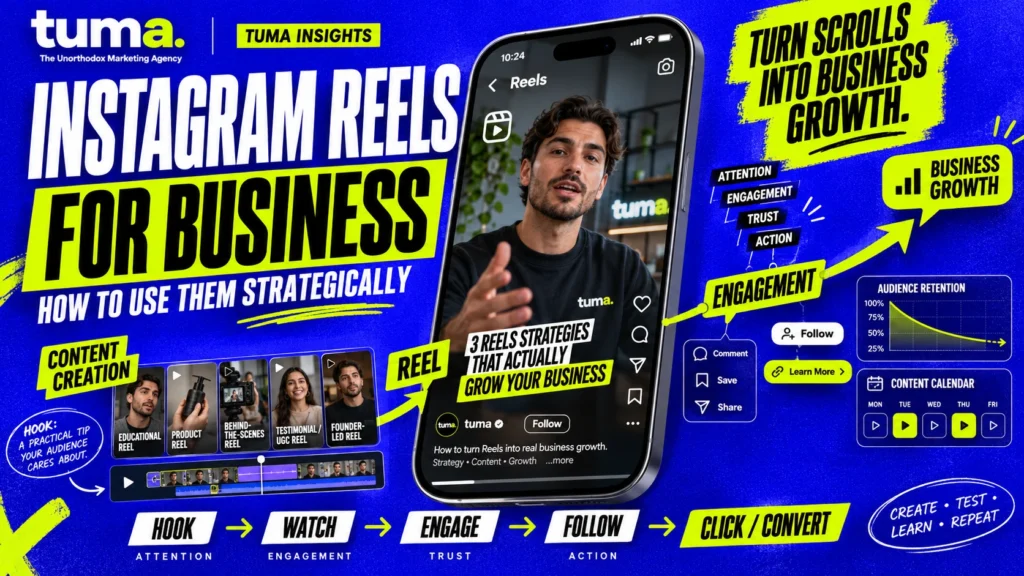
Most businesses approach Instagram Reels with a familiar checklist:
Find a trend. Choose a popular sound. Add some text. Post the video. Hope it gets views.
That creates content.
It doesn’t necessarily create a marketing strategy.
A Reel might generate thousands of views without attracting a single relevant customer. Another could reach a smaller audience but generate meaningful conversations, product enquiries, or qualified leads.
The difference comes down to purpose.
Learning how to use Instagram Reels for business means understanding what each video should accomplish, who it should reach, and how it contributes to a broader marketing objective.
At TUMA, we believe successful short-form video combines audience insight, creative thinking, platform-native execution, and performance measurement.
The goal isn’t to publish more videos simply because Instagram supports them.
It’s to develop a repeatable system that turns creative ideas into useful audience experiences and measurable business opportunities.
How Should Businesses Use Instagram Reels?
Businesses should use Instagram Reels to reach new audiences, educate customers, demonstrate products, share brand stories, build social proof, strengthen communities, and support conversions. An effective Instagram Reels strategy starts with a clear business objective, audience understanding, and creative concept. Performance data then helps businesses refine their content rather than relying on trends or views alone.
A practical framework follows:
Business Goal → Audience Insight → Content Pillar → Creative Concept → Hook → Value or Proof → CTA → Publishing → Performance Data → Learning → Next Reel
This creates a content system instead of a collection of unrelated videos.
What Are Instagram Reels?
Instagram Reels are a video format within Instagram that allows users and businesses to create, edit, publish, and discover video content.
Businesses can use Reels for product demonstrations, tutorials, storytelling, community engagement, customer education, and promotional campaigns.
Unlike content intended primarily for an existing follower audience, eligible public Reels may also reach non-followers through Instagram’s recommendation surfaces.
However, appearing in recommendations is not guaranteed.
Instagram Reels vs. Instagram Stories
| Instagram Reels | Instagram Stories |
|---|---|
| Often useful for reaching new audiences | Often useful for ongoing follower relationships |
| Support educational and discovery-focused videos | Support daily updates and quick conversations |
| Remain available on the profile unless removed or otherwise restricted | Generally disappear after 24 hours unless saved as Highlights |
| Useful for product demonstrations and storytelling | Useful for polls, questions, announcements, and community interaction |
| Can support broader content discovery | Can support relationship building and timely communication |
Both formats can work together.
A Reel might introduce a product, while Stories answer questions about it.
Instagram Reels vs. TikTok
Instagram Reels operate within Instagram’s wider environment of profiles, Stories, direct messages, Feed content, and shopping-related experiences where available.
TikTok has its own audience behaviors, discovery systems, and creative conventions.
A video developed for Instagram may also work on TikTok, but that doesn’t mean identical captions, editing, pacing, and calls to action are always appropriate.
Cross-platform adaptation is not the same as copy-pasting.
Why Should Businesses Use Instagram Reels?
Instagram Reels can support several business objectives.
Brand awareness: Introduce a business to relevant audiences through distinctive creative concepts.
Customer education: Explain complicated products, answer common questions, or demonstrate a process.
Product discovery: Show products in realistic situations rather than relying exclusively on descriptions.
Community engagement: Encourage discussion, respond to audience questions, and feature relevant experiences.
Trust building: Share genuine customer stories, expertise, and behind-the-scenes processes.
Conversion support: Encourage interested viewers to explore a product, contact the business, book an appointment, or visit a relevant page.
A Reel doesn’t have to achieve every objective simultaneously.
A brand-awareness video and a product-conversion video may require entirely different creative approaches.
Start With a Business Goal, Not a Trend
Before deciding what to film, ask:
What should this Reel accomplish?
Different objectives require different success metrics.
| Business Goal | Reel Objective | Useful KPI |
|---|---|---|
| Awareness | Introduce the brand | Reach, views, relevant audience growth |
| Education | Explain a useful topic | Watch time, saves, shares |
| Engagement | Start conversations | Comments, shares, meaningful replies |
| Product Discovery | Demonstrate a product | Profile activity, product interest |
| Lead Generation | Encourage enquiries | Qualified DMs, leads, bookings |
| Conversion | Support purchases | Attributable sales, conversion rate |
| Retention | Help existing customers | Useful interactions, customer actions |
For example, a SaaS company launching a new feature might produce a screen-recorded demonstration.
A restaurant might show an interesting preparation process.
A B2B founder could explain a common industry misconception.
All three use Reels, but their business purposes differ.
Business Goal → Reel Objective → KPI
That relationship should guide creative decisions.
Understand Your Target Audience Before Creating Reels
Effective Reels begin with customer insight rather than assumptions about what audiences enjoy.
Research should uncover:
- Problems customers regularly experience.
- Outcomes they want to achieve.
- Questions they ask before purchasing.
- Objections that delay decisions.
- Language they use to describe their needs.
- Content formats they find useful or entertaining.
- Their current awareness of the brand or solution.
Useful research sources include Instagram comments, DMs, customer reviews, sales conversations, support enquiries, search queries, competitor discussions, and previous advertising results.
Suppose a skincare brand notices customers repeatedly asking how to layer products.
Instead of creating another generic product showcase, the brand could produce a simple routine demonstration.
The insight determines the topic.
The topic shapes the concept.
Customer Language → Relevant Reel Idea → Creative Hook
Audience understanding makes the content more specific and more useful.
Build Your Instagram Reels Content Pillars
Content pillars are recurring themes that organize a brand’s social media content.
They prevent a feed from becoming a random mix of trends, promotions, and disconnected videos.
A business can develop several pillars based on its goals and audience needs.
| Content Pillar | Reel Examples | Strategic Purpose |
|---|---|---|
| Educational | Tutorials, tips, FAQs, industry explanations | Build understanding and authority |
| Entertainment | Relatable situations, humor, cultural observations | Earn attention and encourage sharing |
| Product | Demonstrations, features, comparisons, launches | Build product understanding |
| Brand | Origin stories, values, team, creative process | Strengthen recognition |
| Social Proof | Genuine testimonials, reviews, customer stories | Build credibility |
| Community | Responses, collaborations, audience questions | Encourage relationships |
| Thought Leadership | Founder insights, industry perspectives | Communicate expertise |
Consider a small coffee brand.
Its educational pillar might explain brewing techniques.
Its product pillar could demonstrate a new drink.
Its brand pillar might feature the people preparing it.
Its community pillar could respond to customer questions.
The topics remain connected to the business without repeating the same message.
Business Goal → Content Pillar → Reel Idea
How to Create Instagram Reels People Actually Keep Watching
A strong Reel needs more than an interesting opening.
It must deliver enough relevance, progression, and value to justify continued attention.
A practical creative structure is:
Hook → Value → Progression → Payoff → CTA
1. Develop a Clear Hook
The opening should communicate why someone might want to keep watching.
Useful hook approaches include:
| Hook Type | Example |
|---|---|
| Problem | “Still struggling with inconsistent product photos?” |
| Question | “Why do customers abandon this step?” |
| Tutorial | “Here’s how to create a cleaner product shot.” |
| Comparison | “What’s the difference between these two options?” |
| Contrarian | “A more expensive camera won’t fix a weak concept.” |
| Founder | “We started this brand after noticing one problem.” |
| Product Demo | Show the product solving a problem immediately |
| Story | “This started with a customer complaint.” |
| Result | Show a genuine, substantiated outcome first |
| Visual | Open with a compelling action or reveal |
Avoid treating hooks as interchangeable scripts.
A founder-led video needs a different introduction from a product demonstration.
2. Sustain Attention After the Hook
A strong opening creates an opportunity. The rest of the video must fulfill it.
Use clear explanations, visual demonstrations, purposeful editing, and a logical story.
Introduce relevant information as the video progresses.
Avoid fast cuts that add movement without improving understanding.
A Reel can be engaging because it is funny, educational, visually satisfying, emotionally meaningful, or genuinely useful.
3. Choose an Appropriate Story Structure
Useful Reel templates include:
- Hook → Value → CTA: For quick educational content.
- Problem → Solution → Proof: For product and service explanations.
- Question → Explanation → Takeaway: For FAQs.
- Before → After → How: For truthful transformations.
- Product Demo → Benefit → CTA: For ecommerce.
- Myth → Truth → Example: For education.
- Founder Insight → Lesson → CTA: For thought leadership.
- Customer Problem → Testimonial → Result: For genuine customer stories.
- Behind the Scenes → Process → Reveal: For brand storytelling.
- Teaser → Reveal → Demo → CTA: For launches.
These are creative frameworks, not guaranteed performance formulas.
Instagram Reel Ideas for Business
Instead of collecting random Instagram Reels ideas for business, organize concepts by marketing objective.
Awareness Reel Ideas
Introduce the founder’s story, demonstrate brand personality, comment on a relevant cultural moment, or dramatize a problem customers recognize.
Why: These formats help audiences understand and remember the business.
Educational Reel Ideas
Create tutorials, quick explanations, FAQs, checklists, and myth-busting videos.
Why: Useful information gives viewers a reason to watch, save, or share.
Consideration Reel Ideas
Show product demonstrations, comparisons, use cases, genuine testimonials, or examples of a service process.
Why: These videos help prospective customers evaluate the offering.
Conversion Reel Ideas
Address purchasing objections, demonstrate benefits, explain an offer, or answer questions about the buying process.
Why: They can reduce uncertainty and guide interested viewers toward the next action.
Community Reel Ideas
Respond to customer comments, collaborate with relevant creators, feature employee expertise, or answer audience-submitted questions.
Why: These formats create opportunities for participation and relationship building.
Instagram Reel Ideas for Small Business
Small businesses often have an advantage larger organizations struggle to reproduce: direct access to real customers, products, people, and everyday experiences.
That provides plenty of opportunities for useful short-form content.
Consider these practical formats:
- Answer a common customer question: Reduce confusion before enquiries.
- Demonstrate a product: Help viewers understand how it works.
- Show your service process: Make an unfamiliar service easier to evaluate.
- Introduce a team member: Add a recognizable human perspective.
- Share a founder lesson: Explain an experience that shaped the business.
- Show behind-the-scenes work: Reveal craftsmanship, preparation, or an interesting process.
- Explain a common mistake: Help customers avoid a relevant problem.
- Feature a genuine customer story: Provide credible social proof with permission.
- Create a quick tutorial: Deliver immediate practical value.
- Respond to a comment: Show that the business listens.
- Explain pricing factors: Help prospects understand what affects a quote.
- Show an accurate before-and-after: Demonstrate a real process or outcome.
- Introduce a new product or offer: Give existing followers a useful update.
- Debunk a misconception: Correct a misunderstanding within your expertise.
Choose ideas that can become repeatable formats rather than treating each Reel as a completely new production challenge.
Product, Founder, UGC, and Behind-the-Scenes Reels
Different businesses need different creative approaches.
Product Demonstration Reels
A useful product Reel shows how something works and why that matters.
Feature → Use Case → Customer Benefit
For a travel bag, that might mean demonstrating internal compartments during a realistic packing routine rather than simply listing dimensions.
For a product launch, consider a sequence:
Teaser → Reveal → Demonstration → Proof → FAQ → Offer
A sequence can answer more customer questions than one announcement video.
Founder-Led and Employee-Led Reels
Founders can share product decisions, business lessons, industry observations, and customer insights.
Employees can demonstrate expertise, explain processes, or show how work is completed.
This approach can be particularly relevant for startups, professional services, SaaS companies, and B2B organizations.
Human presence helps communicate expertise when the content contains something worth learning.
UGC and Creator Content
These terms should not be treated as identical.
Organic UGC: Content customers create voluntarily.
Commissioned UGC: Content produced by creators through a paid arrangement.
UGC-style brand content: Material produced by the brand but designed with a creator-native presentation.
Influencer content: Creator-led content where access to the creator’s audience may be part of the partnership.
Businesses should obtain appropriate permissions, agree on usage rights, disclose material relationships where required, and avoid fictional testimonials presented as genuine experiences.
Behind-the-Scenes Reels
Production, packaging, events, product development, team routines, and creative processes can all provide interesting material.
However, being behind the scenes is not automatically compelling.
The video should reveal a process, perspective, skill, or story that audiences have a reason to care about.
Instagram Reels for Ecommerce, B2B, SaaS, and Service Businesses
Reels are not exclusively for consumer entertainment.
| Business Type | Useful Reel Concepts | Potential Outcome |
|---|---|---|
| Ecommerce / DTC | Unboxing, product demos, comparisons, styling, creator content | Product discovery and purchase consideration |
| B2B | Founder perspectives, short explainers, industry misconceptions, mini case studies | Trust and qualified interest |
| SaaS | Feature demos, screen recordings, workflow tips, product updates | Product understanding and demo interest |
| Service Business | FAQs, process walkthroughs, team expertise, customer stories | Enquiries and bookings |
| Local Business | Customer questions, location-relevant content, staff, service demonstrations | Local awareness and trust |
An ecommerce brand may prioritize visual demonstrations.
A SaaS business may need to explain how a feature solves a workflow problem.
A professional service provider may need to establish credibility before asking for a consultation.
The format should follow the buying decision.
Should Businesses Use Instagram Trends and Trending Audio?
Trends can help businesses participate in relevant cultural conversations.
But following trends is not a complete creative strategy.
Before using one, ask:
- Does it fit our audience?
- Can we connect it naturally to our brand?
- Does it communicate something meaningful?
- Is the timing appropriate?
- Do we have the rights needed to use the audio or imagery?
Trend + Brand Fit + Audience Fit + Timing = Potential Opportunity
Trending audio does not guarantee reach.
Original formats, recognizable editing styles, recurring series, distinctive typography, and consistent storytelling may help a brand build a stronger identity over time.
Trends help participation. Original formats build distinction.
Does Authentic Content Need to Look Unpolished?
No.
Authenticity comes from credibility and relevance, not simply camera quality.
A polished studio video can feel genuine.
A creator-style video can feel artificial.
A low-budget video can communicate real expertise, while an expensive video can communicate almost nothing.
The goal is to remain recognizable and credible while adapting to Instagram’s viewing experience.
How Long Should Instagram Reels Be?
An Instagram Reel should be long enough to deliver its intended value without unnecessary repetition.
There is no universal duration that guarantees better performance.
According to Instagram’s Help Center guidance available in October 2026, the Instagram app supports recording and editing Reels up to 20 minutes. However, Instagram also states that Reels longer than three minutes are not recommended to new audiences.
Publishing through external tools or advertising systems may involve different limits.
For discovery-focused business content, the three-minute recommendation threshold is therefore more relevant than the maximum upload duration.
A simple product demonstration may require only a few seconds. A substantial tutorial may need longer.
Choose duration based on the objective, concept, audience, and performance data.
As long as necessary to deliver the value, but no longer than the content can sustain attention.
Recommended Reel Format and Accessibility
A practical production setup is vertical 9:16 video, commonly exported at 1080 × 1920 pixels.
Instagram’s organic upload guidance accepts aspect ratios from 1.91:1 to 9:16 and specifies minimum video quality requirements.
For an effective viewing experience:
- Keep important text away from interface overlays.
- Check framing and safe zones before publishing.
- Use readable captions and sufficient contrast.
- Add subtitles for spoken information.
- Make important visual information understandable.
- Use clear dialogue, voiceovers, or sound design when appropriate.
Captions improve accessibility and comprehension, including when viewers cannot hear the audio.
Music Rights for Business Reels
Businesses should not assume that every song available in Instagram’s music interface is licensed for commercial use.
Meta distinguishes personal, non-commercial music use from commercial usage rights.
For branded or promotional content, use audio that the business is authorized to use, such as appropriately licensed music, original recordings, or eligible tracks from Meta’s Sound Collection.
Additional requirements may apply to advertising and creator partnerships.
Music should support the creative concept, not determine it.
How to Write Better Reel Captions, CTAs, and Search-Friendly Content
A good caption adds context rather than repeating everything shown in the video.
Explain the topic clearly, include relevant audience language, and give viewers a useful next step when appropriate.
Instagram search visibility can benefit from clear topical relevance across content, captions, and profile information.
Use natural keywords that describe the subject.
Avoid stuffing captions with repetitive phrases or relying on long lists of hashtags as a discovery shortcut.
Relevant hashtags may provide context, but they do not guarantee distribution.
Choose CTAs Based on Audience Readiness
| Objective | CTA Example |
|---|---|
| Awareness | “Follow for more practical ideas.” |
| Education | “Save this for your next project.” |
| Community | “What’s been your experience?” |
| Consideration | “DM us if you have a question.” |
| Conversion | “Explore the product through our profile.” |
| Service Enquiry | “Book a consultation through the linked page.” |
Not every Reel needs a direct sales CTA.
A tutorial may be more effective when it simply helps viewers solve a problem.
Objective + Audience Readiness → CTA
Connect Reels With the Conversion Experience
A business conversion might follow this journey:
Reel → Interest → Profile / DM / Website → Product or Landing Page → Conversion
When directing viewers away from Instagram, maintain message consistency.
A Reel about a specific product should lead to relevant product information rather than an unrelated homepage.
Reel Promise → Landing Page Message → Conversion Experience
Good creative can attract interest, but a confusing next step can waste that opportunity.
How to Measure Instagram Reels Performance
Instagram Reels success should be assessed through a combination of audience attention, engagement, growth, and business outcomes.
Professional accounts can use Instagram Insights to review content performance.
Available metrics and reporting views can vary by account, feature, and interface.
Common Reels reporting includes views, watch time, average watch time, viewers, follows, and interaction or profile activity information.
Which Instagram Reels Metrics Matter?
| Objective | Useful Signals |
|---|---|
| Awareness | Views, reach |
| Attention | Watch time, average watch time, retention where available |
| Content Value | Shares, saves |
| Community | Comments, relevant DMs |
| Audience Growth | Follows, profile activity |
| Business Outcomes | Enquiries, qualified leads, attributable purchases |
Views vs. Watch Time
Views indicate content consumption or playback activity under Instagram’s reporting definitions.
Watch time shows how much time people spend viewing the content.
Average watch time helps teams understand attention relative to playback.
A video can generate many views but still lose interest quickly.
Views measure exposure, not complete business impact.
Shares vs. Saves
Shares can indicate that viewers found a Reel relevant, entertaining, useful, or socially valuable enough to send to someone else.
Saves can indicate that the information may be useful to revisit.
Neither automatically proves a sale or a business result.
Follower Growth and Conversions
Follower growth can support long-term audience development, but a large passive following is not necessarily more valuable than a smaller, commercially relevant audience.
Track downstream actions through appropriate website analytics, campaign tracking, booking systems, or customer enquiries.
Where possible, compare Instagram-attributed conversions against the intended business objective.
Organic Instagram Reels vs. Reels Ads
Organic Reels and paid Reels ads are related but distinct.
| Organic Reels | Reels Ads |
|---|---|
| Distributed through organic Instagram surfaces | Distributed through Meta’s advertising system |
| Can support brand, education, community, and discovery | Support specified advertising objectives |
| Discovery depends on platform distribution and audience behavior | Delivery depends on campaign settings and ad systems |
| Commonly evaluated using organic content metrics | Evaluated using campaign and conversion metrics |
| No direct media spend required | Requires advertising budget |
Meta Ads Manager supports Instagram Reels as an advertising placement. Advertising-specific specifications and policies are not identical to organic posting requirements.
Should You Boost a High-Performing Reel?
Sometimes, but only when doing so supports a clear campaign objective.
A Reel may perform organically because it is funny, relatable, or culturally relevant.
That doesn’t guarantee it will generate qualified leads or purchases when promoted.
Organic Winner ≠ Guaranteed Paid Winner
Before boosting, review audience relevance, product clarity, offer, CTA, usage rights, and conversion potential.
Connect Organic and Paid Creative Learning
Organic content can provide clues about useful topics, engaging hooks, and audience questions.
Organic Reel → Audience Response → Creative Insight → Paid Hypothesis
Paid advertising can reveal which messages, benefits, objections, and creative approaches contribute to campaign results.
Paid Creative Data → Audience Insight → Better Organic Reel
These learning loops are valuable because they connect content creation with performance-focused video advertising.
However, organic engagement is not controlled evidence that a paid advertisement will convert.
Paid and organic results should be evaluated separately before drawing conclusions.
How to Test and Improve Your Instagram Reels
Creative testing should help a team learn why particular approaches work.
Use:
Hypothesis → Reel → Data → Learning → Improved Reel
Possible testing variables include hooks, topics, creative concepts, formats, presenters, story structure, CTAs, video length, and editing approaches.
For clearer learning, compare one significant variable at a time when practical.
For example, a business might test a question-based opening against a demonstration-based opening using otherwise comparable creative.
If an idea performs well, explore meaningful variations instead of repeatedly reposting the same asset.
Try a new customer example, visual hook, presenter, format, or CTA.
Winning Idea → Multiple Executions → Learning
Build a Sustainable Reels Content System
A useful content calendar organizes pillars, creative concepts, production resources, publishing dates, and performance reviews.
Businesses can also develop recurring series such as:
- Myth vs. Reality
- One Practical Tip
- Customer Question of the Week
- Product in Action
- Behind the Campaign
- How It Works
- Founder Take
- Three Mistakes to Avoid
Series can improve production efficiency and help establish recognizable content patterns.
How Often Should Businesses Post Reels?
There is no universal posting frequency that guarantees growth.
The appropriate schedule depends on creative capacity, audience needs, available resources, and the quality the team can maintain.
Sustainable Consistency > Arbitrary Volume
Repurposing Reels
One longer video can generate a Reel, supporting Story, carousel, shorter clip, or adapted paid creative.
However, repurposing should include changes to framing, hook, duration, context, or CTA when needed.
AI-Assisted Reels Production
AI can assist with ideation, scripts, storyboards, captions, editing, localization, and creative variations.
Human review remains essential to prevent generic concepts, incorrect claims, inconsistent branding, and rights-related problems.
AI can accelerate execution. It cannot replace audience insight, creative judgment, or testing.
What Instagram Officially Recommends for Reels
Instagram’s official guidance should be separated from third-party marketing frameworks.
Meta’s Instagram Best Practices announcement describes an education hub in the Professional Dashboard covering creation, engagement, reach, monetization, and guidelines.
Its guidance includes topics such as capturing attention, Reel length, trending audio, hashtags, and understanding content performance.
Meta has also described the importance of original content in Instagram recommendations.
For current account-specific advice, businesses should consult Instagram’s Professional Dashboard and Help Center.
TUMA’s Strategic Recommendations
Our approach is to:
- Start with an audience insight and a business objective.
- Create recognizable content pillars and original formats.
- Develop strong hooks that lead to genuine value.
- Adapt the creative to Instagram without losing brand identity.
- Measure attention, engagement, and relevant business actions.
- Apply performance insights to future content.
These are strategic recommendations, not official Instagram ranking requirements.
Common Instagram Reels Mistakes and Algorithm Myths
Several popular assumptions make Reels marketing less effective.
Trending audio guarantees reach: It doesn’t. Audio should support the content.
Businesses must post every day: No universal daily posting requirement guarantees better distribution.
The shortest Reel always performs best: Duration should match the concept.
Hashtags determine performance: Hashtags are not a substitute for relevant, useful content.
Views are the only metric that matters: Business outcomes require broader measurement.
Authentic content must look unpolished: Credibility is not determined by camera quality.
Every Reel should sell: Reels can also educate, entertain, build trust, and strengthen community.
Copying successful competitors guarantees results: Audience relevance and brand differentiation still matter.
Other avoidable mistakes include weak openings, unclear topics, inaccessible captions, inconsistent brand identity, unlicensed audio, fabricated customer proof, inappropriate CTAs, and a lack of creative testing.
The solution is not to chase every supposed algorithm secret.
It is to establish a disciplined connection between ideas, audience behavior, and business results.
How TUMA Thinks About Instagram Reels Strategy
At TUMA, we don’t believe businesses need more short-form videos simply to fill their social calendars.
They need better reasons to create them.
Our approach connects social media marketing, content creation, creative strategy, video editing, and performance-focused thinking.
We believe a Reel should earn attention, communicate a clear idea, strengthen the brand, and give viewers a reason to remember or act.
That may mean a distinctive product demonstration, a founder-led perspective, a culturally relevant concept, or an original video series.
The execution changes.
The thinking stays intentional.
Audience Insight → Creative → Distribution → Data → Better Creative
We don’t just make content; we create culture.
And marketing should deliver results.
Conclusion: Make Instagram Reels Part of a Bigger Strategy
Learning how to use Instagram Reels for business isn’t about discovering one perfect video length, posting schedule, audio track, or editing technique.
It’s about creating relevant content with a clear purpose.
Start with the business goal. Understand the audience. Develop original concepts. Produce videos that deliver value. Measure the response. Improve the next creative decision.
The question isn’t how many Reels a brand can publish.
It’s how effectively those Reels support recognition, relationships, customer understanding, and business growth.
Don’t just create Reels people watch. Create Reels that give people a reason to remember your brand.