
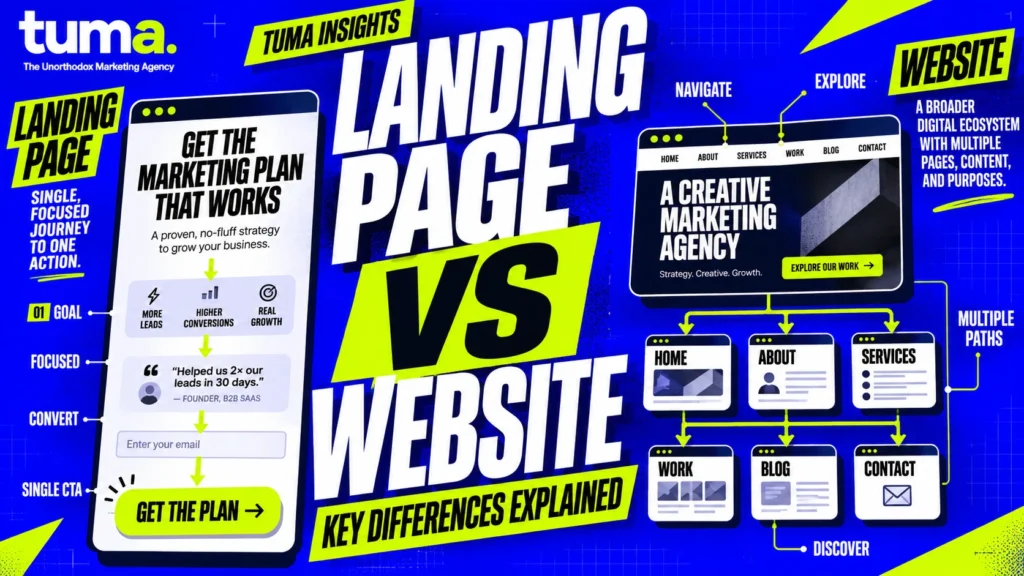
The landing page vs website question sounds like an either/or decision.
It usually isn’t.
A landing page can live inside your website. A website can be designed to convert. And a landing page can rank in search results.
The real difference is not simply the number of pages or whether a visitor clicks a button.
It’s about what the visitor needs, where they came from, and what the business wants them to do next.
Someone clicking an ad for a free product demo has different expectations from someone researching a company before making a major purchase.
Both visitors may eventually become customers, but they don’t necessarily need the same page experience.
That’s why the better question isn’t simply, “Should I build a landing page or a website?”
It’s:
What experience best matches this visitor’s intent, traffic source, and stage in the customer journey?
Understanding that distinction helps businesses make better decisions about web development, paid advertising, SEO, conversion optimization, and long-term brand growth.
Landing Page vs Website: Quick Answer
A landing page is a focused web page designed for a specific audience, campaign, offer, or primary action. A website is a broader collection of interconnected pages that serves multiple visitor needs and conversion paths. A landing page can exist within a website, and neither option is universally better. Many businesses use both to support different marketing objectives.
The simplest distinction is:
Landing Page = Focused Page Experience
Website = Broader Digital Ecosystem
A landing page typically helps visitors complete a defined action. A website supports discovery, education, product exploration, trust-building, and multiple opportunities to convert.
The two are complementary rather than competing solutions.
What Is a Landing Page?
A landing page is a web page designed around a specific audience, traffic source, offer, campaign, search intent, or conversion objective.
Its content and layout help visitors understand a relevant offer and decide whether to take a particular action.
That action might involve booking a consultation, requesting a quote, downloading a resource, registering for an event, starting a trial, or purchasing a product.
A useful framework is:
Landing Page = Focused Intent + Relevant Message + Supporting Proof + Primary CTA
For example, imagine an ecommerce agency running a Meta advertising campaign offering free creative audits.
Rather than sending visitors to a general homepage listing every agency service, it could use a dedicated landing page explaining the audit, who qualifies, what participants receive, and how to apply.
The page would have one primary conversion objective: audit requests.
What Is the Purpose of a Landing Page?
Common landing-page goals include:
- Lead generation and consultation bookings
- Product purchases and special promotions
- Free trial or demo registrations
- Webinar and event signups
- Ebook or resource downloads
- Waitlist registrations
- Quote requests and campaign-specific enquiries
Landing pages can be temporary or evergreen. A limited-time promotion may end after several days, while a service-specific lead generation page may remain useful for years.
Campaign Intent → Relevant Landing Page → Primary Action
Can a Landing Page Be Part of Your Website?
Yes. A landing page can be part of an existing website.
It can exist in a subdirectory, on a subdomain, or under a separate domain when there is a legitimate reason for that structure.
For example:
- example.com/free-audit
- offers.example.com/demo
- campaign.example.com/summer-offer
A dedicated landing page does not require a completely separate website.
In fact, keeping campaign pages within an established website can simplify brand consistency, analytics, tracking, technical management, and some aspects of SEO.
The important distinction is the page’s purpose and experience, not its technical location.
A landing page becomes meaningfully different through its messaging, audience focus, navigation choices, content, and conversion path.
What Is a Website?
A website is an interconnected collection of web pages and digital functionality organized around a business, brand, individual, organization, or product.
Unlike a focused campaign page, a website typically serves multiple audiences and intentions.
A business website may contain a homepage, service pages, product pages, case studies, pricing information, blog articles, customer resources, and contact pages.
Each page performs a different role.
For example, a visitor might discover a company through an educational article, explore its services, review customer examples, and eventually request a consultation.
The website supports that journey through its information architecture.
Website → Multiple Pages → Multiple User Needs → Multiple Conversion Paths
How Website Structure Supports the Customer Journey
A typical service-business website might follow this hierarchy:
Homepage → Service Category → Specific Service → Case Study → Contact
Information architecture defines how these pages connect.
Navigation menus, breadcrumbs, footer links, internal links, and site search help visitors move between relevant content.
Good website architecture also supports search-engine discovery by making important pages easier to find and understand.
Landing Page vs Website: Key Differences
The main differences between a landing page and a website involve scope, audience intent, navigation, messaging, and how conversion opportunities are organized.
| Factor | Landing Page | Website |
| Primary purpose | Focused audience, offer, or action | Multiple user needs and business goals |
| Scope | Usually narrower | Usually broader |
| Audience | Often segmented | Often multiple audience groups |
| Traffic intent | Frequently specific | May include mixed intentions |
| Navigation | Often simplified | Usually more extensive |
| CTA | One dominant conversion goal | Multiple relevant actions |
| Content depth | Matches a focused decision | Varies across different pages |
| SEO | Can target organic searches | Supports broader organic visibility |
| Paid media | Often campaign-specific | Existing pages can also serve ads |
| User journey | Usually more directed | Often more exploratory |
| Internal linking | May be selective | Central to website architecture |
| Lifespan | Temporary or evergreen | Usually designed for ongoing use |
| Testing | Often easier to isolate | Can involve multiple connected journeys |
| Branding | Campaign-focused brand experience | Broader brand ecosystem |
These are common patterns, not rigid rules.
A landing page might contain extensive information and numerous sections. A website’s product page might have a single prominent purchase button.
The difference is focused intent versus broader information architecture, not simply one page versus many pages.
Landing Page vs Sales Page: What’s the Difference?
A landing page is a broad category of focused destination pages.
A sales page is a more specific type of page designed to persuade visitors to purchase a product, service, or offer.
Sales pages often include detailed benefit explanations, product demonstrations, testimonials, objection handling, pricing, guarantees where applicable, and purchase-oriented calls to action.
They may be longer when the buying decision requires more explanation.
Not every landing page is a sales page.
A webinar registration page, for example, might collect signups without attempting an immediate purchase.
Product Page vs. Campaign Landing Page
A product page generally belongs to an ecommerce or product website. It provides information about an item and supports product exploration or purchase.
A campaign landing page may present the same product through a more specific message.
For example, an ordinary product page might explain a skincare serum’s ingredients, usage, price, and delivery details.
A campaign page might focus on the same serum as part of a particular bundle or audience-specific offer.
The two can overlap. What matters is whether the existing product page already meets the campaign’s requirements.
Different Types of Landing Pages
Landing pages can support different stages of the marketing funnel.
| Type | Main Purpose | Example |
| Click-through landing page | Prepare visitors for the next step | Product overview before checkout |
| Lead generation page | Collect enquiries | Consultation request |
| Squeeze page | Capture a simple signup | Newsletter or resource signup |
| Product landing page | Promote a specific product or offer | New product launch |
| PPC landing page | Match paid campaign intent | Google Ads service offer |
| SEO landing page | Serve organic search intent | Industry-specific service page |
| Event landing page | Drive registrations | Webinar or workshop signup |
These categories are not mutually exclusive.
An SEO landing page can generate leads. A PPC landing page can sell products. And a product landing page can support both organic and paid traffic.
How to Choose the Right Page: The Intent-to-Experience Framework
Choosing between a landing page and a website should begin before design or development.
At TUMA, a useful way to think about the decision is to connect the business objective with the visitor’s situation.
Business Objective → Traffic Source → User Intent → Funnel Stage → Page Type → Message + Proof + CTA → User Experience → Conversion → Measurement + Testing
Each step influences the next.
1. Start With the Business Objective
Are you trying to generate leads, sell a product, grow an email list, increase demo bookings, or build awareness?
A specific conversion goal may justify a focused campaign page. A broader growth strategy may require interconnected website experiences.
2. Consider the Traffic Source
Different acquisition channels create different expectations.
| Traffic Source | Typical Visitor Context | Possible Destination |
| Paid search | Searching for a specific solution | Service, product, or PPC landing page |
| Paid social | Responding to creative and an offer | Campaign landing page or product page |
| Organic search | Researching or comparing | Blog, service page, SEO landing page |
| Following an established message | Offer, event, or product page | |
| Influencer / affiliate | Exploring a recommendation | Relevant product or campaign page |
| Direct / branded traffic | Seeking the company or product | Homepage or appropriate destination |
| Events / QR codes | Responding to a specific invitation | Event or registration page |
The source provides context, not an automatic rule.
3. Match User Intent and Funnel Stage
A visitor searching “what is performance creative?” probably needs education.
Someone searching “book performance creative consultation” may be closer to making an enquiry.
Search intent describes what the visitor is trying to find. Conversion intent concerns their readiness to take a meaningful action.
These can overlap, but they are not identical.
User Intent → Content Depth + Navigation + CTA
A good destination provides enough information to satisfy the visitor before asking for a commitment.
What Makes a Strong Landing Page?
A successful landing page connects a relevant offer with a clear user experience and credible reasons to act.
Headline and Value Proposition
The headline should quickly communicate what the visitor can expect.
The value proposition explains why the offer matters and what makes it relevant to the intended audience.
A headline such as “Get a Free Ecommerce Creative Audit” communicates a more specific offer than “Welcome to Our Agency.”
Benefits and Supporting Content
Explain what the visitor receives, what problem the offer addresses, and what happens next.
Avoid filling a page with features without connecting them to customer needs.
Trust and Social Proof
Genuine testimonials, case studies, customer examples, product demonstrations, relevant certifications, and verified reviews can support credibility.
Claim → Evidence → Trust
Never manufacture reviews, invent customer logos, or promise results without evidence.
Call to Action
The CTA should describe a meaningful next step.
Examples include “Request a Quote,” “Book a Demo,” “Start Free Trial,” and “View Available Plans.”
A landing page often has one primary conversion goal, but this does not mean it can contain only one button.
The same CTA can appear at several useful points.
One Primary Goal ≠ One Literal Button
Forms and Objection Handling
Forms should request information appropriate to the next step.
Frequently asked questions can address pricing uncertainty, eligibility, timelines, and other concerns that might prevent someone from continuing.
The strongest structure is often:
Relevant Message → Benefits → Proof → Reduced Friction → Action
Why Message Match Matters for Paid Advertising
Message match is the relationship between what an advertisement promises and what the destination page delivers.
Consider a Meta ad saying:
“Get a Free Ecommerce Creative Audit.”
If the visitor arrives on a homepage introducing ten unrelated agency services, the original offer may be difficult to find.
A more relevant destination would repeat the audit offer, explain its value, establish trust, and provide a clear application process.
Ad Promise → Landing Page Headline → Offer → CTA
Message match supports continuity between advertising creative and the post-click experience.
It also helps prevent visitors from wondering whether they arrived at the correct destination.
This matters for Google Ads, paid social campaigns, email promotions, and other acquisition channels.
Should Landing Pages Have Navigation?
Some campaign landing pages reduce traditional navigation to maintain focus.
Fewer competing links may help visitors concentrate on the offer, but removing every navigation element is not automatically better.
Visitors may still need contact information, a privacy policy, terms, accessibility information, or a way to learn more about the company.
For expensive services or unfamiliar brands, supporting navigation can help establish trust.
The objective is not to trap visitors on one page.
It is to make the most relevant next step clear without hiding information people genuinely need.
Short vs. Long Landing Pages: Which Works Better?
Landing pages do not have to be short.
Content length should reflect the complexity of the decision.
A short page may be appropriate for a familiar offer, simple signup, or low-risk action.
A longer page may be useful when explaining an expensive product, complicated service, unfamiliar solution, or significant purchasing commitment.
For B2B audiences, additional proof, implementation details, and objection handling may be important.
Content Length Should Match Decision Complexity
Removing useful information to reduce scrolling can create more uncertainty rather than less friction.
Landing Page vs Website for SEO
A common misconception is that websites are for SEO while landing pages are exclusively for advertising.
That distinction is inaccurate.
A website can support a broad search strategy through service pages, category pages, blog content, product pages, case studies, and internal linking.
A focused landing page can also target a relevant organic search query.
For example, a SaaS company might create an industry-specific page explaining how its software supports accounting teams.
That page could address a distinct search intent while directing qualified visitors toward a demo.
SEO Landing Page vs. PPC Landing Page
| Factor | SEO Landing Page | PPC Landing Page |
| Acquisition | Organic search | Paid advertising |
| Primary emphasis | Search intent and useful content | Campaign and ad relevance |
| Content | Enough depth to answer relevant queries | Enough depth to support the decision |
| Internal links | Often important | May be more selective |
| CTA | Contextual conversion action | Clear campaign action |
| Optimization | Content, crawlability, SEO, UX | Message match, UX, CRO, tracking |
One page can support both channels when the requirements align.
However, creating near-identical SEO pages for every minor keyword variation is not a sound strategy.
Google’s spam policies specifically address doorway abuse involving substantially similar pages created to target searches without providing meaningful additional value.
A landing page should have a legitimate purpose and distinct usefulness.
Landing Page vs Website for Paid Advertising
Dedicated landing pages can be useful when advertising a specific offer, addressing a segmented audience, or testing campaign messaging.
But existing website pages can perform the same role if they already provide a relevant experience.
A well-structured product page may be the appropriate destination for Shopping-related traffic.
A focused service page may satisfy high-intent Google Search visitors.
Do Not Build a New Landing Page Just Because the Traffic Is Paid.
Create one when it solves an identifiable problem with relevance, messaging, UX, tracking, or conversion.
Should Paid Traffic Go to a Homepage?
Sometimes.
A homepage may make sense for broad branded searches, general company discovery, or awareness campaigns.
For a narrow offer, however, a homepage may introduce too many competing paths.
The decision should follow the visitor’s expectations.
Does a Dedicated Landing Page Improve Google Ads Quality Score?
Not automatically.
Google Ads identifies landing page experience as one of three components of its Quality Score diagnostic, alongside expected click-through rate and ad relevance.
Google recommends making the destination relevant to the advertisement and keywords, providing useful information, and making navigation clear.
Importantly, Quality Score itself is a diagnostic tool rather than a direct input into the ad auction.
A separate landing-page URL does not guarantee a better score, lower CPC, or stronger campaign performance.
See Google Ads’ official Quality Score guidance.
How Landing Pages and Websites Work Together
For many businesses, the strongest strategy connects broad website experiences with targeted landing pages.
Imagine this customer journey:
- A buyer discovers a useful blog article through Google.
- They explore the company’s service page.
- They read a case study but leave without enquiring.
- Later, they encounter a relevant retargeting advertisement.
- They click through to a focused campaign landing page.
- They review the offer and supporting evidence.
- They submit a qualified enquiry.
The website supported discovery, education, and trust.
The landing page supported a specific conversion opportunity.
Website + Landing Pages = Connected Customer Journey
This is also why a website should not be treated as an information-only asset.
A well-planned website can create multiple conversion paths.
For example:
Homepage → Service Page → Case Study → Contact
Or:
Blog → Relevant Service → Proof → Demo Request
The journey may involve multiple sessions and channels before a visitor acts.
Conversion Rate Optimization: Improving What Happens After the Click
Conversion rate optimization (CRO) involves using research, user behavior, and testing to improve the experience around a desired action.
Both websites and landing pages benefit from CRO.
Potential improvements include headline clarity, CTA placement, form design, persuasive content, page structure, performance, and trust signals.
A useful process is:
Behavior → Hypothesis → Test → Learning → Iteration
A/B Testing Landing Pages
An A/B test compares different versions of a page or element to investigate whether a specific change improves a measured outcome.
Teams might test:
- Headlines and value propositions
- CTA wording or placement
- Offer presentation
- Form length and structure
- Customer proof
- Product visuals
- Pricing presentation
Testing requires adequate traffic, appropriate measurement, and careful interpretation.
Not every experiment produces a statistically reliable result.
Form Optimization and Lead Quality
Removing unnecessary form fields may reduce friction, but the shortest possible form is not always the strongest commercial choice.
A B2B business might need company size, service requirements, or budget information to qualify an enquiry.
More Data Requested → Potentially More Qualification + More Friction
A marketing-qualified lead (MQL) and a sales-qualified lead (SQL) represent different stages or definitions of lead readiness, depending on the organization’s qualification process.
More form submissions do not necessarily mean more valuable customers.
The correct objective may be qualified pipeline or revenue rather than raw lead volume.
Which Metrics Matter?
| Page Objective | Useful Metrics |
| Lead generation | Conversion rate, qualified leads, CPL |
| Demo requests | Booking rate, attended demos, SQLs |
| Product sales | Purchases, CPA, revenue, ROAS |
| Website SEO | Organic visibility, relevant traffic, conversions |
| Content journeys | Engagement, assisted conversions, next-step actions |
| Campaign testing | Primary conversions, lead quality, test outcomes |
Page Type → Objective → KPI
For paid campaigns, the landing page is only one part of performance.
Audience targeting, creative quality, bidding, competition, attribution, and the offer also influence outcomes.
UX, Performance, Accessibility, and Brand Experience
A focused page is not automatically a usable page.
Both landing pages and websites require clear visual hierarchy, intuitive interactions, readable typography, mobile responsiveness, and appropriate accessibility.
Good accessibility practices include sufficient contrast, meaningful form labels, keyboard operation, descriptive alternative text, and accessible interactive components.
The W3C’s WCAG 2.2 guidance provides an established reference for accessible web experiences.
Performance matters too.
Large images, unnecessary scripts, inefficient code, and poorly configured resources can make pages frustrating to use.
Google’s current Core Web Vitals measure loading performance through Largest Contentful Paint (LCP), responsiveness through Interaction to Next Paint (INP), and visual stability through Cumulative Layout Shift (CLS).
The recommended good thresholds are LCP at 2.5 seconds or less, INP at 200 milliseconds or less, and CLS at 0.1 or less, measured at the 75th percentile.
These metrics are described in Google’s Web Vitals documentation.
Better technical performance can reduce friction, but it cannot compensate for an irrelevant offer.
Brand consistency is equally important.
A campaign page should use recognizable typography, colors, imagery, messaging, and brand voice.
Campaign Focus + Brand Consistency = A More Coherent Experience
Landing Page vs Website Examples
The following examples are hypothetical and illustrate how different businesses can use both approaches.
| Business | Website Experience | Dedicated Landing Page |
| SaaS company | Features, pricing, resources, product details | Enterprise demo campaign |
| Ecommerce brand | Collections, product pages, customer accounts | Limited-time bundle promotion |
| B2B agency | Services, portfolio, case studies, blog | Free paid-social creative audit |
| Local service business | Services, locations, reviews, contact | Specific service offer from Google Ads |
| Startup | Product vision, team, information | Early-access waitlist |
| Consultant | Expertise, services, resources | Consultation booking campaign |
Example of a Landing Page
Imagine a paid social advertisement offering a free ecommerce creative audit.
The destination could contain:
Headline: Find Out What’s Holding Back Your Ecommerce Ads
Subheading: Request a creative audit focused on your messaging, hooks, and opportunities for improvement.
The page would then explain who the audit is for, what is included, how the process works, and what the visitor should expect.
Supporting proof would use genuine examples or clearly identified experience.
The CTA could read:
Request My Creative Audit
A simple form would capture relevant contact and business information.
That is a landing page because the entire experience supports one specific audience, offer, and primary action.
Landing Page vs Website Pricing: How Much Do They Cost?
Landing page vs website pricing depends more on project scope than on the label attached to the deliverable.
A simple template-based page can be inexpensive to produce, while a custom campaign experience with original design, copywriting, tracking, CRM integrations, and testing can require considerably more investment.
What Is the Average Cost of a Landing Page?
There is no single reliable average that represents every market, provider, platform, and scope.
Published pricing examples from 2026 illustrate the differences:
| Development Approach | Published Pricing Example | Important Context |
| DIY landing-page builder | Unbounce Starter: $29/month | Platform subscription; excludes your production time |
| Freelancer | Estimates of 300–1,500 per page in one 2026 pricing guide | Scope, skill, and included services vary |
| Agency template-based page | WebFX: $1,125 per page | Specific vendor’s published package |
| Agency custom landing page | WebFX: $3,000 per page | Specific vendor’s custom package |
| Complex bespoke experience | Quote-based | Depends on functionality, integrations, and ongoing work |
Sources: Unbounce pricing, WebFX published service pricing, and CRO Designer’s October 2026 pricing guide.
These are U.S.-dollar examples and provider estimates, not a representative market average or a quote from TUMA. Published figures were checked in November 2026.
Before comparing quotes, clarify whether they include strategy, copywriting, design, development, hosting, analytics, integrations, testing, and ongoing revisions.
How Much Does a Website Cost?
Website pricing introduces additional variables:
- Number of pages and reusable templates
- Information architecture and navigation
- Custom UX/UI design
- Content management functionality
- Ecommerce or customer accounts
- Technical integrations
- Content creation and migration
- SEO and analytics implementation
- Security, accessibility, and performance requirements
- Ongoing maintenance
Clutch’s 2026 web design pricing guide, updated September 21, reports that most reviewed web design projects were below $10,000, while project scope and agency pricing varied substantially.
Those figures describe Clutch’s reviewed projects, not every website market or all development categories.
A sophisticated custom landing page may cost more than a simple multi-page website.
Compare Deliverables and Outcomes, Not Just Page Count.
When Is a Landing Page Enough?
A focused landing page may be sufficient when a business has one immediate objective, such as validating an idea, promoting an event, collecting waitlist registrations, or testing a simple offer.
For early-stage startups, this can be a practical way to gather initial demand signals without building a full website.
However, signups alone do not prove product-market fit or profitable demand.
One February 2026 r/startups discussion describes the difficulty of generating meaningful traffic for an early landing-page test. It is an individual founder’s experience, not evidence of universal results.
A single page may also limit how much information visitors can explore about products, services, company credibility, and support.
When Does a Full Website Make More Sense?
A broader website becomes valuable when the business serves multiple audiences, offers several products or services, publishes ongoing content, or relies on organic search.
It can also support complex buying journeys where customers need time to compare solutions and evaluate trust.
Websites are particularly useful for businesses requiring product catalogs, case studies, support content, detailed service information, or multiple conversion paths.
An established ecommerce business, for instance, generally needs an integrated shopping experience rather than a collection of disconnected campaign pages.
When Do You Need Both?
For many growing or established businesses, the most practical architecture combines a website with dedicated landing pages.
The website supports ongoing brand discovery, search visibility, product information, trust, and customer journeys.
Landing pages support campaign-specific messaging, segmented audiences, focused offers, and experimentation.
| Business Type | When a Website Helps | When a Landing Page Helps |
| SaaS | Product education and ongoing discovery | Demo or trial campaigns |
| Ecommerce | Catalog, checkout, customer experience | Promotions and launches |
| B2B | Credibility, services, case studies | Targeted lead generation |
| Local services | Organic search, service and location information | Specific paid-search offers |
| Startup | Growing brand and product information | Waitlist and demand validation |
| Creator / consultant | Authority and service exploration | Lead magnet or booking campaign |
The strongest choice depends on the stage of the business and the objectives of each acquisition channel.
Website for the Ecosystem. Landing Pages for Focused Opportunities.
AI Landing Page Builders: Useful, but Not a Complete Strategy
AI-powered website and landing-page tools can assist with initial layouts, copy suggestions, component generation, content variants, and experimentation ideas.
They can make early production faster.
But automated outputs may contain generic messaging, unsupported claims, poor brand alignment, weak accessibility, or confusing interaction patterns.
The tool cannot independently establish whether an offer is compelling, the audience is qualified, or the conversion goal makes commercial sense.
AI Can Accelerate Production. It Does Not Replace Strategy or CRO Judgment.
Human review, testing, and measurement remain necessary.
Common Landing Page and Website Mistakes
The biggest mistake is treating the decision as a strict choice between brand-building and conversions.
Other problems include:
| Mistake | Why It Matters |
| Sending specific ads to unrelated pages | Breaks message match |
| Creating new pages for every minor campaign variation | Adds management overhead without clear value |
| Assuming landing pages cannot rank | Misses organic opportunities |
| Assuming websites cannot convert | Ignores site-wide conversion journeys |
| Removing navigation blindly | Can reduce access to useful information |
| Using competing primary CTAs | Creates decision confusion |
| Weak headlines and offers | Makes relevance unclear |
| Asking for unnecessary form information | Introduces friction |
| Optimizing only for lead volume | Can sacrifice lead quality |
| Ignoring mobile usability and accessibility | Excludes or frustrates visitors |
| Using unsupported testimonials | Undermines trust |
| Ignoring performance and analytics | Makes problems harder to identify |
| Treating templates as guaranteed winners | Confuses a starting point with proven performance |
| Inconsistent branding | Creates a disconnected customer experience |
Effective web experiences begin with clear requirements and improve through evidence.
How TUMA Approaches Landing Pages and Websites
At TUMA, we believe a website should do more than exist, and a landing page should do more than collect clicks.
Both need a reason to exist within the broader marketing strategy.
That means considering brand identity, web development, UX, content, campaign creative, traffic source, user intent, and measurable business objectives before choosing the page structure.
Our approach can be summarized as:
Intent → Experience → Action
A paid campaign should feel connected to the destination. A website should provide meaningful routes from discovery to enquiry or purchase. And every digital experience should communicate the brand consistently.
TUMA brings together web development, branding, content, creative strategy, and performance thinking to support those connections.
Because marketing should deliver results.
Explore TUMA’s web development services to see how strategy, design, and functionality can work together.
Conclusion: Landing Page vs Website — Which Should You Choose?
The landing page vs website decision is not about choosing conversions over information or performance over branding.
A landing page provides a focused experience for a particular audience, offer, or action.
A website creates a broader ecosystem of information, functionality, trust, and conversion opportunities.
Both can support SEO, paid advertising, and business growth when designed around the right requirements.
For some early-stage campaigns, a landing page may be enough.
For businesses with multiple customer needs, a website may be essential.
And for many established brands, the strongest answer is to connect both.
Choose the experience that matches the intent, supports the decision, and makes the next action clear.