
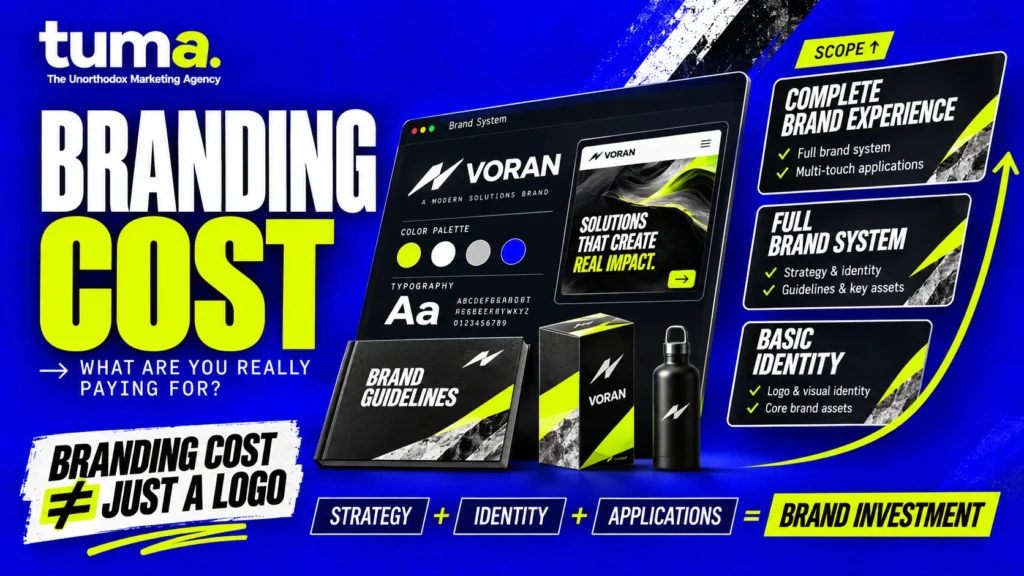
One branding proposal covers a logo suite, colors, and fonts. Another includes customer interviews, positioning, a messaging system, and a rollout across packaging, a website, and sales materials. Both may say “branding” at the top. Compare them line by line and the price difference starts to make sense.
The most useful way to estimate branding cost is to ask what your business needs to decide, what your team needs to use, and which customer-facing materials need to change.
How much does professional branding cost for a business?
Professional branding cost depends on scope. Upwork estimates 1,500–6,000 for a freelance visual identity system, while most agency branding projects reviewed by Clutch fall between $10,000 and $49,999. A basic identity may cover a logo, color, and typography. A broader engagement can add research, positioning, messaging, naming, full identity, guidelines, and launch applications. Rebranding can also require a separate rollout budget for the website, packaging, signage, or other materials.
Start with your business stage and branding need, then pick a project type. Define the research and strategy, followed by messaging, identity, and applications. Estimate implementation, then factor in the provider and timeline. That gives you a budget for the work you actually need.
Professional branding cost by project type
Use these USD figures to get oriented. Some are marketplace estimates and others are examples from individual providers. Quotes overlap because an extensive visual identity can take more production work than a compact strategy engagement.
| Project type | What you’re paying for | Indicative USD reference |
| Logo design | A wordmark, symbol, or combination mark with variants and production files | 150–800, an entry-to-intermediate freelance estimate from Upwork. |
| Basic visual identity | Logo system, color palette, typography, and core assets. Specify any guidelines or templates. | 1,500–6,000 in Upwork’s freelance guide. One studio lists 4,500–11,000 for an entry package with short guidelines and a social kit. |
| Strategic brand foundation | Discovery, positioning, messaging, visual identity, and guidelines | 5,000–8,000 is one provider’s reported range for most of its projects. Clutch’s broader reviewed agency band is 10,000–49,999 across mixed scopes. |
| Identity-led refresh | Audit existing design, refine the identity, and produce selected transition assets | 2,000–8,000, Upwork’s estimate for a freelance rebrand or refresh with a visual focus. |
| Full rebrand | Reassess positioning and messaging, rebuild the identity, and plan which materials change at launch | 27,000–63,000, one agency’s published repositioning package with selected applications and training. Price broader implementation separately. |
| Enterprise brand transformation | Portfolio decisions, multiple teams or markets, adoption, governance, and implementation | Bespoke. As an example of a complex consulting scope, San Leandro approved up to $150,000 for city branding work through an application plan. File #: 25-606 |
Two proposals may both list “research” while one includes a founder workshop and a competitor review and the other recruits customers, runs interviews, and tests competing positioning ideas. Ask what each team will actually do and which decisions that work will inform.
Branding cost versus logo design cost
A logo is part of the visual identity. Visual identity is part of branding.
A logo engagement might deliver a wordmark, a standalone symbol, light and dark versions, a small-format mark, and files for print and digital use. A visual identity adds rules for how the brand looks across contexts, such as type hierarchy, graphic elements, photography, and layouts. An identity might also include motion or illustration if those elements matter to the channels you use.
A branding engagement can also define who you serve, which category you compete in, what you promise, and why buyers should believe you. A logo gains meaning as customers repeatedly encounter it alongside a recognizable offer and experience. If buyers struggle to tell why they should choose you, include positioning and messaging in the brief.
What is included in professional branding?
A proposal should identify which of these components it covers and how far each one goes.
| Component | What it solves | What changes the cost |
| Brand audit | Identifies what to keep, clarify, or replace | Number of channels, assets, and customer perceptions reviewed |
| Research | Shows how customers describe their needs and evaluate options | Recruiting, interviews, surveys, markets, and analysis |
| Positioning | Defines the audience, competitive difference, and reason to believe | Number of segments, offers, and teams that need to align |
| Naming | Develops names for a business, product, or portfolio | Naming criteria, languages, screening, and legal coordination |
| Messaging and verbal identity | Establishes what to say, how to say it, and what evidence supports it | Audience groups, products, channels, and writing examples |
| Logo and visual identity | Creates recognizable assets and rules for using them | Concepts, responsive versions, imagery, illustration, and motion |
| Guidelines | Helps employees and partners apply the system correctly | Depth of instruction, templates, and approval rules |
| Applications | Puts the brand on real materials | Number of assets, formats, product variants, and languages |
| Rollout | Moves customers and teams onto the new brand | Migration, production, approvals, training, and sequencing |
Research, positioning, and messaging
Good research resolves a decision. A local service business might need a founder interview, a few customer conversations, and a review of nearby competitors. A SaaS business moving upmarket might need interviews with users, buyers, sales, and leadership to understand who decides, who uses the product, and what proof each group needs. A rebrand starts with an audit of the current identity, messaging, asset library, website, social channels, competitors, and customer perceptions.
Research → Insight → Positioning → Messaging → Identity
Positioning defines the audience, the competitive category, the difference that matters, and the evidence behind the value proposition. It can also define the brand promise, personality, and purpose where those help guide decisions. Messaging turns those choices into a hierarchy of claims and proof points for different audiences, products, and services. A tagline can sit within that system. Verbal identity makes it usable with voice, tone, vocabulary, and examples for web copy, ads, social, email, and sales collateral.
Naming, visual direction, and guidelines
Scope naming separately if you need it. The work can include naming criteria, name development, linguistic screening, domain research, and preliminary availability checks. For U.S. projects, the USPTO describes comprehensive clearance as searching multiple sources for similar marks. Budget separately for specialist searches, attorney review, filing fees, and any domain purchase.
Visual scope depends on use. A clear logo suite and type system might cover a consultancy’s site and decks. A consumer brand may also need illustration, art direction for photography, or rules for packaging across multiple products. A digital-first brand may specify logo animation, transitions, or reusable video titles. A custom shoot is a production line item unless the scope includes it.
Brand strategy records the choices behind positioning, messaging, and identity. A brand kit gives teams files such as logos, colors, and fonts. Brand guidelines explain how to use the system. A short guide can cover logo placement, color, and type. A broader brand book can show voice, photography, layouts, motion, templates, and who approves exceptions.
Also Read: What Is Branding? A Complete Guide for Brands
What drives the price of professional branding?
Professional branding can become expensive when one fee covers research, senior strategy, workshops, copywriting, creative exploration, production, revisions, and project management. Ask who will make each decision, which specialists are involved, and where the work will be tested. The value of research depends on the decisions it improves. The value of design depends on how well teams can use it.
- Stakeholders and feedback. A founder may approve work in one meeting. An established company may need input from leadership, marketing, product, legal, and regional teams. Name one approval owner, define the included revision rounds, and ask how a new direction after approval will be priced.
- Portfolio and market complexity. Brand architecture answers questions about how the masterbrand, sub-brands, products, and acquisitions relate. International work can add cultural research, linguistic checks, translation or transcreation, localized materials, and multilingual guidelines.
- Schedule and provider location. Tight deadlines may require parallel work and reserved staff. Provider rates can reflect local labor costs, seniority, specialist access, and overhead. Remote teams expand your options. Compare the proposed team, review schedule, and assumptions about turnaround alongside the fee.
How much does branding cost for a small business?
For a small business with a clear offer, Upwork’s 1,500–6,000 estimate for a freelance visual identity is a useful starting reference. It covers core design assets. If you need audience research, new positioning, or customer-facing copy, ask for those deliverables in the scope. One Ohio provider reports 5,000–8,000 for most of its branding projects, including strategy, messaging, identity, and guidelines. A website build or wider rollout needs its own scope. Upwork
| Business | Scope to put in the brief |
| Early startup | One priority audience, a clear value proposition, core messaging, a functional identity, and lightweight guidelines |
| Small service business | Service and pricing messages, visual identity, proposal templates, and consistency on priority web pages |
| Growing ecommerce or DTC brand | Identity, packaging rules and product variants, photography direction, and campaign templates |
| SaaS or established B2B | Positioning, buyer-specific messages, proof points, and an identity that works on the website, in decks, and in the product where relevant |
| Enterprise | Portfolio architecture, brand governance, market adaptation, and a staged rollout |
A minimum viable brand gives an early business enough to launch and operate consistently while it learns. Leave elaborate motion systems or dozens of templates until you know which channels and formats customers use. Too little scope can also create rework. If sales, marketing, and the website describe three different businesses, resolve the positioning before funding a visual update.
Choose a basic identity when the offer and audience are clear and you need launch assets. Choose strategic branding when the business needs clearer differentiation or consistent messaging across channels. Consider a full rebrand when the company has changed enough that its current brand misrepresents the offer, serves the wrong audience, or cannot accommodate expansion.
Brand refresh versus full rebrand
A refresh evolves assets people already know. It may refine a wordmark, update type and layouts, or make messaging clearer. A refresh can still be a significant project if the updated identity must work across dozens of product labels, locations, or digital interfaces.
A full rebrand can change the positioning, audience, messaging, name, identity, or architecture. Start by identifying what customers recognize now and where the current brand causes confusion. Then decide which elements to keep and which need to change. Rebrand cost = creation + transition + implementation. Budget for legacy files, packaging inventory, signs, digital migration, staff adoption, and customer communication.
Is rebranding risky?
Yes. A rebrand can weaken recognition, confuse existing customers, or create inconsistent experiences if channels launch out of sequence. Internal resistance can slow adoption. Keeping a brand that misrepresents the offer also has a cost. A strong rationale, an audit of existing brand equity, and a staged rollout help teams decide how much to change. For example, a retailer could preserve a recognizable packaging color while changing how product variants are named and organized.
Freelancer, studio, or branding agency?
| Provider | When the model can fit | What to confirm |
| Independent freelancer | You need focused strategy, messaging, design, or a compact identity and want direct access to the specialist | Scope breadth, any collaborators, capacity, and handoff |
| Small studio or boutique agency | You need strategy, writing, and design to work together for one brand or launch | Who leads each discipline, which applications are included, and any outsourced work |
| Larger agency or consultancy | You need research, portfolio coordination, multiple markets, or broad rollout support | Team seniority, regional capacity, project management, and which teams implement |
A specialist freelancer may have more relevant experience for your project than a generalist team. A larger agency may be equipped to coordinate many approvals and workstreams. Ask each shortlisted provider to show a comparable project, explain which strategic decision changed the work, and name the people you’ll work with.
How branding providers charge
- Hourly or day rate. Useful for advisory, audits, and open-ended support. Ask for a cap or spending checkpoints if the total is uncertain.
- Fixed project fee. Suits defined deliverables and review rounds. Specify how changes are approved and billed.
- Value-based pricing. The fee reflects the strategic importance of the problem, its potential commercial value, and the complexity involved. Ask for the deliverables and assumptions.
- Retainer. Reserves ongoing capacity for governance, campaign assets, and updates after launch. Check capacity, turnaround, and cancellation terms.
- Phased engagement. Commission research or strategy first, then scope identity and rollout once decisions are clear. Define what you receive at each approval point.
Implementation and hidden branding costs
A guideline that shows the logo on a box illustrates the system. A print-ready file for every box size and product variant takes production work. The same distinction applies to a homepage mockup and a live site. List each application you need and mark whether the provider will illustrate it, deliver editable files, produce it, or launch it.
| Budget line | Items to check |
| Launch applications | Social profile assets and templates, sales decks, stationery, email signatures, advertising templates, signage, and merchandise |
| Packaging | Label design, dielines, production files, required label-copy coordination, print proofs, and physical printing |
| Website and product | Site structure, user journeys, wireframes, interface design, copy, CMS, integrations, redirects, migration, testing, and launch |
| Third-party costs | Stock, type, photography, illustration, video, research incentives, trademark counsel, filing, and domain purchase |
| Adoption | Staff training, internal templates, product interfaces, regional versions, and the time to retire old materials |
Brand strategy defines who the business serves, what makes it distinct, and how it communicates. Website strategy turns that direction into a site structure, content hierarchy, and conversion paths. Ask for a separate line item for the website development scope so you can tell which online assets will be designed, built, and launched.
Clarify logo ownership and delivery of editable source files, production exports, and reusable templates. Confirm how you can use commissioned illustration, photography, and video. Font terms can vary by desktop, web, app, or enterprise use. Adobe Fonts, for example, says a client who needs to edit live text may need their own license. Review the licenses that apply to your team and channels.
How to compare branding proposals
Give each provider the same brief. Include the problem, priority audience, launch date, materials you need, and who approves the work. Then compare these points in writing.
- Research and strategy. Which interviews, audits, markets, positioning decisions, and messaging deliverables are included?
- Identity and applications. How many initial directions, logo versions, templates, packaging variants, and guidelines will you receive? Which mockups become production files?
- Revisions and timing. Who signs off at each stage? What counts as a revision? What happens if the direction changes after approval?
- Team and handoff. Who does the work? Which source files, ownership rights, and usage licenses transfer? Who trains your team?
- Total budget. What are the payment milestones, change fees, outside expenses, implementation obligations, and post-launch terms?
Imagine a new beverage brand comparing two quotes. Both show a bottle on a mockup. One covers a concept and one label design. The other covers production files for every initial flavor, coordination with the printer, and a reusable layout for future products. Compare the cost to get the same number of products on the shelf, including the work your team would otherwise do.
Is professional branding worth the investment?
It can be when it solves a business problem. If customers confuse your offer with a competitor’s, clearer positioning and proof may improve sales conversations. If each campaign requires a new design from scratch, a usable system can make ads, social posts, web pages, and decks faster to produce. If you’re still testing which audience wants your product, a lean foundation leaves room to change direction as you learn.
Distinctive colors, shapes, imagery, packaging, sound, or motion can help audiences recognize a brand through consistent use, distribution, and time. Recognition can contribute to brand equity, which can also take the form of familiarity, preference, loyalty, and perceived value.
Set a baseline before launch. Track customer recall, branded search, lead quality, sales feedback, website conversion, or production time according to the problem you set out to solve. Changes in media, pricing, and distribution complicate attribution. When testing a paid launch campaign, a controlled lift study can estimate the campaign’s effect on awareness or recall.
How TUMA thinks about branding investment
At TUMA, the work moves from strategy to identity to execution. For Meal on the Way, the name, cart-shaped wordmark, and visual language carried from physical materials into a digital subscription experience. The brand gave customers a recognizable experience, while the platform handled plan selection, checkout, and vendor routing.
Check Full Branding Meal on the Way case study TUMA
Marketing should deliver results. Start with the business problem, then fund the decisions, assets, and rollout that address it. If you’re planning a launch, refresh, or rebrand, tell us what’s changing and where customers will experience it.
Explore TUMA’s branding services
7. Frequently Asked Questions
How much should professional branding cost?
Upwork estimates 1,500–6,000 for a freelance visual identity system. Most agency branding projects reviewed by Clutch fall between $10,000 and $49,999 across mixed scopes. Set your budget around the strategy, identity, and implementation you need, then compare quotes for the same work.
How much does branding cost for a small business?
For a basic freelance visual identity, use 1,500–6,000 as a planning reference. An Ohio-based provider reports 5,000–8,000 for most of its projects, which typically include strategy, messaging, identity, and guidelines. Confirm whether your quote covers website copy, design, development, or launch materials.
Why is professional branding so expensive?
The fee can cover research, interviews, workshops, senior strategy, messaging, multiple creative concepts, design systems, reviews, and implementation. Ask which deliverables and types of expertise account for the price, and which your project needs.
What is included in a professional branding package?
A visual identity package may include logos, color, typography, and usage guidance. A strategic package may also include research, positioning, messaging, verbal identity, and launch templates. Confirm naming, website development, packaging production, and rollout in the written scope.
Is logo design the same as branding?
Logo design creates an identifying mark and its variations. Branding can also define the target audience, positioning, messaging, visual system, and how the business presents itself across customer touchpoints.
How much does rebranding cost?
Upwork estimates 2,000–8,000 for an identity-led freelance refresh. One agency publishes 27,000–63,000 for repositioning, identity, and selected launch applications. Price migration, production, and internal adoption based on the assets and locations you need to update.
Is rebranding risky?
Yes. Changing familiar assets or messages can reduce recognition or cause confusion, especially during a fragmented rollout. An audit, a clear reason to change, and a staged implementation plan help manage the risk.
What is the 3-7-27 rule in branding?
It’s an informal rule of thumb about how people might notice, remember, and come to trust a brand. Inside Brando describes three seconds for attention, seven exposures for recall, and 27 touchpoints for trust. Other versions count all three as interactions or assign different meanings. The sources offer no validated universal thresholds.
Should I hire a freelancer or a branding agency?
A freelancer can suit a focused assignment or a business that can coordinate specialists itself. A studio or agency can suit an engagement that requires several disciplines, extensive stakeholder alignment, or rollout support. Compare similar work, proposed staff, and ownership terms.
How long does professional branding take?
Timing depends on research, approvals, scope, and launch dependencies. As one published example, Mellon lists two to three weeks for its essentials package and eight to twelve weeks for its repositioning package. Ask for a milestone schedule that also shows client review time and implementation.