
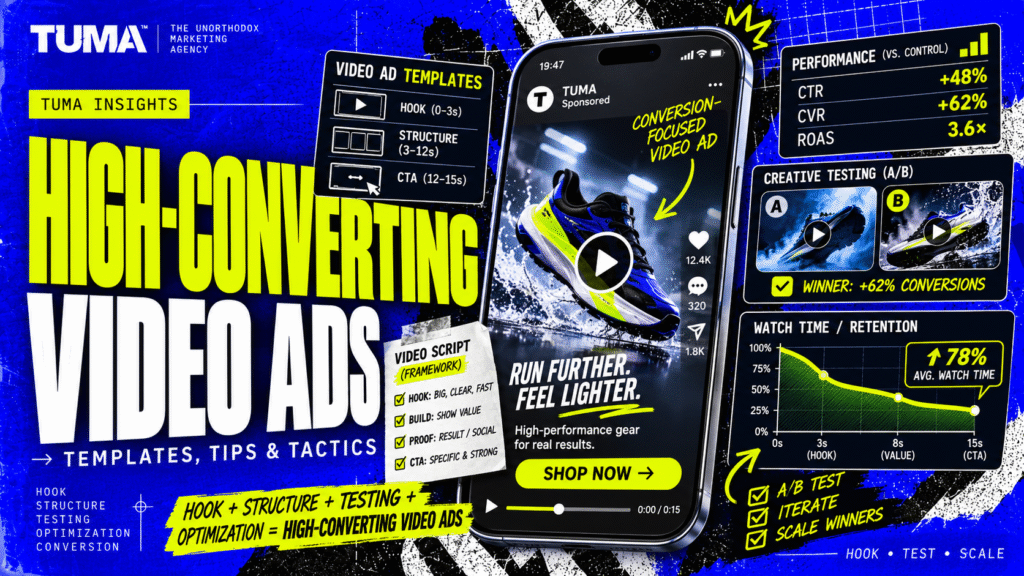
A high-converting video ad is not simply a video with a strong hook, fast cuts, engaging visuals, and a “Shop Now” button.
An advertisement can earn millions of views, generate thousands of clicks, and still fail to produce profitable customers.
Why?
Because attention and conversion are different outcomes.
A compelling video might attract the wrong audience. An effective product demonstration might lead to an unconvincing offer. A well-targeted campaign might lose potential customers on a confusing landing page.
That is why creating high-converting video ads requires more than good production or persuasive copywriting.
The creative must work alongside the audience, campaign objective, customer awareness, product, offer, advertising platform, and post-click experience.
For ecommerce brands, that might mean connecting product demonstrations with credible customer evidence and a frictionless checkout.
For SaaS companies, it might involve demonstrating a workflow problem, showing how the software addresses it, and encouraging qualified prospects to book a demo.
For service businesses, conversion-focused video advertising might prioritize trust, expertise, and a clear booking process.
The underlying principle is the same:
Audience + Concept + Proof + Offer + Execution + Platform + Post-Click Experience
This guide explains how to develop, produce, test, and improve video advertising that contributes to meaningful business outcomes.
What Does “High-Converting Ads” Mean?
High-converting ads are advertisements that effectively contribute to the specific business actions a campaign is designed to generate.
Those actions depend on the business model and campaign objective.
For an ecommerce brand, a conversion might be a purchase. For a SaaS company, it could be a free trial signup or demo booking. For a B2B service provider, it might be a qualified lead.
A campaign optimized for app installations has a different conversion objective from one focused on product purchases.
| Business type | Potential conversion events |
| Ecommerce | Purchase, checkout, add to cart |
| SaaS | Trial signup, demo booking, paid subscription |
| B2B | Qualified lead, consultation, form submission |
| Local service | Phone call, quote request, appointment |
| Subscription business | Subscription signup, paid membership |
| Mobile app | Install, registration, valuable in-app action |
Not all conversion events have equal commercial value. An add-to-cart event, for example, is not equivalent to a completed purchase.
Campaign Objective → Conversion Event → Relevant KPI
An advertisement should be judged against its intended outcome and the economics of achieving that outcome.
This means a high-converting ad is not automatically the one with the highest click-through rate, longest watch time, or greatest reach.
Its effectiveness is relative to the audience, offer, funnel stage, platform, product economics, and historical performance.
There is no universal conversion-rate benchmark that makes an advertisement successful for every business.
What Makes a Video Ad High-Converting?
High-converting video ads generally connect a relevant audience with a compelling creative concept, clear messaging, credible proof, a valuable offer, and an appropriate call to action. The video must fit its advertising platform and lead to a post-click experience that supports the promise. Continuous testing and performance measurement help determine which creative decisions contribute to conversions.
That relationship is more important than any single editing technique.
A practical conversion-oriented sequence is:
Hook → Hold → Message → Proof → Offer → CTA
However, the sequence only works when the wider campaign strategy makes sense.
A strong hook attracts attention. The message establishes relevance. Proof supports credibility. The offer creates a reason to act. The CTA tells the audience what to do next.
The landing page must then deliver on the advertisement’s promise.
The High-Converting Video Ad Framework
At TUMA, we approach performance creative as a connected system rather than an isolated production task.
A useful framework follows this sequence:
Business Objective → Customer Research → Audience & Awareness → Creative Hypothesis → Concept → Hook → Message → Proof → Offer → CTA → Production → Platform Adaptation → Launch → Measurement → Learning → Iteration
Each stage answers a different question.
The objective defines what success means.
Customer research identifies the motivations, problems, and objections that influence purchasing decisions.
Creative strategy transforms those insights into a persuasive concept.
Production communicates the concept through video, audio, copy, and editing.
Distribution places the creative in the appropriate advertising environment.
Measurement establishes what happened and what deserves further investigation.
Iteration uses those findings to inform the next creative decision.
This is why producing ten videos without a learning plan is not automatically more valuable than producing three carefully developed concepts.
The goal is not simply more advertising assets. It is better creative learning.
Start With the Campaign Objective
Before opening a script document or planning a shoot, determine what the campaign must accomplish.
Possible objectives include brand awareness, product education, consideration, lead generation, app installs, demo bookings, direct sales, retargeting, and retention.
Different objectives call for different communication.
An awareness campaign may introduce the product category, brand, or customer problem.
A product-education campaign may require demonstrations and explanations.
A retargeting campaign may focus on objections, comparisons, reviews, or a relevant offer.
A direct-sales campaign may need stronger product proof and a clear purchase path.
Business Goal → Campaign Objective → Creative Approach → KPI
A short, offer-led product video may be appropriate for an audience already familiar with the brand.
The same video might provide insufficient context for someone who has never encountered the product.
Campaign objectives should therefore shape the creative brief before production starts.
Understand the Audience Before Writing the Hook
A creative concept becomes more relevant when it is based on actual customer understanding.
Research should identify what the audience wants, what frustrates them, which alternatives they consider, and what prevents them from purchasing.
Useful research sources include:
- Customer reviews and support conversations
- Interviews with customers and sales teams
- CRM records and first-party analytics
- Search queries and customer language
- Competitor reviews and product comparisons
- Social listening and community discussions
- Previous advertising performance
- Landing-page behavior and conversion feedback
Suppose an ecommerce brand sells premium luggage.
Its team might initially assume customers care most about appearance.
Customer interviews may reveal that durability, organization, and ease of movement are stronger purchase motivations.
That insight changes the creative direction.
Instead of filming only cinematic lifestyle footage, the team could demonstrate practical packing features, wheel movement, and product construction.
Customer Insight → Creative Angle
Real behavioral evidence and customer feedback should take priority over unsupported assumptions about fictional buyer personas.
Match Creative to Customer Awareness
Customer awareness influences how much explanation a video advertisement needs.
A useful copywriting framework divides audiences into five awareness stages. These are practical messaging categories, not a universal scientific classification.
| Awareness stage | Audience situation | Suitable messaging |
| Unaware | Does not recognize the problem | Relevant situation or insight |
| Problem aware | Recognizes the problem | Frustration, consequence, desired outcome |
| Solution aware | Knows solution categories exist | Mechanism, differentiation, comparison |
| Product aware | Knows the product but has not decided | Proof, objections, suitability |
| Most aware | Understands the offer and may be ready | Availability, specific incentive, CTA |
For example, a problem-aware customer might respond to a video demonstrating a common workflow frustration.
A solution-aware customer may need to understand why one software approach differs from another.
A product-aware customer might benefit from a walkthrough, case study, or comparison.
A most-aware customer may need a clear offer or reminder.
Awareness Stage → Message → Creative
Effective creative speaks to what customers currently understand rather than expecting every viewer to begin at the same point.
Creative Concept vs Creative Angle: What’s the Difference?
These terms are related but serve different purposes.
Creative Concept
The central idea that organizes the advertisement.
For a travel brand, a concept might be: “An experience is more memorable than another ordinary gift.”
That idea can support multiple executions.
Creative Angle
The persuasive perspective used to communicate the concept.
Potential angles include problem, benefit, demonstration, comparison, objection, testimonial, founder perspective, use case, aspiration, social proof, and education.
Using the travel example:
- Emotional angle: Give someone a memory worth keeping.
- Convenience angle: Find an experience gift without complicated planning.
- Comparison angle: Compare a physical gift with an experience.
- Practical angle: Demonstrate how the booking or redemption process works.
The concept creates cohesion. The angle determines the argument.
Customer Insight → Concept → Angle → Execution
This distinction helps teams develop meaningful variations instead of creating several nearly identical videos.
Build a Creative Hypothesis Before Testing
Performance creative becomes more useful when every important test is connected to a question.
Consider this hypothesis:
A problem-first creator video will generate stronger early attention among problem-aware prospects than a feature-first studio video.
A useful test brief should define four elements.
Variable: Problem-first versus feature-first opening.
Audience: The same defined audience or comparable randomized groups.
Measurement: Early retention, CTR, and the relevant conversion outcome.
Decision: Determine whether the opening deserves further development, replacement, or additional testing.
An attention improvement does not necessarily establish a conversion improvement.
If the problem-first video holds viewers longer but generates weaker qualified leads, the team should investigate the relationship between its opening, message, and offer.
Hypothesis → Test → Data → Learning
The objective is not to produce a winner at any cost. It is to learn what the audience responds to and whether that response contributes to business results.
How to Write a High-Converting Video Ad Hook
A hook is the opening element intended to earn continued attention.
It may be a spoken line, visual action, question, demonstration, unexpected comparison, or recognizable customer problem.
The opening must communicate relevance quickly.
However, there is no universal rule that every advertisement has exactly three seconds to succeed.
The available attention window depends on the platform, placement, audience, message, and viewing context.
10 Practical Video Ad Hook Templates
| Hook type | Example template |
| Problem | “Still struggling with [problem]?” |
| Benefit | “Here’s how to [outcome] without [frustration].” |
| Demonstration | Immediately show the product performing its main function |
| Contrarian | “Most people misunderstand [topic].” |
| Comparison | “Here’s the difference between [option A] and [option B].” |
| Objection | “You don’t necessarily need [assumption] to achieve [goal].” |
| Social proof | “Here’s why [customer group] chose [solution].” |
| Founder | “We built this because [specific unresolved problem].” |
| Question | “What if [desired outcome] were easier?” |
| Visual | Begin with a surprising but relevant product action |
These hooks are creative starting points, not proven universal winners.
The right hook should establish genuine relevance and lead naturally into the advertisement’s message.
Hook Rate and Early Attention
Teams may monitor hook rate, early video retention, three-second view rate, and hold rate.
For internal analysis, a team might define hook rate as:
3-Second Video Views ÷ Video Starts × 100
However, this is an operational definition, not a universal platform-standard metric. View definitions and reporting denominators may vary.
Early retention can indicate whether the opening earns continued viewing.
It cannot independently establish purchase intent or profitability.
Opening → Attention → Continued Viewing
How to Hold Attention After the Hook
A strong opening creates an expectation.
The middle of the advertisement must reward it.
If the hook promises to demonstrate a product, show the product.
If it introduces a customer problem, explain the problem and how the solution addresses it.
If it challenges an assumption, provide a credible explanation.
Effective middle sections often combine message progression, visual evidence, product relevance, and objection handling.
Avoid filling the video with unrelated transitions merely to increase movement.
Fast editing cannot permanently disguise an unclear argument.
The creative should move viewers toward understanding, not simply keep them watching.
10 High-Converting Video Ad Templates
The following structures can help teams develop conversion-focused video advertising for different audience needs.
These are strategic templates, not guaranteed formulas. The examples are illustrative and should be adapted using real product information and substantiated evidence.
Template 1: Problem → Solution → Proof → CTA
Best suited for: Problem-aware audiences.
- Hook: Identify a familiar problem.
- Solution: Introduce the relevant product or service.
- Proof: Demonstrate how it addresses the problem.
- CTA: Invite the next appropriate action.
Example: “Tired of tangled charging cables?” Show a cable-organizing product in use, demonstrate the practical improvement, and direct viewers to the product page.
Template 2: Hook → Product Demo → Benefit → Proof → Offer
Best suited for: Products whose value becomes clearer through demonstration.
Open with the product in action, explain its practical benefit, support the claim with evidence, then introduce the purchase offer.
The demonstration should show actual capabilities rather than exaggerated outcomes.
Template 3: Testimonial → Problem → Experience → Result → CTA
Best suited for: Brands with genuine customer evidence.
A real customer describes the original problem, explains their experience, and shares an accurate outcome before the CTA.
Obtain appropriate permission and disclose relevant material relationships.
Template 4: Before → After → Mechanism → Offer
Best suited for: Products with demonstrable transformations.
Show a truthful comparison, explain what creates the difference, and connect it to the offer.
Before-and-after claims must be representative or appropriately qualified and supported.
Template 5: Founder Hook → Problem → Why We Built It → Product → CTA
Best suited for: Founder-led brands and differentiated products.
The founder explains the customer problem that motivated the product, demonstrates the solution, and invites the audience to learn more.
This can communicate credibility when the story is genuine and relevant.
Template 6: Comparison → Difference → Proof → CTA
Best suited for: Competitive categories and solution-aware audiences.
Compare alternatives using fair, verifiable criteria.
For example, a software advertisement might compare workflow steps or features rather than make unsupported superiority claims.
Template 7: Objection → Explanation → Evidence → Offer
Best suited for: Consideration and retargeting.
Address a genuine purchase barrier, explain the relevant product characteristic, support it with proof, and present the appropriate next step.
Template 8: Myth → Truth → Demonstration → CTA
Best suited for: Educational advertising.
Identify a common misconception, correct it accurately, demonstrate the practical implication, and connect it to the product.
The educational message should remain relevant to the offer.
Template 9: UGC Problem-Solution
Best suited for: Creator-led advertising and social-first content.
Creator Hook → Problem → Discovery → Demonstration → Experience → CTA
The delivery may be conversational, but the underlying sequence should remain purposeful.
Do not fabricate product experiences or disguise paid actors as independent customers.
Template 10: Feature → Benefit → Outcome → Proof → CTA
Best suited for: Products with distinct functional advantages.
Begin with a meaningful feature, explain its practical benefit, and connect it to an outcome the customer values.
For example, a luggage compartment is a feature. Easier packing is a benefit. Reduced travel frustration is a possible customer outcome.
Use demonstrations or credible evidence to support the connection.
Script, Storyboard, and Shot List: Plan Before Production
Three planning documents help transform a creative concept into an executable advertisement.
Script
The script determines what the advertisement communicates.
It may include dialogue, voiceover, on-screen text, proof points, offer details, and a CTA.
A simple message hierarchy is:
Hook → Development → Proof → Offer → CTA
Not every ad needs word-for-word dialogue.
Creator-led videos often benefit from talking points, interview prompts, and structured improvisation.
Storyboard
A storyboard explains how the message unfolds visually.
It maps scenes, camera perspectives, product demonstrations, graphics, and transitions.
Shot List
A shot list identifies the footage needed.
This may include creator talking-head footage, product close-ups, packaging, screen recordings, B-roll, lifestyle scenes, and CTA frames.
Planning these assets supports efficient production and provides additional footage for future creative variations.
Add Proof Before Asking for the Conversion
Persuasive advertising makes claims. Credible advertising supports them.
Claim → Evidence → Credibility
Proof can appear through product demonstrations, genuine customer testimonials, reviews, documented case studies, expert explanations, accurate screenshots, and verifiable product information.
The appropriate evidence depends on the claim.
A product demonstration may establish how something works.
A customer review may provide evidence of an individual’s experience.
A case study may explain a business outcome within its specific context.
An expert endorsement should reflect genuine expertise and follow applicable disclosure requirements.
Proof must not be invented, manipulated into misleading conclusions, or presented as more representative than it is.
A paid creator acting in a fictional scenario should not automatically be portrayed as a real customer providing genuine testimony.
Handle Customer Objections Inside the Creative
Prospects may understand the product but hesitate because of price, trust, effectiveness, usability, product fit, switching costs, or perceived risk.
Objection-led creative addresses those concerns directly.
For example, a SaaS company might discover that prospects worry about difficult onboarding.
An advertisement could demonstrate the actual setup process and explain available support.
A premium ecommerce brand might address price concerns by demonstrating product materials, construction, durability, or a relevant warranty.
The goal is not to manipulate the audience into overlooking concerns.
It is to provide information that makes the decision easier.
Objection → Evidence → Reassurance → CTA
This approach can be especially useful for consideration-stage audiences and retargeting campaigns.
Offer vs CTA: What’s the Difference?
The offer and call to action perform different jobs.
The Offer
The offer defines what the customer receives and under which conditions.
It may include a product, bundle, discount, subscription, trial, consultation, bonus, or other value proposition.
The Call to Action
The CTA tells the customer what to do next.
Examples include Shop Now, Learn More, Book a Demo, Start Free Trial, Request a Quote, and Download Guide.
Message + Offer → CTA
A strong CTA cannot rescue an offer that customers do not value.
Offer quality may depend on price, product benefits, discounts, delivery terms, availability, guarantees, and perceived risk.
Strong Creative + Weak Offer → Limited Conversion Potential
Conversion optimization sometimes requires changing the underlying proposition rather than rewriting the final button.
UGC vs Polished Video Ads: Which Works Better?
User-generated content and professionally produced advertising are often treated as opposites.
That comparison is too simplistic.
UGC-style advertising may use conversational delivery, creator footage, familiar social formats, and demonstrations that resemble ordinary platform content.
Polished video advertising may use professional lighting, controlled environments, art direction, cinematic visuals, or advanced motion graphics.
Both can communicate effectively.
| Factor | UGC-style video | Polished video |
| Production approach | Often creator-led | Often controlled production |
| Speed | Can be faster to produce | Depends on complexity |
| Creative control | May be more conversational | Usually more controlled |
| Brand consistency | Requires guidance | Easier to standardize |
| Social proof | Useful with authentic experiences | Can also feature testimonials |
| Product demonstration | Frequently effective | Frequently effective |
| Premium presentation | Depends on execution | Often suitable |
| Testing variations | Can support rapid iteration | Can support planned variants |
Authenticity ≠ low production quality.
Polish ≠ poor performance.
A smartphone video can communicate a product clearly. A professional production can still feel credible, human, and relevant.
The important question is whether the execution matches the brand, audience, platform, and objective.
How Much Production Quality Do You Really Need?
More expensive production does not automatically produce better advertising performance.
A founder explaining a simple customer problem may only need clear audio, appropriate lighting, and a smartphone.
A complex physical product may require professional demonstrations.
A premium brand campaign may benefit from more controlled art direction and visual storytelling.
The appropriate production quality follows the creative concept.
Production Fit > Production Cost
Budget should be allocated according to what the advertisement needs to communicate, not according to the assumption that expensive footage is always more persuasive.
Editing Video Ads for Clarity and Retention
Editing influences how effectively viewers receive the message.
Relevant techniques include pacing, transitions, B-roll, close-ups, captions, graphics, sound design, music, and visual emphasis.
The objective should be:
Clarity + Momentum + Message Delivery
A quick product demonstration may benefit from concise editing.
A thoughtful customer testimonial might require longer uninterrupted statements.
There is no universal requirement to change shots every few seconds.
Pacing should preserve attention without sacrificing comprehension.
Captions and Text Overlays
Use readable captions, sufficient contrast, clear typography, and sensible text placement.
Important information should remain understandable when audio attention is limited.
Captions also support accessibility, particularly when spoken content is central to the message.
Where appropriate, ensure meaningful visual information is communicated accessibly as well.
Music and Audio
Voice clarity should generally take priority when dialogue conveys the main message.
Music and sound effects should reinforce the concept without overwhelming speech.
Confirm that the intended advertising use is covered by the relevant music, voice, stock footage, and sound licenses.
Royalty-free does not necessarily mean free, unrestricted, or approved for every commercial placement.
Performance Creative Should Still Build Brand Memory
Conversion-focused advertising should not abandon brand identity.
Recognizable branding can help connect multiple ads to the same company.
Useful brand signals include product appearance, packaging, distinctive colors, typography, visual style, motion, tone of voice, and sonic cues.
A logo is only one possible brand asset.
For example, a DTC beverage company might consistently use recognizable packaging, product presentation, and visual treatments across creator videos, static ads, and professionally produced campaigns.
Individual executions can change without making the brand unrecognizable.
Performance creative should build both immediate relevance and recognizable brand associations where appropriate.
High-Converting Meta Ads: What Matters?
Meta advertising includes placements across Facebook and Instagram, such as Feeds, Stories, and Reels.
High-converting Meta ads are not defined by one visual format.
Performance depends on the relationship between audience relevance, campaign objective, concept, offer, placement, landing-page experience, and measurement.
Important creative considerations include:
- Communicating the product or message clearly
- Making key visuals readable on mobile screens
- Using relevant demonstrations and proof
- Developing meaningful concept and format variations
- Adapting composition to the chosen placement
- Testing creative against appropriate business KPIs
Meta campaigns can use video, static images, carousels, testimonials, and creator-led formats.
A vertical creative designed for Reels should account for interface elements and placement-specific safe zones.
Feed creative may require different framing and visual hierarchy.
Avoid assuming that placing the same file across every placement creates an equally effective experience.
High-Converting Facebook Ads: Is There a Best Format?
There is no universally best Facebook advertising format.
A product demonstration may communicate complicated functionality more effectively than a single image.
A clear static offer may be sufficient for a familiar product.
A carousel may allow customers to explore several features or items.
A customer testimonial may address trust or uncertainty.
The format should follow the message.
Highest Converting = Account-Specific Winner, Not Universal Format
The most useful examples of high-converting Facebook ads are those supported by context: what the brand offered, who the audience was, which conversion was measured, and how the creative performed against a relevant baseline.
TikTok and YouTube: Adapt the Creative to the Platform
Platform Behavior → Creative Language
On TikTok, vertical creator-style advertising can fit naturally with short-form viewing behavior. Demonstrations, conversational storytelling, and platform-aware editing may be suitable when they serve the message.
TikTok’s June 2026 auction In-Feed specifications recommend 9:16 vertical creative for Non-Spark Ads, while supporting other aspect ratios. Safe-zone requirements depend on the asset and interface elements.
YouTube supports several advertising experiences, including skippable in-stream, non-skippable in-stream, in-feed, bumper, and Shorts ads.
A video intended for Shorts should be developed for vertical viewing and rapid comprehension. An in-stream advertisement may require a different opening and narrative structure.
Google’s current creative specifications recommend 9:16 vertical assets for Shorts and 16:9 horizontal assets for standard in-stream placements.
These are format recommendations, not guarantees of performance. Exact technical limits depend on campaign type and placement.
Platform-native does not mean trend-chasing.
It means understanding how people experience content in that environment and adapting communication accordingly.
High-Converting Static Ads and Image Ads
Video is not the only format capable of producing conversions.
High-converting static ads can communicate a compelling offer quickly, particularly when the product, benefit, or message is straightforward.
Common static and image-ad structures include:
- Product + Primary Benefit
- Problem + Solution
- Genuine Testimonial Quote
- Product Comparison
- Offer-Led Creative
- Accurate Before-and-After Comparison
- Feature + Customer Outcome
A useful image-ad framework is:
Visual → Message → Proof / Offer → Action
Strong visual hierarchy, readable typography, recognizable branding, and message clarity matter more than decorative complexity.
Video Ads vs Static Ads: Which Converts Better?
| Factor | Video ads | Static ads |
| Storytelling | Can develop a narrative over time | Relies on visual shorthand |
| Product demonstration | Shows operation and movement | Uses still imagery |
| Production effort | Often higher | Often lower |
| Testing speed | Depends on editing and assets | Often easier to vary quickly |
| Motion and sound | Available | Not available |
| Simple offers | Effective with concise execution | Often efficient |
| Complex explanations | Can show multiple steps | May require several images or a carousel |
| Platform suitability | Strong in video placements | Strong across suitable image placements |
Video is not automatically better than static.
A diversified creative portfolio might include video, static images, creator content, branded creative, carousels, demonstrations, testimonials, and founder-led messaging.
Creative Diversity > Format Dependence
7 High-Converting Video Ads Examples by Industry
The following are hypothetical creative examples designed to illustrate how different businesses can connect audience insight, creative execution, and conversion objectives.
They are not reported campaigns or claims of achieved performance.
| Industry | Audience and problem | Creative format | Hook | Proof and offer | CTA |
| DTC skincare | Customers uncertain which product fits their routine | Product demonstration | “Not sure where this fits in your routine?” | Accurate usage demo and product information | Explore the Product |
| SaaS | Teams struggling with repetitive tasks | Screen recording | “Still copying the same information between tools?” | Demonstrate actual workflow functionality; trial where offered | Start Free Trial |
| Travel | Customers seeking experience gifts | Lifestyle / creator video | “What if the best gift wasn’t another thing?” | Real experience footage and verified booking details | Explore Experiences |
| Local service | Homeowners seeking a reliable provider | Service walkthrough | “Need help with [specific service problem]?” | Real team, work examples, service details | Request a Quote |
| B2B service | Decision-makers facing a costly workflow challenge | Expert-led video | “Where is your process losing time?” | Practical insight and documented evidence | Book a Consultation |
| Ecommerce accessory | Shoppers uncertain about product usefulness | Feature-to-benefit demo | “See how this organizer fits into everyday travel.” | Show dimensions, use, and relevant features | Shop Now |
| Subscription product | Buyers worried about commitment or value | Objection-led explanation | “How does this subscription actually work?” | Explain real plan terms, benefits, and cancellation conditions | View Plans |
These examples show why effective creative depends on audience awareness, product complexity, and the action being requested.
A local service advertisement should not automatically use the same script as a DTC product campaign.
A SaaS demo may require more explanation than a simple ecommerce accessory.
Templates help organize the message, but the actual creative must reflect the business.
Connect the Ad to the Landing Page
One of the most overlooked parts of video advertising happens after the click.
Ad Promise → Click → Landing Page → Offer → Checkout / Form → Conversion
Imagine a video advertisement promoting a product bundle.
The audience clicks expecting to see the advertised bundle, but the destination displays a generic homepage.
Visitors must search for the product, locate the offer, and confirm the terms.
Every unnecessary step introduces friction.
Message match means keeping the advertisement and destination aligned across the headline, product, primary benefit, price, offer, proof, and CTA.
A good post-click experience should make the promised next step easy to understand and complete.
For lead generation, the form should request information appropriate to the objective.
For ecommerce, relevant factors may include product information, pricing clarity, delivery details, mobile usability, checkout complexity, and trust signals.
A high-performing video cannot indefinitely compensate for a poor landing page or uncompetitive offer.
Video Ad Metrics That Actually Matter
Video advertising requires more than one measurement.
Some metrics describe attention. Others indicate traffic quality, conversions, or business economics.
| Metric | What it helps evaluate |
| Reach | Number of people reached |
| Impressions | Total ad exposures |
| Hook rate | Early attention under a defined calculation |
| Hold rate | Continued viewing under a defined calculation |
| Watch time | Viewing duration |
| VTR | Video viewing or completion behavior, depending on platform definition |
| CTR | Clicks relative to impressions |
| CPC | Advertising cost per click |
| Conversion rate | Conversions relative to the selected denominator |
| CPL | Cost per lead |
| CPA | Cost per defined action or acquisition |
| CAC | Broader cost of acquiring a customer |
| Revenue | Sales value generated or attributed |
| ROAS | Attributed revenue divided by advertising spend |
Hook rate, hold rate, video views, and VTR can differ in definition across advertising platforms and reporting tools.
Always verify the reporting methodology before comparing performance.
Match KPIs to Campaign Objectives
| Objective | Relevant KPIs |
| Awareness | Reach, frequency, video viewing, brand lift |
| Consideration | Watch time, product views, qualified site visits |
| Lead generation | Leads, qualified leads, CPL, lead-to-customer rate |
| Sales | Purchases, CPA, CAC, revenue, ROAS |
| Profitability | Contribution margin, acquisition economics, customer value |
CTR Does Not Equal Conversion
A high click-through rate may indicate curiosity, relevance, or an attractive offer.
It may also reflect an opening that generates interest without attracting qualified customers.
Attention ≠ Conversion
That is why CTR should be evaluated alongside downstream behavior.
CPA vs CAC
CPA measures the cost of a defined action. Depending on campaign settings, that action might be a lead, signup, purchase, or another conversion.
CAC generally represents broader customer acquisition economics and may include media costs, agency fees, sales costs, and other acquisition expenses according to the company’s accounting method.
The two should not be treated as automatically interchangeable.
ROAS vs Profitability
ROAS is calculated as:
ROAS = Attributed Advertising Revenue ÷ Advertising Spend
A ROAS greater than 1 means attributed revenue exceeds media spend.
It does not automatically mean the campaign is profitable.
Profitability may also depend on product costs, gross margin, shipping, discounts, refunds, payment processing, fulfillment, creative production, agency fees, and other expenses.
A brand should understand its own contribution margin and allowable acquisition costs before deciding whether a campaign is economically successful.
How to Diagnose Why a Video Isn’t Converting
Performance metrics become more useful when interpreted as diagnostic signals.
| Performance signal | What to investigate |
| Weak early attention | Opening, relevance, visual clarity, audience |
| Strong hook but weak retention | Message progression, pacing, unmet curiosity |
| Strong watch time but low CTR | CTA, offer, audience intent, clarity |
| Strong CTR but low landing-page conversion | Message match, price, usability, offer |
| Good conversion rate but high CPA | CPC, audience costs, auction conditions |
| Good CPA but weak profitability | Gross margin, CAC, refunds, other costs |
| Performance declining over time | Creative fatigue, competition, seasonality, tracking |
These patterns identify possible causes, not definitive diagnoses.
For example, weak CTR might reflect an unconvincing offer rather than a poor hook.
High CPC may reflect competitive auction conditions rather than bad creative.
A useful diagnostic process compares multiple metrics and examines where the customer journey begins to break down.
How to Test High-Converting Ads
Creative testing should turn uncertainty into evidence.
A useful framework is:
Research → Hypothesis → Test → Data → Learning → Iteration
Before testing, define what is being compared and why.
Possible test variables include:
- Creative concept and persuasion angle
- Opening hook and first frame
- Evidence and objection handling
- Product demonstration
- Offer and CTA
- Creator or presenter
- Video format and length
- UGC-style versus polished execution
- Static versus video
- Editing and pacing
A/B Testing vs Creative Testing
Classical A/B testing aims to isolate the effect of a specific variation.
For example, two versions might use the same creative except for the opening line.
Creative testing can also compare substantially different concepts to explore which strategic approach resonates.
Both approaches are useful.
A controlled test supports clearer attribution. Exploratory tests can uncover larger creative opportunities.
Controlled Testing + Practical Creative Exploration
Creative Test vs Audience Test
A creative test compares different creative executions while holding the audience and other important conditions as consistent as practical.
An audience test compares different audiences using the same creative.
Changing the audience, offer, video, and landing page simultaneously makes it harder to identify the cause of a performance difference.
When broad exploration is necessary, record the changes and avoid making unsupported causal claims.
What Should You Test First?
A useful starting hierarchy is:
- Creative concept
- Persuasive angle
- Hook
- Proof
- Offer
- Format
- Creator
- CTA
- Editing details
This is guidance, not a fixed rule.
If customer research reveals that pricing is the largest barrier, testing the offer may be more useful than developing another hook.
Tests should run under conditions that provide sufficient, relevant evidence. Avoid drawing strong conclusions from very small samples or unstable measurement.
How to Iterate Winning Video Ads
When a video performs well, the next step is understanding why.
Winner → Diagnose Why → Create Meaningful Variations
Suppose a product demonstration generates stronger qualified purchase behavior than a lifestyle concept.
The team could investigate whether the improvement relates to clarity, evidence, audience awareness, or offer alignment.
Possible iterations include a new hook, different creator, revised demonstration, additional proof, alternative format, or new objection.
Do not simply duplicate the same winner indefinitely.
The goal is to build a creative system that can continue learning and adapting.
Creative Fatigue: When Should You Refresh Ads?
Creative fatigue describes a situation where an advertisement may become less effective after repeated exposure.
Potential indicators include declining engagement, lower CTR, weakening conversion performance, or increasing acquisition cost alongside sustained exposure.
However, performance decline is not automatically creative fatigue.
Other explanations include seasonality, competition, audience changes, tracking errors, landing-page problems, and offer relevance.
A useful operating sequence is:
Launch → Learn → Scale → Monitor → Refresh
There are four practical refresh levels.
Hook refresh: Keep the concept but change the opening.
Execution refresh: Keep the idea but change the creator, visuals, or editing.
Angle refresh: Present a different persuasive perspective.
Concept refresh: Develop a new central creative idea.
The size of the refresh should match the problem diagnosed.
How Long Should a High-Converting Video Ad Be?
There is no universal ideal length.
A video should be as long as necessary to communicate the idea effectively, but no longer than the creative can continue earning attention.
A simple product demonstration may require little explanation.
An unfamiliar product or complex B2B solution may need more context.
Placement specifications also matter.
For example, YouTube bumper advertisements are a short, non-skippable format, while other YouTube placements can accommodate longer creative.
The right length should be informed by the message, awareness stage, viewing context, and performance data.
Do not cut essential information merely to satisfy an arbitrary duration.
Can AI Create High-Converting Video Ads?
AI can assist with many stages of video advertising production.
Potential applications include customer-research synthesis, concept exploration, script drafting, storyboarding, voice generation, visual asset generation, editing assistance, captions, localization, and creative versioning.
AI can make production workflows more efficient.
However, producing more assets does not automatically improve their strategic relevance.
Risks include generic messaging, inaccurate claims, unrealistic product representations, inconsistent branding, unclear usage rights, and misleading synthetic endorsements.
AI-generated footage should not fabricate product capabilities or imply that a fictional customer experience genuinely occurred.
Human review remains important for factual accuracy, creative judgment, originality, brand consistency, and compliance.
AI can accelerate execution. It does not replace customer insight, strategy, taste, testing, or human judgment.
Rights, Compliance, and Accessibility
Conversion-focused creative must also be responsibly produced.
Before publishing, review:
- Creator and talent usage rights
- Model releases and third-party permissions
- Music and stock-footage licensing
- Accuracy of product claims
- Testimonials and endorsements
- Paid sponsorship disclosures
- Before-and-after representations
- AI-generated people, voices, and product depictions
- Applicable advertising and platform policies
- Captions, readability, and accessibility
In the United States, FTC guidance requires material relationships in endorsements to be disclosed clearly when applicable. Disclosures should be difficult to miss; placing them only in a video description may be insufficient.
Other markets have their own advertising requirements.
Legal and platform review should be appropriate to the campaign’s target markets and product category.
Common Mistakes That Prevent Video Ads From Converting
Several recurring problems can undermine otherwise strong creative.
Starting production before strategy: The team creates an attractive video without understanding the audience or objective.
Targeting everyone: Messaging becomes too broad to communicate a compelling reason to act.
Weak concept: Editing attempts to compensate for an unconvincing central idea.
Hook without payoff: The opening attracts viewers but fails to deliver what it promises.
Feature dumping: The audience hears specifications without understanding their practical value.
Missing proof: Claims remain unsupported, reducing credibility.
Weak offer: The creative creates interest without sufficient perceived value.
Confusing the offer with the CTA: The advertisement explains what to click but not why the action is worthwhile.
Multiple competing CTAs: The viewer receives unclear instructions.
Overproducing platform-native creative: The execution becomes less suitable for the intended viewing environment.
Assuming UGC always wins: The brand ignores its audience, positioning, and product needs.
Assuming video always beats static: The team overlooks simpler formats that may communicate efficiently.
Ignoring brand identity: Every advertisement looks and sounds like a different business.
Copying competitors: The brand imitates execution without understanding the strategy or evidence behind it.
Optimizing only for CTR: Attention metrics replace commercial objectives.
Ignoring the landing page: The ad promise and conversion experience become disconnected.
Treating ROAS above 1 as profitability: Product costs and broader acquisition expenses are overlooked.
Testing without hypotheses: Many variables change without generating useful learning.
Scaling without monitoring: Strong initial results are assumed to continue indefinitely.
Using outdated platform specifications: Creative is cropped, obscured, rejected, or poorly adapted.
Ignoring usage rights: Creator, music, footage, or AI-related permissions are not established.
Using AI purely for volume: More variations are produced without stronger insight or quality control.
These mistakes share one underlying problem: treating advertisements as isolated creative assets rather than parts of a conversion system.
How TUMA Approaches High-Converting Creative
At TUMA, we believe creative advertising should connect audience understanding with business objectives.
We don’t just make content; we create culture.
But attention is only part of the job.
Our creative-performance approach brings together creative strategy, video production, UGC-style content, paid social creative, editing, performance insights, and brand consistency.
The objective is to develop ideas worth testing, produce assets suited to their platforms, and use relevant performance feedback to improve subsequent creative decisions.
Sometimes that calls for a creator-led product demonstration.
Sometimes it requires an ambitious branded campaign.
Sometimes the biggest opportunity is not another video, but a clearer message, stronger offer, or more relevant creative angle.
The goal is not to make more ads. The goal is to produce better creative learning.
Because the creative should earn attention for a reason.
Marketing should deliver results.
Conclusion: High-Converting Video Ads Are Built, Tested, and Improved
Creating high-converting video ads is not about discovering one perfect hook, editing style, or advertising template.
It begins with understanding the business objective and customer.
It requires the right creative concept, message, proof, offer, and execution.
It depends on choosing suitable advertising platforms and creating a post-click experience that supports conversion.
And it improves through testing, measurement, and informed iteration.
Creative + Audience + Offer + Landing Page + Media Strategy → Campaign Performance Opportunity
A video that gets attention has completed only the first part of the job.
The more useful question is whether that attention reaches the right people, influences the intended action, and supports sustainable business outcomes.
That is the difference between simply making video ads and building performance creative that works.