
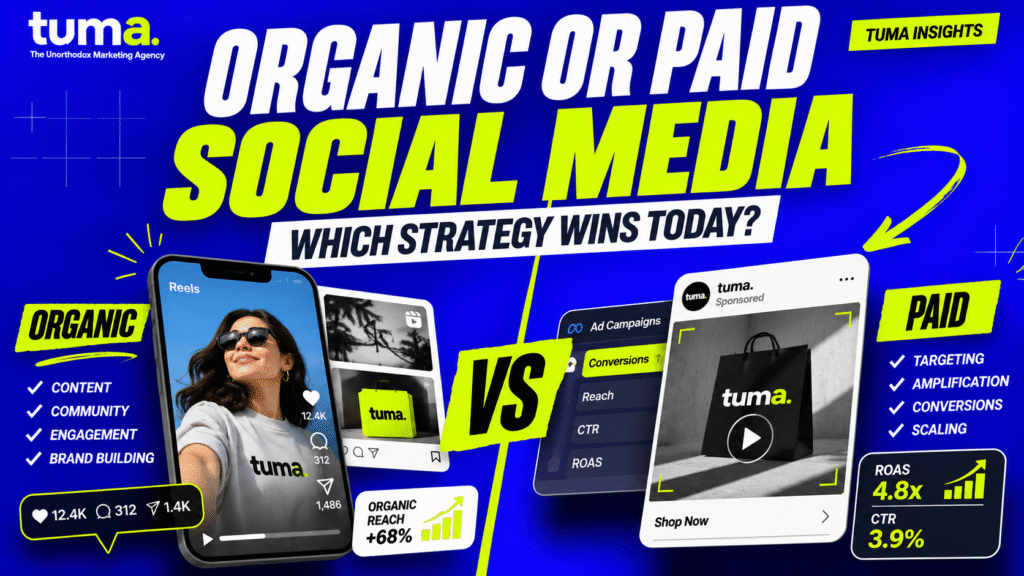
Brands keep asking the same question: should we invest in organic social media or paid advertising?
But that comparison often starts in the wrong place.
A strong organic post can build a community, introduce a product, and generate sales. A paid campaign can drive conversions while helping people discover and remember a brand.
The distinction isn’t simply branding versus performance. It’s about how content reaches people, what businesses can control, and how each approach contributes to growth.
The better question is: what role should organic and paid social media play in your marketing strategy?
Organic vs Paid Social Media: Quick Answer
Neither organic nor paid social media is universally better. Organic social helps businesses maintain a brand presence, build communities, discover audiences, and learn from customer interactions. Paid social provides greater control over distribution, supporting awareness, acquisition, retargeting, and measurable campaigns. The right choice depends on business objectives, resources, and audience behavior. Many brands benefit from connecting both approaches.
What Is Organic Social Media?
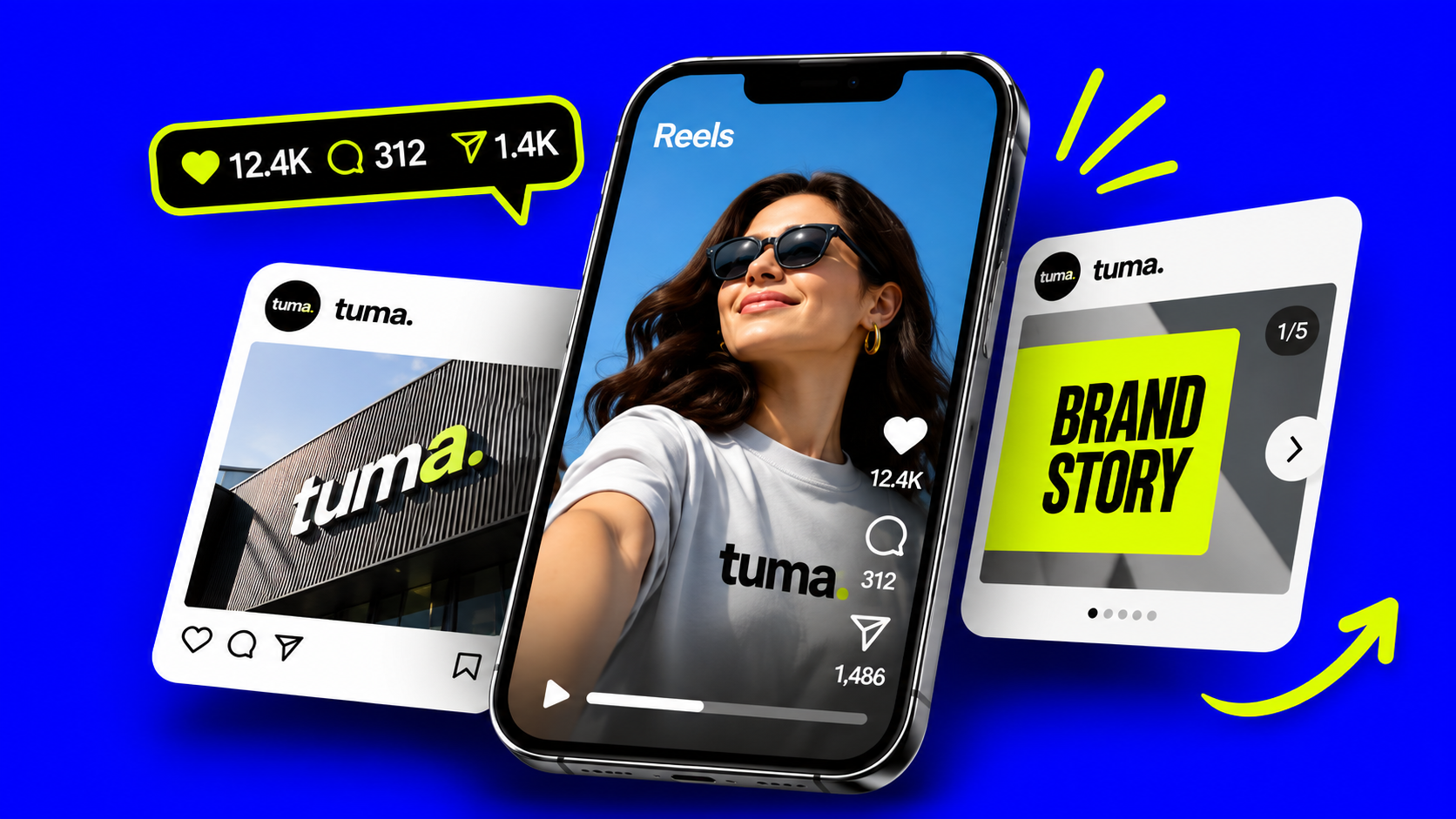
Organic social media refers to content and interactions distributed through social platforms without paying the platform to promote a particular post or campaign.
It includes Instagram Reels, TikTok videos, LinkedIn posts, YouTube videos, carousels, Stories, community conversations, direct messages, founder content, employee advocacy, and user-generated content (UGC).
Organic distribution operates through three connected elements:
Organic Social = Content + Community Interaction + Algorithmic / Social Discovery
Importantly, organic content isn’t limited to existing followers.
Recommendation systems, suggested posts, shares, and social search can introduce content to people who have never interacted with a brand.
This makes social SEO increasingly relevant. Searchable captions, descriptive keywords, and content aligned with audience questions can support discovery, although visibility is never guaranteed.
Is Organic Social Media Really Free?
Organic social requires no direct media spend, but that doesn’t make it free.
Businesses still invest in strategy, copywriting, graphic design, video production, editing, creators, community management, analytics, tools, and employee time.
Organic Cost = Time + Talent + Production + Tools
A brand publishing without an advertising budget still needs to evaluate what its content costs to produce and the business value it creates.
What Is Paid Social Media?
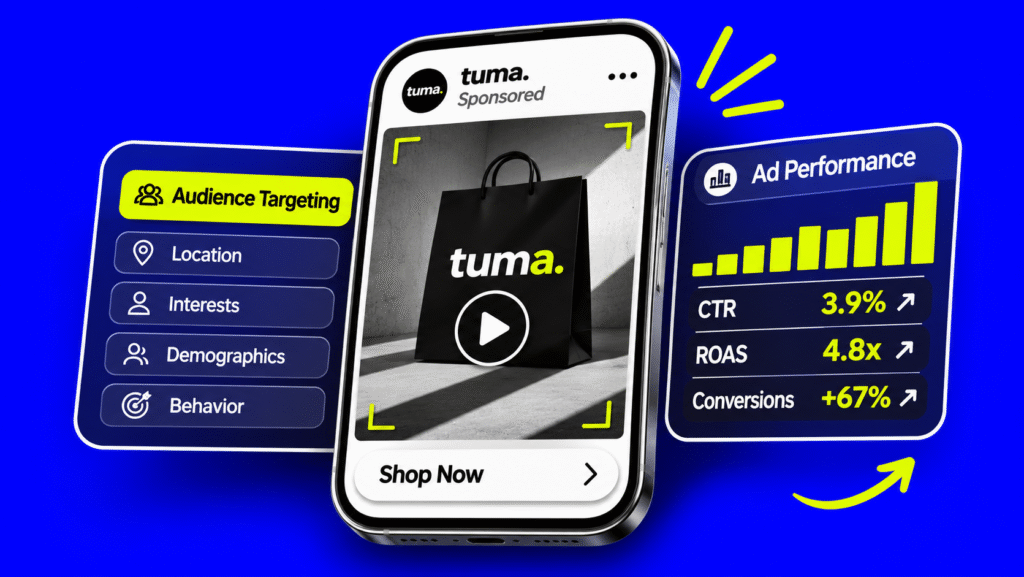
Paid social media is advertising distributed through social platforms in exchange for media spend.
Businesses use formats such as sponsored posts, video ads, static ads, carousel ads, Stories advertising, Reels advertising, paid creator content, boosted posts, and retargeting campaigns.
The basic system is:
Media Spend + Audience + Creative + Placement → Paid Distribution
Platforms such as Meta, TikTok, LinkedIn, and YouTube support advertising objectives that may include awareness, traffic, lead generation, and sales, depending on the platform and campaign format.
Unlike organic distribution, paid social allows advertisers to allocate budgets and configure campaign delivery around specified goals.
However, targeting capabilities depend on platform rules, location, privacy restrictions, and available campaign features. Paying for distribution does not guarantee profitable results.
Organic vs Paid Social Media: Key Differences
Understanding organic vs paid social media marketing starts with comparing the distribution systems rather than assuming they serve completely separate purposes.
| Factor | Organic Social | Paid Social |
| Distribution | Algorithmic and earned | Purchased through advertising |
| Media spend | Not required | Required |
| Production cost | Still exists | Still exists |
| Reach control | Lower | Greater |
| Discovery | Search, recommendations, shares | Campaign delivery |
| Community | Strong use case | Can support engagement |
| Conversions | Direct or assisted | Often an explicit objective |
| Targeting | Limited control | More campaign controls |
| Testing | Directional audience learning | Structured testing possible |
| Measurement | Often less direct | More campaign-level reporting |
| Speed | Variable; may build gradually | Distribution can begin quickly |
| Longevity | Content may continue circulating | Generally depends on active spend |
Neither approach owns a particular outcome.
Organic can generate revenue. Paid can build a brand.
The distinction is how each creates and distributes opportunities for those outcomes.
Benefits and Challenges of Organic Social Media
Organic social gives brands a place to establish their identity beyond individual advertising campaigns.
It can support recognizable brand voice, thought leadership, customer relationships, social proof, community participation, retention, and advocacy.
Comments, replies, and DMs are particularly valuable. They reveal customer questions, objections, language, and interests that polished market research may overlook.
Organic content can also generate website traffic, inquiries, and purchases, especially when its message connects naturally to a relevant offer.
But organic distribution comes with limitations.
Reach can fluctuate because of recommendation systems, competition, audience interests, and content quality. Brands have less control over exactly who sees a post.
Consistent production requires resources, while attribution becomes difficult when customers encounter multiple pieces of content before purchasing.
Another challenge is organic content fatigue.
Publishing the same topic, hook, or format repeatedly can reduce audience interest.
Consistency should reinforce brand identity, not produce interchangeable content.
Benefits of Paid Social Media Advertising
One of the biggest benefits of paid social media advertising is distribution control.
Instead of relying entirely on organic discovery, brands can allocate budgets to campaign objectives and reach eligible audiences beyond their existing communities.
Paid social can support product launches, brand awareness, website visits, lead generation, customer acquisition, retargeting, and creative experimentation.
It also provides structured performance data that helps teams compare different creative approaches.
However, paid advertising introduces its own costs and limitations.
Media spend, creative production, auction competition, optimization, and measurement infrastructure all affect campaign economics.
Performance may deteriorate through repeated exposure, audience saturation, offer fatigue, increased competition, or weaknesses in the conversion journey.
Paid Social ≠ Set and Forget
A declining click-through rate might indicate creative fatigue, but it could also reflect audience or auction changes.
Creative fatigue means people may be tiring of particular advertising executions. Audience saturation relates to repeatedly reaching a limited group. Offer fatigue suggests the proposition itself has become less compelling.
Diagnosing the difference matters before producing more ads or increasing budgets.
Organic vs Paid Social Media Content: What Actually Changes?
Organic and paid content don’t need completely separate creative teams or brand identities.
They need different execution decisions.
Organic content often emphasizes education, entertainment, community interaction, culture, founder perspectives, and thought leadership.
Paid creative may emphasize product benefits, customer proof, objections, offers, and conversion-focused calls to action.
But these are tendencies, not rules.
An educational organic Reel can generate purchases. A paid brand film can strengthen awareness without asking viewers to buy immediately.
Both should share a consistent positioning and audience understanding.
Business Goal + Audience Insight → Creative Strategy → Organic Content + Paid Creative
What changes is the execution: hook, format, pacing, message, offer, placement, and CTA.
Boosted Posts vs Purpose-Built Paid Ads
A boosted post and a purpose-built advertising campaign can both involve paid distribution, but their planning processes differ.
What Is a Boosted Post?
A boosted post is existing social content promoted through a simplified advertising workflow.
It can extend distribution beyond the post’s original organic audience.
For example, a brand might boost a LinkedIn thought-leadership post to support a relevant campaign objective.
LinkedIn documents boosting as a way to amplify existing content, while Meta distinguishes simplified boosting from the broader campaign-management capabilities of Ads Manager.
What Is a Purpose-Built Paid Ad?
A purpose-built ad is developed around a defined business objective.
Its creative, audience, offer, CTA, placement, destination, and measurement plan should work together.
Consider a skincare brand.
An entertaining Reel featuring a morning routine may earn substantial engagement. A conversion-focused variation might need to demonstrate the product’s benefits, address objections, and explain what viewers should do next.
Platforms can also combine existing organic posts with formal campaigns. TikTok Spark Ads, for instance, can use authorized organic posts within paid advertising.
The important distinction isn’t simply whether content was originally organic.
It’s whether the campaign is designed for its intended outcome.
Why Organic Performance Does Not Always Predict Paid Performance
A high-performing organic post is a creative signal, not proof of conversion potential.
Organic content might succeed because it’s funny, relatable, culturally relevant, or highly shareable.
Those characteristics can attract attention without necessarily communicating product value or buying intent.
Conversely, a product demonstration with modest organic engagement might become useful paid creative because it answers a specific purchase objection.
Imagine a fashion brand whose humorous behind-the-scenes video attracts significant organic engagement.
That response suggests the concept connects with viewers. It doesn’t establish that those viewers are likely to purchase.
A sensible next step is to test different executions with clearer product relevance and appropriate measurement.
Engagement ≠ Purchase Intent
Paid testing helps investigate the relationship; it doesn’t automatically prove causation.
How Organic and Paid Social Should Work Together
The strongest opportunity is often the learning shared between both systems.
THE ORGANIC + PAID FEEDBACK LOOP
Create. Listen. Test. Learn. Repeat.
Organic Content
Topics, stories, education, community
Engagement + Customer Insight
Comments, questions, language, objections
Paid Creative Testing
Hooks, concepts, messages, offers
Performance Data + Learning
Attention, clicks, conversions, qualified outcomes
Use performance learning to guide the next round of content.
Organic Content Can Improve Paid Creative
Organic content can reveal popular topics, recurring questions, customer language, objections, and useful storytelling formats.
Organic Response → Creative Insight → Paid Hypothesis
Suppose comments on a product video repeatedly ask whether it works in small spaces.
That question could inspire a paid demonstration focused on compact environments.
Organic responses offer directional evidence, not controlled experimental proof.
Paid Campaigns Can Improve Organic Content
Paid data can also reveal useful messaging opportunities.
If campaigns consistently attract qualified interest through a particular product benefit, the content team can explore that benefit through tutorials, founder stories, customer examples, or educational posts.
Paid Performance Data → Customer Insight → Better Organic Content
Teams should avoid treating a single advertising metric as a complete explanation of audience preferences.
Connect Both Through Creative Testing
A disciplined testing process follows:
Hypothesis → Creative → Distribution → Data → Learning
Teams can test hooks, concepts, creators, formats, messages, offers, and CTAs.
Creative testing should be distinguished from audience and placement testing. Changing several variables simultaneously can make results difficult to interpret.
Content repurposing also helps integrated teams use production resources efficiently.
A long-form video might become an organic Reel, paid cutdown, static quote, retargeting ad, and founder post.
Each version should be adapted to its platform and purpose rather than published identically everywhere.
Organic vs Paid Social Across the Customer Journey
Both approaches can contribute throughout the funnel.
| Funnel Stage | Organic Role | Paid Role |
| Awareness | Discovery, culture, thought leadership | Scaled reach |
| Consideration | Education, community, proof | Retargeting and education |
| Conversion | DMs, proof, assisted sales | Direct-response campaigns |
| Retention | Community and education | Reactivation and upsell |
| Advocacy | UGC and customer stories | Amplifying relevant stories |
This is a planning model, not a rigid division.
A single piece of content may influence multiple stages, and customer journeys rarely follow a perfectly linear path.
How to Measure Organic and Paid Social Media
Measurement should begin with the business objective, not whichever platform metric looks most impressive.
Organic Social Metrics
Useful indicators include reach, impressions, engagement rate, shares, saves, comments, profile visits, DMs, link clicks, community growth, organic traffic, and assisted conversions.
Follower growth alone doesn’t establish business impact.
Paid Social Metrics
Paid campaigns may use CPM, CTR, CPC, CPL, CPA, conversion rate, customer acquisition cost (CAC), return on ad spend (ROAS), and attributed revenue.
The appropriate metrics depend on the campaign goal.
ROI vs ROAS: What’s the Difference?
ROAS = Attributed Advertising Revenue ÷ Advertising Spend
ROI = (Financial Return − Total Investment) ÷ Total Investment
ROAS focuses on advertising efficiency. ROI considers broader investment and returns.
For organic social, costs might include labor, creators, software, production, and agency fees.
A strong ROAS does not automatically mean a campaign is profitable.
Why Attribution Is Still Imperfect
Customers may discover a product organically, see multiple ads, search for the brand, and purchase later.
Cross-device journeys, view-through attribution, attribution windows, and privacy restrictions complicate measurement.
Even sophisticated advertising reporting cannot establish every channel’s exact contribution. Google documents distinct conversion attribution and view-through measurement rules for video advertising.
Compare platform-reported results with website analytics, CRM records, qualified leads, sales, and overall business performance.
Which Strategy Should Your Brand Prioritize?
The decision should reflect your objectives, current resources, and ability to turn attention into business results.
Prioritize Organic More Heavily When
You need to establish a recognizable brand voice, build community, develop thought leadership, understand audience questions, or create an ongoing content system.
It can also be a reasonable priority when media budgets are constrained, provided the business has resources to produce and manage content.
Prioritize Paid More Heavily When
You have a clear offer and conversion path, need controlled distribution, are launching something time-sensitive, or want to test acquisition-focused creative.
Paid distribution may be particularly useful when reaching qualified prospects beyond an existing audience is important.
Integrate Both When
Your business wants consistent audience relationships alongside acquisition, already produces content, or needs customer insights to inform creative decisions.
A B2B business might combine founder-led LinkedIn content with paid lead-generation campaigns.
A consumer brand might combine creator content, product demonstrations, UGC, and retargeting.
Neither approach requires an equal budget split, and platform selection should follow audience behavior rather than industry stereotypes.
How TUMA Thinks About Organic + Paid Social
At TUMA, we don’t just make content; we create culture.
But creative ambition should have a commercial purpose.
Our approach connects brand positioning, audience insight, content creation, social media marketing, video advertising, and performance creative.
Creative Strategy → Content → Distribution → Performance Learning
With over six years of experience working across industries and international markets, we see organic and paid social as parts of a larger brand experience rather than isolated content calendars and advertising dashboards.
Organic activity can reveal what audiences care about. Paid creative can test propositions against campaign goals. Both can inform the next creative decision.
The objective isn’t to publish more or spend more simply for the sake of activity.
It’s to make stronger decisions about what deserves attention, how it reaches people, and what happens afterward.
Organic or paid social media? The winning strategy is the one that connects creative decisions to business goals.
Because at TUMA, marketing should deliver results.
6. Frequently Asked Questions
What is the difference between organic and paid social media?
Organic social media distributes content without paying the platform for promotion. Paid social media uses advertising budgets to support controlled distribution. Both approaches can contribute to awareness, engagement, traffic, leads, and sales.
Is organic social media free?
Organic content does not require media spend, but it still involves costs for planning, production, editing, tools, community management, and team time. Its total investment should be evaluated alongside the value it creates.
Is paid social better than organic social?
Not universally. Paid social can offer greater distribution control and structured campaign measurement. Organic social supports continuous content, discovery, community interaction, and customer insight. The better approach depends on the business objective.
What are the benefits of paid social media advertising?
Paid social can support broader reach, campaign objectives, retargeting, creative testing, lead generation, customer acquisition, and launch amplification. Results depend on the creative, offer, campaign configuration, audience, and conversion experience.
Can organic social media generate sales?
Yes. Organic content can generate purchases through product demonstrations, educational posts, customer stories, social proof, direct messages, and website referrals. Measuring its contribution may require more than platform engagement metrics.
Should you boost your best organic posts?
Sometimes. Strong organic engagement can identify content worth testing with paid distribution, particularly for awareness or engagement objectives. However, conversion campaigns should evaluate product relevance, audience intent, offers, CTAs, and conversion metrics rather than engagement alone.
Which has better ROI: organic or paid social media?
Neither consistently delivers better ROI across all businesses. Organic investment includes production and labor, while paid investment includes media and creative costs. Compare returns using consistent time frames, total costs, and meaningful business outcomes.
Should small businesses use organic or paid social media?
Small businesses should prioritize the approach that best fits their objectives and resources. Organic content can develop credibility and customer relationships, while paid campaigns can support specific offers, local reach, or acquisition goals. Both are options, not universal requirements.