
Agency labels sound simple until you actually need to hire one.
A creative agency might develop your brand identity, produce video advertisements, and help shape your marketing campaigns.
A marketing agency might manage paid advertising, create social media content, improve search visibility, and develop conversion-focused landing pages.
An advertising agency might handle creative concepts and media strategy. A digital agency might offer branding, web development, SEO, and social media marketing under one roof.
So, where does one agency end and another begin?
The answer is not always obvious.
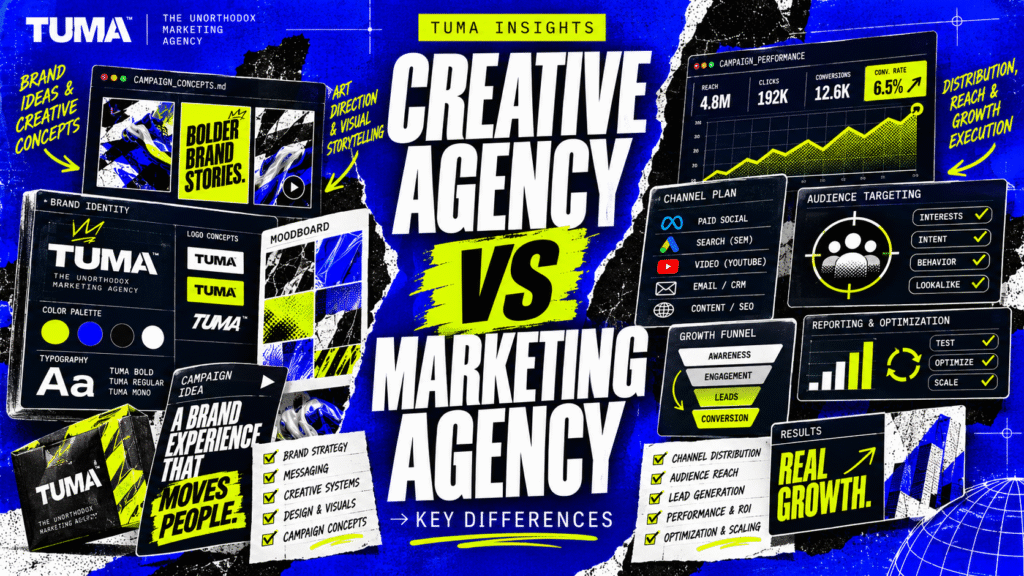
The real difference between a creative agency vs marketing agency is generally where each places its strategic emphasis, not necessarily which services it can provide.
A business struggling with brand recognition may need something entirely different from one struggling with customer acquisition. Another business might need both capabilities working together.
That makes the most important question less about agency labels and more about solving the right problem.
What does your business need to achieve, and which agency has the expertise to get you there?
Let’s break it down.
Creative Agency vs Marketing Agency: Quick Answer
What is the difference between a creative agency and a marketing agency?
A creative agency typically specializes in brand strategy, visual identity, storytelling, design, content, and creative production. A marketing agency generally focuses more on audience acquisition, channel strategy, advertising, SEO, campaign execution, conversion, and performance measurement. However, modern agencies increasingly combine these capabilities, making actual expertise, services, and business objectives more important than the agency’s label.
In practical terms:
- Creative agencies help determine what a brand should communicate and how that communication should look, sound, and feel.
- Marketing agencies help determine how to reach the right audience, generate demand, and achieve measurable marketing objectives.
- Integrated agencies connect brand strategy, creative execution, distribution, and measurement.
These are tendencies, not strict industry boundaries.
What Is a Creative Agency?
A creative agency is a company that helps businesses develop and execute their brand identity, communication, creative concepts, and marketing assets.
Its work often begins with understanding what a brand represents, who it serves, how it differs from competitors, and how those differences should be communicated.
Creative agencies can influence how customers recognize, understand, experience, and remember a business.
Their responsibilities may include brand positioning, logo design, messaging, campaign concepts, video production, website design, photography, and social media creative.
However, branding is much broader than designing a logo.
A logo identifies a brand. Brand strategy helps determine what that identity should represent.
Consider a new skincare company entering a crowded market.
Before designing packaging or filming advertisements, a creative agency might investigate the audience, competitors, product positioning, value proposition, and desired customer perception.
That research informs the brand’s messaging, visual direction, packaging, website, and campaign concepts.
The relationship is straightforward:
Brand Strategy → Creative Strategy → Creative Execution
Not every creative agency provides all these services. Some specialize in identity design, while others focus on campaigns, digital experiences, or production.
What Do Creative Agencies Do?
Understanding what creative agencies do becomes easier when their work is divided into five core disciplines.
1. Brand Strategy and Positioning
Brand strategy establishes the foundation for how a business competes and communicates.
Typical deliverables include:
- Target audience profiles and customer insights
- Competitive positioning and differentiation
- Brand purpose, values, promise, and value proposition
- Brand architecture and strategic messaging
A strong strategy answers why customers should recognize and choose the brand rather than its alternatives.
2. Brand Identity and Visual Systems
Brand identity translates strategy into recognizable creative elements.
These can include logos, typography, color palettes, illustration, photography direction, motion identity, social media templates, packaging, and brand guidelines.
The objective is not simply visual consistency. It is to create a coherent identity that supports recognition and positioning across customer touchpoints.
3. Verbal Identity, Messaging, and Copywriting
Brands communicate through words as well as visuals.
Creative agencies may develop a brand voice, tone of voice, tagline, campaign messaging, website copy, advertising copy, and social media copy.
A technical B2B company might require precise, evidence-led messaging, while a consumer lifestyle brand may benefit from a more conversational voice.
Neither approach is automatically better.
Brand Positioning → Messaging → Audience Interpretation
4. Storytelling and Creative Production
Creative agencies develop the ideas and assets used to communicate with audiences.
Production may include photography, video advertising, brand films, product demonstrations, customer stories, motion graphics, and campaign visuals.
Storytelling gives information structure, context, and meaning.
It does not require every brand to manufacture an emotional founder narrative. Sometimes a compelling product demonstration, customer problem, or clear comparison tells the strongest story.
5. Digital Creative and Experiences
Many creative agencies also design digital experiences, including websites, landing pages, digital campaigns, social content, and interactive assets.
These experiences should support usability, accessibility, brand consistency, and meaningful customer actions.
The value of creative work is not limited to how attractive it looks. It also depends on what it communicates and enables people to do.
What Is a Marketing Agency?
A marketing agency is a business that helps organizations understand their audiences, reach potential customers, generate demand, support sales, and improve marketing effectiveness.
Marketing agencies generally place greater emphasis on the strategies, channels, campaigns, and measurement systems that connect a business with its market.
Common marketing agency services include:
- Market research and audience segmentation
- Marketing and growth strategy
- Search engine optimization (SEO)
- Paid search and Google Ads
- Meta Ads and other paid social campaigns
- Social media marketing and community management
- Content marketing and distribution
- Email marketing and lifecycle automation
- Lead generation and demand generation
- Conversion rate optimization (CRO)
- Marketing analytics, attribution, and reporting
For example, an established ecommerce brand may already have clear positioning and recognizable branding but struggle with paid acquisition.
A performance-focused marketing agency might investigate its campaign structure, audience targeting, advertising creative, landing pages, conversion tracking, and acquisition economics.
The objective is not simply to increase traffic.
It is to reach relevant audiences and improve outcomes aligned with the business model.
Business Goal → Audience → Channel → Campaign → Measurement
Marketing agencies vary considerably. An SEO agency might concentrate on organic search, while a full-service marketing agency may coordinate multiple channels.
Creative Agency vs Marketing Agency: Key Differences
The following table compares the typical centers of gravity of the two agency categories.
| Factor | Creative Agency | Marketing Agency |
| Primary focus | Brand expression and creative communication | Market reach, demand, acquisition, and growth |
| Core strategy | Brand and creative strategy | Marketing, channel, and growth strategy |
| Brand positioning | Often a core capability | May support marketing strategy |
| Brand identity | Often a major capability | Available at some agencies |
| Design | Usually important | Scope varies |
| Content production | Common | Common; production depth varies |
| Messaging | Brand voice and creative concepts | Audience and campaign messaging |
| Paid advertising | May develop advertising creative | Often manages campaigns and budgets |
| Media buying | Varies; less central traditionally | Common in performance agencies |
| SEO | May support content or website design | Common in digital marketing agencies |
| Audience targeting | Informs concepts and messaging | Central to channel execution |
| Analytics | Brand, creative, and campaign insights | Campaign, conversion, and business KPIs |
| Conversion optimization | Supports through design and messaging | Often a direct service |
| Reporting | Deliverables, creative outcomes, brand indicators | Traffic, leads, acquisition, revenue, and KPIs |
| Success measures | Clarity, consistency, recognition, creative effectiveness | Reach, qualified demand, conversion, and marketing performance |
The most important distinction: creative agencies often concentrate on developing the message and experience, while marketing agencies often concentrate on getting that message to the right audience and evaluating its impact.
An integrated agency may perform activities from both columns.
Read Also: Organic vs Paid Social Media: Which Strategy Wins Today?
Where Creative and Marketing Agencies Overlap
The biggest misconception in this comparison is that creativity and marketing are separate, competing disciplines.
They are not.
Creative does not exist only to make things look good. Marketing does not exist only to buy ads.
Most modern marketing activities depend on both.
Consider a Meta advertising campaign. The marketing strategy determines its objective, audiences, budget, placements, and measurement approach.
Creative strategy determines the hook, message, storytelling, visual treatment, and call to action.
Without strong creative, even carefully managed campaigns may struggle to communicate value.
Without distribution, strong creative may never reach enough of the intended audience.
The same relationship appears across several disciplines.
Content Marketing
A creative team might produce articles, videos, illustrations, or thought-leadership content.
A marketing team might research search intent, select distribution channels, plan publishing, and measure engagement or conversions.
An integrated team may handle both activities.
Social Media Marketing
Organic social combines content strategy, design, Reels, TikTok videos, LinkedIn posts, community management, UGC, creator content, and analytics.
Paid social adds media strategy, targeting, budgets, creative testing, and conversion measurement.
The strongest approach connects content quality with audience understanding and platform behavior.
Video Marketing
A creative agency may develop the concept, script, shoot, edit, and produce a video.
A marketing agency may define its audience, distribution strategy, campaign objective, channel, and KPIs.
Video Production ≠ Video Marketing
Production creates the asset. Video marketing determines how that asset contributes to a defined marketing objective.
Website Development
Website projects often connect brand identity, UX/UI, accessibility, copywriting, development, technical SEO, analytics, and conversion optimization.
A website needs to represent the brand and support the customer journey.
The Integrated Model
Together, these disciplines create a more complete system:
Creative + Distribution + Measurement = Stronger Marketing System
The aim is not simply to produce more content or run more campaigns. It is to make the individual activities work together.
Creative Strategy vs Marketing Strategy
These two strategic disciplines are closely related but answer different questions.
What Is Creative Strategy?
Creative strategy connects business objectives and audience insights with the messages, ideas, formats, and stories used to communicate.
It helps determine:
- Which customer need or objection matters
- What message or value proposition to emphasize
- Which hook or campaign angle is most relevant
- What creative format fits the audience and platform
- How storytelling should support the objective
- Which creative variations deserve testing
Business Goal + Audience Insight → Creative Strategy → Creative Execution
For example, a DTC fitness brand may learn that potential customers are skeptical of exaggerated product claims.
Its creative strategy could prioritize demonstrations, realistic use cases, credible explanations, and customer evidence rather than dramatic promises.
What Is Marketing Strategy?
Marketing strategy determines how the business will pursue marketing objectives through audiences, channels, campaigns, resources, and measurement.
It considers positioning, customer journeys, demand, competition, budgets, acquisition costs, retention, and channel opportunities.
Research is central to the process.
Agencies may examine customer interviews, competitors, search behavior, social listening, reviews, CRM data, first-party analytics, and previous campaign results.
Research → Audience Insight → Marketing Strategy
Audience segmentation then translates that understanding into relevant campaign decisions.
Segments may differ by demographics, psychographics, customer needs, buying behavior, awareness stage, purchase intent, and platform behavior.
Audience Insight → Segment → Message → Channel → Creative
Creative strategy bridges the two disciplines by ensuring that marketing objectives become communication people can understand and respond to.
Creative Agency vs Digital Marketing Agency
The creative agency vs digital marketing agency comparison is particularly relevant to brands investing in online growth.
A creative agency typically emphasizes brand positioning, visual identity, storytelling, design, creative direction, and content production.
A digital marketing agency typically emphasizes online visibility, traffic generation, paid advertising, SEO, email marketing, analytics, and conversion optimization.
For example, a creative agency may design a new ecommerce website, establish its visual language, and produce product photography.
A digital marketing agency may improve its organic search visibility, manage paid acquisition, implement conversion tracking, and develop retention campaigns.
However, a creative agency can offer digital strategy, and a digital marketing agency can employ designers, copywriters, video editors, and creative strategists.
The distinction becomes useful only when the service scope is clear.
Creative Agency vs Advertising Agency
The difference between a creative agency vs advertising agency is also less rigid than the labels suggest.
Creative agencies may develop brand identity systems, campaign concepts, copywriting, design, photography, and video content.
Advertising agencies have traditionally focused more specifically on advertising strategy, campaign concepts, production, and sometimes media planning and buying.
Some advertising agencies specialize in developing creative campaigns, while others coordinate both creative development and paid distribution.
A separate media agency may handle media planning, buying, and optimization.
There is also a terminology distinction worth understanding:
A creative agency is an organization. Advertising is a marketing activity.
A creative agency can produce advertising creative, but creative services and advertising are not interchangeable concepts.
When comparing agencies, examine what each is responsible for: the concept, production, media strategy, campaign management, or all four.
What Is a Creative Marketing Agency?
A creative marketing agency combines brand and creative capabilities with marketing strategy, campaign development, distribution, and performance measurement.
It generally aims to connect what a brand communicates with how that communication reaches customers and influences business outcomes.
A practical operating model is:
Strategy → Creative → Distribution → Performance
For example, one team might establish the campaign direction, develop advertising concepts, produce video content, prepare landing-page messaging, and coordinate paid distribution.
Performance feedback can then influence subsequent creative development.
Some agencies call this integrated marketing, while others use terms such as creative-performance agency, digital agency, or full-service agency.
The terminology is less important than the actual capabilities.
What Services Does a Creative Business Agency Offer?
The phrase creative business agency services often describes a broad set of services that support brand development and marketing execution.
Depending on specialization, these may include:
| Service category | Possible deliverables |
| Strategy | Brand, marketing, audience, and creative strategy |
| Branding | Positioning, identity, messaging, guidelines |
| Content | Photography, video, copywriting, social assets |
| Digital | Websites, UX/UI, digital experiences, content marketing |
| Performance | Paid media, performance creative, testing, analytics |
An agency using this terminology should explain which capabilities it provides internally, which involve external partners, and how responsibilities are coordinated.
A long service list is not evidence that every discipline receives the same depth of expertise.
What Are the Three Types of Agencies?
There is no universally accepted industry classification consisting of exactly three agency types.
However, one practical framework groups agencies according to their primary capabilities.
1. Creative and Brand Agencies
These agencies mainly help businesses develop their positioning, identity, messaging, creative concepts, and brand communication.
2. Marketing and Performance Agencies
These agencies mainly help organizations reach audiences, manage channels, generate demand, acquire customers, and measure results.
3. Integrated and Full-Service Agencies
These agencies combine multiple capabilities across brand strategy, creative production, digital channels, advertising, and performance.
Beyond these broad groups, there are specialist agencies focused on SEO, PPC, social media, public relations, content, video, web development, influencer marketing, and other disciplines.
Another useful way to view the industry is as a spectrum:
Brand Agency → Creative Agency → Content Agency → Integrated Agency → Digital Marketing Agency → Performance Marketing Agency
These categories overlap rather than represent fixed boundaries.
Specialist vs Full-Service vs Integrated Agencies
A specialist agency concentrates on a clearly defined discipline, such as branding, SEO, paid advertising, video production, or website development.
An integrated agency coordinates several disciplines around a broader strategy.
| Specialist Agency | Integrated Agency |
| Concentrated expertise in one field | Multiple disciplines coordinated |
| Useful for clearly defined problems | Useful for interconnected challenges |
| Potentially narrower deliverables | Potentially broader campaign scope |
| May require coordination with other vendors | May reduce external handoffs |
| Depth is easier to evaluate in a specialty | Cross-functional ability must be verified |
Full-service describes breadth, but it does not guarantee seamless integration.
An agency can offer many services while operating through disconnected teams.
Conversely, several strong specialist agencies can work effectively together when the brand has capable internal leadership.
Choose depth when the problem is specific. Choose coordination when the problem crosses disciplines.
When Should You Hire a Creative Agency?
A creative agency may be the right choice when the core challenge involves how your business is positioned, perceived, or communicated.
Possible signals include:
- Customers struggle to understand what makes your brand different.
- Your visual identity is inconsistent or generic.
- Your messaging changes across channels.
- Your campaigns lack a recognizable creative direction.
- Your website does not reflect your brand positioning.
- You are launching a new company, product, or identity.
- You need a rebrand or a coherent design system.
However, weak conversion rates do not automatically indicate a branding problem.
The issue could involve pricing, product-market fit, usability, targeting, or demand.
Diagnosis should come before selecting an agency.
When Should You Hire a Marketing Agency?
A marketing agency may be more appropriate when the business has an established offer and brand foundation but struggles to reach, attract, or convert customers.
Signals can include:
- Poor organic search visibility
- Inconsistent lead generation
- Weak audience targeting
- Inefficient paid acquisition
- Limited channel expertise
- Unclear conversion tracking
- Stalled customer acquisition
- Weak lifecycle marketing or retention
- Inconsistent reporting and optimization
A marketing agency might improve channel strategy, search visibility, campaign structure, targeting, landing pages, or customer retention.
But marketing execution cannot always compensate for unclear positioning or an uncompetitive offer.
When Does an Integrated Agency Make More Sense?
An integrated approach becomes valuable when creative and marketing problems are interconnected.
For example, a business might have strong media-buying expertise but produce inconsistent advertising assets.
Another might publish excellent content without any meaningful distribution plan.
An integrated approach can connect:
- Brand positioning with campaign messaging
- Content production with distribution
- Paid media with creative testing
- Website experience with conversion optimization
- Marketing analytics with creative decisions
The simplest diagnostic is:
Brand Problem? → Creative / Brand Support
Distribution Problem? → Marketing Support
Both? → Integrated Approach
Integration can come from one agency, a well-coordinated group of specialists, or an internal team working with outside partners.
Creative Agency vs Marketing Agency by Business Stage
Agency needs often change as a company develops.
| Business stage | Common challenge | Likely capability needed |
| Early stage | Establishing positioning and identity | Brand strategy, identity, messaging, website |
| Growth stage | Building predictable acquisition | Content, paid media, SEO, creative testing |
| Scaling stage | Coordinating channels and production | Integrated strategy, analytics, creative operations |
| Established stage | Sustaining relevance or expanding | Repositioning, campaign innovation, market expansion |
Business stage provides context, not a universal prescription.
A new company with a validated offer might need immediate demand generation. An established company might need to rebuild its brand positioning.
The stronger framework is:
Business Stage → Current Problem → Required Capability
Brand Building vs Performance Marketing
Brand building and performance marketing are sometimes described as competing priorities.
That framing misses how the two can support each other.
Brand strategy influences recognition, differentiation, customer expectations, and reasons to choose a business.
Performance marketing focuses more directly on measurable actions such as leads, purchases, bookings, sign-ups, and revenue.
Strong branding can support trust, memorability, preference, and repeat purchases.
Performance marketing can generate customer insights, conversion data, creative learning, and demand.
Neither automatically guarantees the success of the other.
A useful combined model is:
Brand Strategy → Creative → Distribution → Measurement → Optimization
Brand Foundation vs Growth Engine
Brand foundations establish what the business stands for and how it communicates.
Marketing systems help those messages reach audiences through relevant channels.
Measurement provides feedback on whether the strategy is contributing to its objectives.
The full system matters more than any isolated component.
How Agencies Support the Customer Journey
| Journey stage | Typical activities |
| Awareness | Brand campaigns, social media, video, paid reach |
| Consideration | SEO, educational content, case studies, retargeting |
| Conversion | Landing pages, advertising, CRO, email |
| Retention | Lifecycle email, community, customer content |
| Advocacy | Reviews, referrals, customer stories, community |
Every stage requires the right relationship between message, creative, and channel.
Customer Journey Stage → Message → Creative → Channel
How Performance Creative Blurs the Line
Performance creative is one of the clearest examples of creative agencies and marketing agencies working across the same responsibilities.
Performance creative combines creative strategy, advertising production, testing, audience insight, and performance data to improve marketing communication over time.
Unlike a workflow where creative assets are produced and handed off as finished products, performance creative introduces a continuous learning process.
Creative → Data → Insight → New Creative
Imagine an ecommerce brand promoting a skincare product through Meta Ads.
Its team develops several advertising concepts:
- A problem-focused customer testimonial
- A product demonstration
- An educational explanation of ingredients
- A comparison highlighting a specific benefit
Each concept may use different hooks, visuals, copy, proof points, or calls to action.
After launch, the team evaluates viewing behavior, click-through rate, conversion rate, customer acquisition costs, and other relevant signals.
The goal is to identify meaningful patterns rather than simply declare one video the winner.
For example, a testimonial might attract more attention but produce fewer purchases than a demonstration.
That finding could suggest a need to change the offer, message, landing page, or creative direction.
Creative Testing and Iteration
Performance creative teams may test hooks, formats, advertising angles, offers, storytelling structures, and visual treatments.
They also monitor creative fatigue, when performance may deteriorate as audiences become familiar with an advertisement.
However, declining performance does not automatically prove creative fatigue. Auction conditions, targeting, seasonality, conversion tracking, and offer relevance may also contribute.
Useful creative testing is hypothesis-driven.
Research → Hypothesis → Creative → Launch → Analysis → Iteration
This is where creative thinking becomes part of a measurable marketing system without surrendering creative judgment.
How Marketing Channels Connect Creative and Performance
The agency comparison becomes clearer when individual marketing disciplines are examined.
Paid Advertising and Media Buying
Paid advertising may include Google Ads, Meta Ads, paid social, search advertising, retargeting, and other media channels.
Marketing agencies often handle targeting, campaign budgets, bids, placement strategy, media buying, and conversion measurement.
Creative teams support those campaigns with messaging, visual assets, video ads, and landing-page experiences.
Creative + Media + Audience + Offer + Landing Page → Campaign Performance
Search Engine Optimization
SEO focuses on helping relevant audiences discover a website through organic search.
Marketing agencies may provide keyword research, search-intent analysis, content SEO, technical SEO, site architecture, and search performance reporting.
Creative and content teams may contribute editorial content, website copy, visual resources, and user experience.
Content + Website + Technical Implementation + Search Strategy → Search Visibility
SEO is an ongoing improvement process. Rankings and traffic are not guaranteed.
Email and Lifecycle Marketing
Marketing continues after customer acquisition.
Email and lifecycle services may include CRM segmentation, welcome sequences, lead nurturing, abandoned-cart campaigns, retention messaging, and marketing automation.
Creative teams contribute email design, copywriting, imagery, and messaging consistency.
Marketing teams manage segmentation, automation, delivery, and performance measurement.
Content and Social Media
Content marketing may involve blog articles, short-form video, organic social content, educational resources, and thought leadership.
Effective execution requires both the content itself and a distribution strategy.
The same principle applies across Instagram, TikTok, LinkedIn, YouTube, and other platforms.
Content without a distribution plan is an incomplete marketing strategy.
Analytics and Measurement: How Agencies Demonstrate Value
Different business objectives require different KPIs.
| Objective | Relevant measurements |
| Brand awareness | Reach, impressions, brand searches, aided or unaided awareness, recall |
| Engagement | Watch time, engagement rate, shares, saves |
| Website traffic | Sessions, CTR, CPC, traffic quality |
| Lead generation | Leads, qualified leads, CPL, conversion rate |
| Customer acquisition | CPA, CAC, conversion rate |
| Revenue | Sales, revenue, ROAS, customer value |
| Retention | Repeat purchase, retention rate, lifecycle revenue |
A creative agency might evaluate brand consistency, message comprehension, audience perception, and creative engagement.
A performance marketing agency might focus on acquisition, conversion, advertising efficiency, and revenue.
Integrated teams may examine both.
Measurement also requires careful interpretation.
For example, ROAS compares attributed advertising revenue with advertising spend, while CAC typically includes a broader range of customer acquisition costs.
A campaign with strong ROAS is not necessarily profitable once product costs, agency fees, and operating expenses are considered.
Attribution models also have limitations. Last-click reporting cannot fully capture every contribution made by brand building, organic content, and earlier customer interactions.
A useful process is:
Campaign → Data → Insight → Optimization
The right KPI depends on the objective, not the agency’s preferred dashboard.
How to Choose the Right Agency
Choosing an agency should begin with a diagnosis, not a list of service categories.
Step 1: Define the Business Problem
Is the challenge brand positioning, recognition, acquisition, conversion, retention, or a combination?
Be specific.
“We need better marketing” is less actionable than “our paid campaigns generate traffic, but qualified visitors rarely convert.”
Step 2: Identify the Required Capabilities
Translate the problem into the skills required to address it.
A weak brand identity might require positioning, creative direction, and design systems.
Poor search visibility might require technical SEO, content strategy, and website improvements.
Ineffective paid advertising might require media strategy, creative testing, landing-page optimization, and measurement.
Step 3: Evaluate Strategic Thinking
Ask prospective agencies how they would investigate the issue before proposing a solution.
Strong agencies should be able to explain their reasoning, assumptions, research process, and approach to prioritization.
Step 4: Review the Team and Delivery Process
Understand who will actually work on the account.
Review the relevant specialists, production capabilities, outsourced work, approval process, communication expectations, and reporting responsibilities.
Step 5: Evaluate Evidence
Examine relevant case studies, deliverables, references where available, and measurable outcomes.
Industry experience can help an agency understand customer behavior, market context, and regulations.
However, cross-industry experience may also introduce valuable creative ideas and new perspectives.
Step 6: Assess Working Compatibility
Communication quality matters.
Discuss responsiveness, feedback cycles, pace, decision-making authority, stakeholder involvement, and escalation procedures.
A strategically capable agency can still be a poor fit if its workflow conflicts with the client’s needs.
Step 7: Match Scope With Budget and Accountability
The proposal should make responsibilities, deliverables, fees, measurement, and ownership clear.
Business Problem → Required Capability → Agency Fit
That is a more reliable selection process than assuming a particular agency category is the automatic solution.
Questions to Ask Before Hiring an Agency
Before signing an agreement, ask:
- What business problem do you believe we need to solve first?
- What does your discovery and research process involve?
- Who will work directly on our account?
- Which services are handled in-house?
- What work will be outsourced?
- How will your strategy connect to our business objectives?
- Which KPIs will you use to evaluate success?
- How frequently will we receive performance reports?
- What will you need from our internal team?
- What is included in the agency fee?
- Is paid media spend charged separately?
- Are production costs included or billed separately?
- Who owns final creative assets, advertising accounts, and data?
- What happens after launch, and how are revisions handled?
- Can you show relevant case studies and explain your contribution?
The answers should help reveal whether the agency can support the required work, not merely present a convincing pitch.
What Does a Good Agency Process Look Like?
A reliable process typically follows a logical sequence:
Discovery → Research → Strategy → Creative / Campaign Planning → Production → Launch → Measurement → Optimization
The exact stages vary by engagement.
For a branding project, brand guidelines and asset handover may represent major final deliverables.
For an ongoing performance campaign, measurement and optimization may continue throughout the engagement.
Before approaching an agency, prepare a client brief covering business goals, the current problem, target audience, competitors, positioning, existing assets, channels, available budget, timeline, KPIs, decision-makers, and previous performance data.
Relevant brand guidelines, customer research, references, and analytics can also help.
The better the starting information, the easier it becomes to establish realistic priorities.
Agency Pricing: Retainers, Projects, Media Spend and Production
Agency pricing varies according to service complexity, deliverables, team expertise, project duration, and engagement structure.
There is no reliable universal price that applies to every agency.
The most important distinction is between three separate cost categories.
Agency Fee
This is the amount paid for the agency’s strategy, expertise, management, execution, and agreed services.
Production Budget
This covers the creation of assets such as photography, video shoots, actors, locations, editing, or specialized production.
Media Spend
This is the money paid to advertising platforms, publishers, or other media inventory providers to distribute advertising.
Agency Fee ≠ Production Budget ≠ Media Spend
A proposal stating that campaign management costs a certain amount does not automatically mean advertising spend or production is included.
Common Agency Pricing Models
| Model | How it works | Main consideration |
| Project fee | Fixed price for defined deliverables | Requires clear scope |
| Monthly retainer | Recurring fee for ongoing work | Useful for continuing services |
| Hourly pricing | Billing based on time worked | Requires visibility into hours |
| Monthly package | Defined services or output volume | Check limits and exclusions |
| Percentage of ad spend | Fee linked to media budget | Understand spending incentives |
| Performance-based | Fee partly tied to agreed results | Requires reliable attribution and controls |
| Hybrid pricing | Combines two or more structures | Clarify each component |
No pricing model is automatically best.
The appropriate structure depends on the work, predictability, financial risk, and accountability required.
What Should the Scope of Work Include?
Before starting, the agreement should specify:
- Services and deliverables
- Timelines and milestones
- Client and agency responsibilities
- Revisions and approval limits
- Meetings and reporting
- Performance objectives and KPI definitions
- Ownership of assets and advertising accounts
- Licensing and usage rights
- Third-party costs and exclusions
- Post-launch support and termination terms
A well-defined scope reduces ambiguity and helps both parties understand what successful delivery looks like.
How to Evaluate Agency Portfolios and Case Studies
Creative portfolios and marketing case studies often demonstrate different forms of evidence.
A creative portfolio may show visual quality, conceptual thinking, brand identity, motion design, copywriting, and production capability.
A marketing case study may show changes in traffic, leads, conversion rate, CPA, ROAS, or revenue.
Neither tells the complete story by itself.
Beautiful work does not automatically prove marketing effectiveness.
Equally, one strong ROAS case study does not guarantee that the same results will occur for another brand.
When reviewing evidence, ask:
- What was the original problem?
- What did the agency actually do?
- Which results were measured?
- Over what period?
- What other factors may have influenced the outcome?
- How closely does the project resemble our situation?
A useful evaluation model is:
Claim → Evidence → Relevance → Confidence
Strong case studies explain the connection between the challenge, strategy, execution, and observed results without overstating causation.
Agency Red Flags to Watch For
Potential warning signs include:
- Promises of guaranteed virality
- Guaranteed ROAS without understanding the business
- No meaningful discovery or diagnostic process
- Vague deliverables, pricing, or exclusions
- No clear ownership of accounts and assets
- No explanation of outsourced responsibilities
- Generic strategies presented to every client
- No relevant proof or transparent case studies
- Poor communication or unclear accountability
- Reporting focused only on vanity metrics
- Media spend presented as if it were an agency service fee
One concern does not automatically establish incompetence or dishonesty.
However, unresolved issues involving transparency, evidence, ownership, or measurement should be addressed before committing.
Will AI Replace Creative Agencies?
AI is unlikely to eliminate the need for creative agencies entirely, but it is changing which tasks agencies perform and how they deliver value.
Generative AI increasingly supports research, brainstorming, copy variations, image generation, video production, editing, localization, content adaptation, and workflow automation.
Marketing agencies can also use AI for audience analysis, campaign variations, reporting, content repurposing, and optimization support.
Advertising platforms already offer AI-assisted creative tools. Google Ads, for example, provides generative capabilities for advertising assets, while emphasizing advertiser review and control.
Industry guidance from the Interactive Advertising Bureau also addresses AI-assisted creative production, campaign applications, governance, and brand-safety considerations.
However, producing an asset is not equivalent to developing an effective strategy.
Agencies still need to understand customers, interpret culture, prioritize opportunities, make creative judgments, protect brand consistency, evaluate evidence, collaborate with stakeholders, and take responsibility for decisions.
AI-generated work can introduce factual errors, misleading claims, inconsistent visuals, intellectual-property concerns, and other risks requiring appropriate review.
AI can automate parts of production. It does not eliminate the need for strategic judgment.
The real question for brands is not whether an agency uses AI.
It is whether the agency uses technology responsibly to improve the quality, relevance, efficiency, and effectiveness of its work.
Which Type of Agency Does Your Brand Actually Need?
Consider these five illustrative situations.
| Business situation | Main problem | Likely agency fit |
| New DTC skincare brand | No clear positioning, identity, or messaging | Brand or creative agency |
| Established ecommerce brand | Inefficient customer acquisition | Marketing or performance agency |
| Growing consumer brand | Strong media team but inconsistent advertising creative | Integrated creative-performance team |
| B2B software company | Limited organic search visibility | SEO and content marketing specialist |
| Company rebranding before international expansion | Identity, messaging, media, and launch campaigns must align | Integrated agency or coordinated specialists |
These examples illustrate possible starting points, not guaranteed diagnoses.
Before hiring, classify the challenge.
Brand Clarity Problem
Symptoms may include unclear positioning, weak differentiation, generic messaging, inconsistent identity, or poor recognition.
Prioritize brand and creative capabilities.
Marketing Traction Problem
Symptoms may include limited relevant traffic, weak reach, poor targeting, inconsistent qualified leads, or inefficient acquisition.
Prioritize marketing strategy, channel expertise, and measurement.
Combined Brand and Marketing Problem
Symptoms may include strong media investment but inconsistent creative, disconnected channel messaging, or content production without distribution.
Consider a coordinated approach that brings creative and marketing capabilities together.
Agency, Freelancer, or In-House Team?
Once the required expertise is clear, decide how to access it.
- Freelancers can provide focused expertise and flexible project capacity, although the client often manages coordination.
- In-house teams offer organizational knowledge and ongoing availability, but require hiring, management, and capacity planning.
- Agencies can provide multidisciplinary resources and specialized expertise, although they also require a clear scope and effective communication.
Hybrid models are common.
The best arrangement depends on existing internal capabilities, budget, speed, management resources, and long-term needs.
How TUMA Thinks About Creative and Marketing
At TUMA, we believe the most interesting work happens when creative thinking and commercial objectives are connected.
We don’t just make content; we create culture.
But culture, attention, and creativity should serve a purpose.
That is why our approach connects branding, creative strategy, content creation, video advertising, social media, digital experiences, and performance-oriented thinking.
A distinctive brand deserves communication that reflects its identity.
An ambitious campaign deserves creative people want to watch.
And strong content deserves a strategy for reaching the people who matter.
Our work across different industries and markets has reinforced a simple belief:
Marketing should deliver results.
That does not mean every campaign should be judged exclusively by immediate conversions.
It means understanding the objective, creating for the audience, and evaluating whether the work is moving the brand in the intended direction.
We believe in bold ideas, but not creativity disconnected from the business problem.
Brand + Creative + Content + Performance
That is how we think about building campaigns worth remembering, sharing, and acting on.
Conclusion: Creative Agency vs Marketing Agency — Which Is Better?
The creative agency vs marketing agency decision is not about identifying which category is universally better.
Creative agencies often concentrate on brand positioning, communication, identity, storytelling, and production.
Marketing agencies often concentrate on audiences, channels, acquisition, campaigns, and measurement.
Modern agencies can combine both.
What matters is identifying the challenge, understanding the expertise required, and choosing a partner whose process, people, deliverables, and evidence match your objectives.
Don’t hire an agency because of what it calls itself. Hire it because of the problem it can credibly help solve.
The most effective brand and marketing systems connect strategy, creative, distribution, measurement, and continuous improvement.
And that is where creativity becomes more than an asset.
It becomes part of how a business grows.
6. Frequently Asked Questions
1. What is the main difference between a creative agency and a marketing agency?
A creative agency generally emphasizes branding, creative strategy, identity, design, storytelling, and content production. A marketing agency generally emphasizes audience reach, acquisition, distribution channels, campaign management, conversion, and measurement. Many modern agencies offer services in both categories.
2. What does a creative agency do?
A creative agency develops brand strategies, identities, messaging, visual assets, campaign concepts, photography, videos, and digital creative. Some also provide website design, social media content, and advertising creative. Its precise services depend on its specialization.
3. What is a creative marketing agency?
A creative marketing agency combines brand and creative services with marketing strategy, campaign development, distribution, and performance measurement. It connects how a brand communicates with how its content reaches audiences and contributes to marketing objectives.
4. What is the difference between a creative agency and an advertising agency?
A creative agency may work across branding, identity, design, content, digital experiences, and campaign concepts. An advertising agency traditionally focuses more specifically on advertising strategy, concepts, and campaigns, sometimes including media planning and buying. Their services frequently overlap.
5. What is the difference between a creative agency and a digital marketing agency?
A creative agency typically focuses more on brand expression, identity, storytelling, and creative assets. A digital marketing agency typically focuses more on online channels such as SEO, PPC, paid social, email marketing, analytics, and conversion optimization. Many agencies combine creative and digital services.
6. What are the three types of agencies?
There is no universally accepted classification of exactly three agency types. One practical grouping is creative or brand agencies, marketing or performance agencies, and integrated or full-service agencies. Many specialist categories also exist, including SEO, PR, social media, web, and advertising agencies.
7. When should you hire a creative agency?
Consider hiring a creative agency when your business needs clearer positioning, stronger brand identity, consistent messaging, distinctive creative direction, or better brand communication. A creative agency can be particularly useful during product launches, rebrands, and major campaign development.
8. When should you hire a marketing agency?
Consider a marketing agency when your business needs better customer acquisition, stronger search visibility, paid advertising management, lead generation, channel strategy, email marketing, or performance measurement. Start by identifying whether the underlying challenge is distribution, targeting, conversion, or something else.
9. Is a full-service agency better than a specialist agency?
Not necessarily. Specialist agencies can provide deep expertise in clearly defined areas, while integrated agencies can coordinate multiple disciplines. The better choice depends on project complexity, budget, internal resources, team expertise, and the level of coordination needed.
10. Will AI replace creative agencies?
AI can automate or accelerate aspects of creative research, content production, editing, versioning, and marketing analysis. However, strategic judgment, customer understanding, creative direction, brand stewardship, collaboration, and accountability remain important agency capabilities. AI is more likely to reshape agency services than eliminate the entire category.