
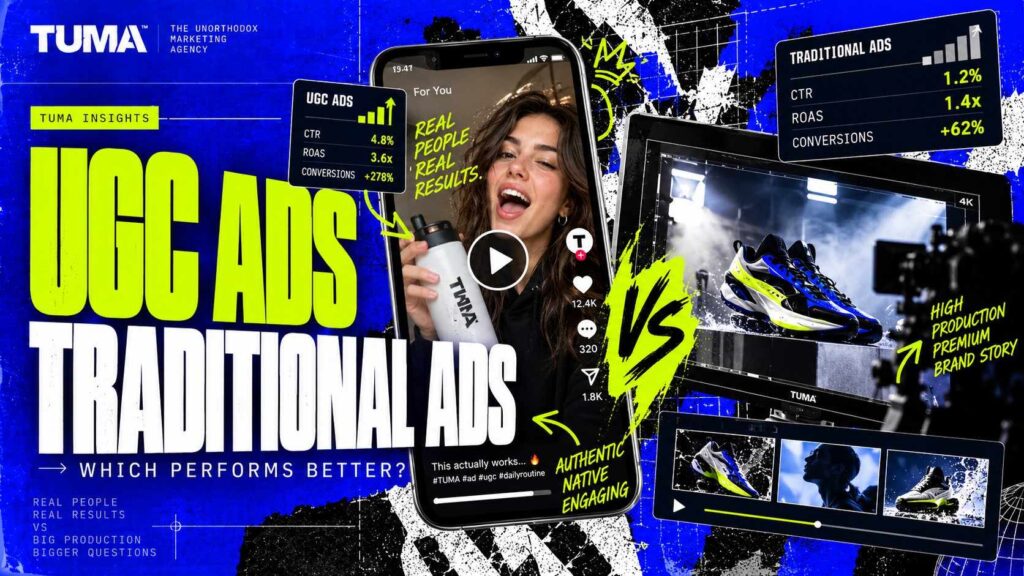
Brands are often told that polished advertising is dead and raw, creator-style content is what converts.
That is too simple.
A creator filming a product demonstration on their phone might outperform an expensive studio commercial. But a professionally produced brand video might also outperform dozens of UGC variations.
Neither outcome is surprising when you understand how advertising actually works.
An advertisement does not perform because it was filmed on a smartphone or produced with a professional camera. It performs when the creative connects the right message with the right audience, in the right environment, and gives people a compelling reason to act.
This is where the UGC ads vs traditional video ads debate becomes more interesting.
UGC-style advertising can offer relatable storytelling, social-feed familiarity, and opportunities for rapid creative testing. Traditional branded video can provide tighter creative control, distinctive brand storytelling, and carefully managed product presentation.
Both approaches can generate awareness, engagement, qualified leads, and sales.
Both can fail.
The useful question is not simply which format is better.
It is which creative approach is better for your audience, campaign objective, platform, message, and business model.
This guide breaks down the differences, performance metrics, creative strategies, production considerations, and testing methods that help brands make that decision.
Read Also: High-Converting Video Ads: Templates, Tips, and Tactics
UGC Ads vs Traditional Video Ads: Quick Answer
Do UGC ads perform better than traditional video ads?
UGC ads can perform strongly in social-feed and direct-response campaigns because creator-style content may feel native, relatable, and easier to test at scale. Traditional video ads offer greater control over brand storytelling, production quality, and visual consistency. Neither format consistently outperforms the other. Results depend on audience preferences, platform, creative concept, campaign objectives, offers, and conversion experience.
The key distinction is this: performance is not a production style. It is an outcome.
A UGC video that generates plenty of clicks but few purchases may be less valuable than a branded video with fewer clicks and more profitable conversions.
Similarly, a cinematic campaign that builds brand recognition and consideration may be delivering exactly what it was designed to achieve, even without producing immediate purchases.
Before choosing a format, define what success actually means.
What Is a UGC-Style Video Ad?
A UGC-style video ad is advertising content designed to resemble the natural presentation, language, pacing, and visual characteristics of organic content created by everyday users or social media creators.
UGC stands for user-generated content.
Historically, the term referred to content voluntarily created by customers or users rather than produced directly by brands.
In modern digital advertising, however, UGC is also commonly used to describe creator-style videos intentionally produced for marketing campaigns.
These advertisements often feature someone speaking directly to the camera, demonstrating a product, explaining a personal experience, or answering a common customer question.
Popular UGC-style video formats include:
- Talking-head videos: A creator addresses the viewer directly.
- Product demonstrations: The product is shown in use.
- Testimonials: Real customers describe genuine experiences.
- Problem-solution ads: A relatable frustration introduces a relevant product benefit.
- Unboxing videos: A creator presents a product and its packaging.
- Tutorials: The video teaches viewers how something works.
- Lifestyle content: Products appear in realistic everyday settings.
- Green-screen commentary: A creator reacts to or explains supporting visuals.
- Voiceover videos: Narration accompanies product footage or demonstrations.
- Before-and-after content: A genuine, representative transformation is shown with appropriate substantiation.
UGC-style ads often use vertical framing, conversational scripts, natural lighting, captions, and editing patterns familiar from social platforms.
However, these are creative characteristics rather than mandatory rules.
A video can be professionally directed and still feel creator-native.
Are all UGC ads actually user-generated?
No.
Some UGC advertisements use genuine content originally created by customers.
Others are commissioned from professional creators who are hired to produce videos resembling organic social content.
A brand may also script, shoot, and edit its own videos in a UGC-inspired style.
This distinction matters because looking like a customer testimonial is not the same as being a genuine customer testimonial.
A paid actor or creator should not be presented as an independent customer describing a personal experience they never had.
The creative style can be informal. The claims still need to be honest.
Organic UGC vs Commissioned UGC vs UGC Advertising
Although marketers often use these terms interchangeably, they describe different stages or sources of content.
| Content type | Definition | Who creates it? | Typical purpose |
| Organic UGC | Content voluntarily created by customers or users | Customers, users, community members | Sharing experiences, opinions, and recommendations |
| Commissioned UGC | Content created under an agreement with a brand | Hired creators or content producers | Producing creator-style marketing assets |
| UGC advertising | Organic or commissioned UGC-style assets distributed through paid media | Brand, creator, or customer as applicable | Awareness, engagement, leads, or conversions |
Organic User-Generated Content
Imagine someone purchases a skincare product, uses it, and voluntarily posts a review on TikTok.
That is organic UGC.
The brand did not necessarily direct the production, write the script, or pay for the content.
However, the brand still needs appropriate permission before reusing someone else’s video commercially.
Commissioned UGC
Now imagine a skincare brand hires a creator to demonstrate a moisturizer, explain its ingredients, and deliver three different opening hooks.
The creator receives a brief and produces the agreed assets.
This is commissioned UGC-style content.
The video may look informal, but the production is a commercial arrangement.
UGC Advertising
Finally, the brand uses an appropriately licensed creator video in a paid Instagram or TikTok campaign.
That is UGC advertising.
In other words:
UGC describes a source or style of content. Paid advertising describes how the content is distributed.
Understanding this distinction helps brands manage creative production, authenticity, licensing, and advertising compliance.
UGC Creator vs Influencer: What’s the Difference?
UGC creators and influencers may produce similar-looking content, but brands often hire them for different reasons.
A UGC creator is generally hired primarily to produce content.
An influencer is typically hired to create content and provide access to an existing audience.
| Factor | UGC Creator | Influencer |
| Primary value | Content production | Content creation and audience access |
| Follower count | May be less important | Often relevant to the partnership |
| Distribution | Frequently through brand-owned or paid channels | Commonly through creator-owned channels |
| Deliverables | Videos, scripts, variations, raw footage | Sponsored posts, videos, stories, campaigns |
| Compensation | Production fee and possible licensing fees | Content, distribution, partnership, and licensing fees |
| Paid media | Requires suitable advertising rights | May require separate paid-media and partnership permissions |
These categories overlap.
An influencer may produce UGC-style ads for a brand without publishing them.
A UGC creator may also have a substantial audience and negotiate sponsored distribution.
The important questions are commercial rather than semantic.
Is the brand purchasing content, reach, paid-media rights, or a combination?
Does the agreement include creator account permissions, exclusivity, raw footage, revisions, and usage duration?
A creator’s audience size matters much less when the brand intends to distribute the asset entirely through its own paid advertising.
What Are Traditional Video Ads?
Traditional video ads are brand-led advertisements typically developed through a more controlled creative production process.
They may involve professional planning, scripts, casting, locations, cinematography, lighting, art direction, editing, sound design, and brand identity systems.
The advertiser usually maintains greater control over the final presentation.
Examples include:
- Television commercials
- Brand films
- Cinematic advertisements
- Studio product demonstrations
- Professionally produced social media ads
- Product launch videos
- Motion graphics advertisements
- Connected-TV commercials
- Corporate and campaign videos
- Documentary-style brand storytelling
Importantly, traditional video advertising does not necessarily mean television advertising.
A highly polished product commercial running on Instagram is still professionally produced branded video advertising.
Likewise, a cinematic campaign published on YouTube remains a digital advertisement even though its visual language resembles a television commercial.
Traditional and UGC-style video are primarily creative distinctions, not media-channel categories.
Why brands use professionally produced video
A controlled production environment lets creative teams decide precisely how the product, brand, and message appear.
Consider a premium fragrance advertisement.
The creative team may use deliberate lighting, carefully designed sets, sophisticated sound, and cinematic pacing to communicate elegance or exclusivity.
A casual creator demonstration may communicate a different message: what the fragrance feels like in everyday use, how someone experiences it, or why they chose it.
Both approaches can be valuable.
They simply express different dimensions of the product.
UGC Ads vs Traditional Video Ads: Key Differences
The most useful comparison considers production, creative control, brand perception, advertising performance, and operational flexibility.
| Factor | UGC Ads | Traditional Video Ads |
| Production style | Often creator-led and conversational | Often brand-led and tightly directed |
| Production speed | Can be faster with a simple brief | May require longer planning and production |
| Complexity | Often lower, depending on the concept | Can involve more specialized resources |
| Creative control | Shared with creator or managed through a brief | Typically greater direct control |
| Visual consistency | May vary between creators | Easier to standardize |
| Perceived authenticity | Can feel personal and relatable | May communicate professionalism and credibility differently |
| Social proof | Easy to incorporate through genuine experiences | Can include interviews, evidence, and demonstrations |
| Testing flexibility | Often suitable for rapid creative variations | Flexible when production is modular |
| Creative volume | May be easier to expand | Can require greater resources |
| Platform nativeness | Often well suited to social feeds | Depends on creative execution |
| Brand storytelling | Effective for personal and social narratives | Greater control over complex brand worlds |
| Premium presentation | Possible through carefully directed execution | Easier to manage with precise art direction |
| Direct response | Frequently used | Equally capable when designed for conversion |
| Brand building | Can strengthen community and recognition | Often useful for consistent brand expression |
| Repurposing | Can support multiple short-form edits | Can generate extensive assets when planned correctly |
These are tendencies, not guarantees.
A carefully directed creator ad can deliver greater brand consistency than a poorly coordinated studio campaign.
A professional production can also generate dozens of reusable assets if variation is part of the production plan.
Modern video advertising exists on a spectrum
One of the biggest problems with the UGC vs traditional advertising debate is that it treats creative formats as two completely separate categories.
Modern advertising is more flexible.
THE VIDEO CREATIVE SPECTRUM:
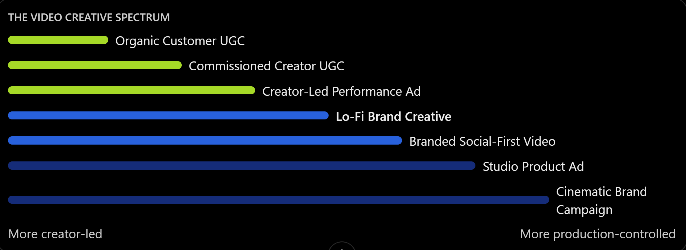
This spectrum is illustrative, not a formal industry classification. Actual campaigns may combine characteristics from several points.
For instance, a beauty brand might feature a creator speaking naturally to the camera while using professionally filmed product close-ups, custom motion graphics, and a carefully written direct-response script.
Is it UGC or branded video?
It is both.
That flexibility creates opportunities for hybrid creative, which we will explore later.
Which Performs Better: UGC or Traditional Video?
There is no universal winner.
The answer depends on what the campaign is trying to achieve and how success is measured.
A video designed to introduce a brand to millions of potential customers should not be judged using exactly the same criteria as a retargeting advertisement intended to generate immediate purchases.
Similarly, an advertisement promoting a $20 everyday product may require a different creative approach from one introducing a complex enterprise software platform.
The relationship looks like this:
Business Objective → Target Audience → Creative Strategy → Campaign Execution → Performance Measurement
Why a winning ad can depend on the metric
Imagine an ecommerce brand tests two advertisements.
Ad A is a creator-style video that opens with a relatable customer problem.
Ad B is a studio-produced product commercial emphasizing the brand’s design and product quality.
The creator video receives stronger early engagement and more clicks.
The studio video attracts fewer clicks but generates more qualified purchases.
Which advertisement performed better?
For a traffic campaign, Ad A might be the stronger result.
For a profitability-focused acquisition campaign, Ad B might be preferable.
For a brand campaign, neither conclusion is sufficient without considering awareness, recall, consideration, and other brand outcomes.
The same advertisement can outperform on one metric while underperforming on another.
That is why effective advertising decisions require objective-specific measurement rather than format-based assumptions.
UGC vs Traditional Ads by Performance Metric
Marketers should evaluate video ads across four important groups of performance indicators.
| Performance category | Key metrics | What they help measure |
| Attention | Hook rate, early retention, hold rate, watch-through rate | Whether the creative earns and maintains attention |
| Engagement | Watch time, completion rate, shares, saves, comments | Whether people continue interacting with the content |
| Traffic | Click-through rate (CTR), cost per click (CPC) | Whether the ad generates visits and at what cost |
| Conversion | Conversion rate, CPA, CPL, CAC, revenue, ROAS | Whether the campaign contributes to measurable business actions |
| Brand | Awareness, recall, consideration, preference, brand lift | Whether advertising influences how audiences recognize and evaluate the brand |
1. Attention and video engagement
The opening seconds of a video influence whether people continue watching.
Creator-style ads may earn attention because their presentation resembles the content viewers already consume.
Polished video can earn attention through exceptional cinematography, compelling movement, unexpected imagery, or distinctive storytelling.
Neither method has a monopoly on attention.
Hook rate is a commonly used creative-analysis metric, but its definition varies by team and platform. One team might measure the share of impressions producing a three-second view, while another uses a different threshold.
Hold rate and early retention describe whether viewers continue watching after the opening.
Watch-through rate and completion rate can help assess how many viewers progress through or finish a video, using the platform’s applicable definitions.
Compare these metrics consistently within the same measurement environment.
A creator video might generate stronger early retention because its opening feels familiar.
A cinematic video might generate deeper watch time through storytelling.
Neither result automatically establishes stronger business performance.
2. Traffic performance
Click-through rate measures how often impressions generate clicks, according to the particular click definition being reported.
Cost per click measures advertising spend relative to the clicks received.
A curiosity-led creator video might generate clicks from people who want to learn more.
A product-focused branded video might attract fewer but more qualified visitors.
Traffic quality matters as much as traffic quantity.
A high CTR is useful only when the clicks support the intended campaign objective.
3. Conversion performance
For ecommerce and lead-generation campaigns, important metrics include:
- Conversion rate: The share of eligible visitors or interactions resulting in a desired action.
- CPA: Advertising spend divided by the number of attributed desired actions.
- CPL: Cost per qualified or recorded lead, depending on the definition.
- CAC: Broader customer acquisition cost, typically including more than direct advertising spend.
- ROAS: Attributed advertising revenue divided by advertising spend.
ROAS does not represent profit.
A campaign with apparently strong revenue returns may still face problems with product margins, fulfillment costs, refunds, or customer acquisition economics.
Likewise, platform-attributed sales are not necessarily all incremental sales caused by advertising.
Where possible, marketers should supplement platform reporting with business data, controlled experiments, and appropriate attribution or incrementality analysis.
4. Brand performance
Brand campaigns may prioritize outcomes such as:
- Brand awareness
- Ad recall
- Message association
- Consideration
- Brand preference
- Brand lift
These outcomes require suitable research or measurement methods.
An advertisement can improve recognition or consideration without immediately producing a purchase.
That does not make the advertisement ineffective.
High engagement does not automatically mean profitable advertising. A lower-CTR brand advertisement is not automatically unsuccessful.
The Creative Performance Chain: How Video Ads Actually Convert
A strong video ad does more than capture attention.
It guides viewers through a sequence of understanding, evaluation, and potential action.
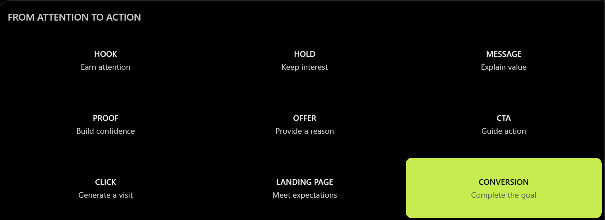
Conceptual customer journey. Actual viewing and purchasing behavior is not always linear.
A strong hook creates an opportunity for the message to be heard.
The message explains why the product matters.
Proof reduces uncertainty.
The offer and CTA create a reason to continue.
The landing page supports the promise made in the advertisement.
Conversion occurs when the full experience provides enough value and confidence for the customer to act.
An outstanding hook cannot compensate indefinitely for a weak offer, unsupported claims, or a confusing checkout.
This applies equally to creator-led and traditional video advertising.
Why UGC Ads Can Work in Paid Social
UGC advertising has several characteristics that can make it useful in social-first marketing.
1. UGC can feel native to social feeds
People encounter creator videos, conversations, tutorials, reviews, and personal stories throughout their social media experience.
An advertisement using familiar presentation styles may fit naturally into that environment.
Rather than opening with a corporate brand introduction, a creator might begin with a relevant observation or customer problem.
That approach can make the message feel more conversational.
TikTok’s official creative guidance encourages advertisers to develop mobile-first, platform-native content, use relatable people, and test different creative approaches. These are platform recommendations, not proof that every creator-style advertisement will outperform polished creative.
TikTok for Business+1
2. Relatability can make product benefits easier to understand
Consider two advertisements for a compact travel backpack.
One shows a beautifully filmed product rotating against a studio background.
The other shows a traveler fitting clothes, accessories, and a laptop into the backpack before a trip.
The studio video may communicate product quality and design.
The creator demonstration may make the practical benefit easier to understand.
Both communicate value differently.
The stronger execution depends on what the audience needs to know.
3. UGC can incorporate credible social proof
Customer reviews, demonstrations, and authentic experiences can help people evaluate products.
When viewers can see a product being used or hear a genuine account from someone with relevant experience, uncertainty may decrease.
The relationship can be described as:
Visible Evidence → Reduced Uncertainty → Greater Purchase Confidence
However, social proof must be genuine.
A creator reading a fictional customer experience is not a legitimate customer testimonial.
4. UGC can support rapid creative testing
Creator-led production can make it easier to produce different hooks, product explanations, objections, and CTAs without rebuilding an entire production.
For example, one product demonstration might produce several advertisements:
- One begins with a customer frustration.
- Another opens with the product benefit.
- A third answers a common objection.
- A fourth emphasizes convenience.
- A fifth focuses on the offer.
This creates opportunities to learn which messages resonate.
But creative volume is valuable only when the variations answer meaningful questions.
Authenticity, Trust, and Social Proof: What UGC Gets Right and Wrong
UGC often feels authentic because it resembles everyday communication.
Natural language, familiar environments, direct eye contact, and conversational pacing can make advertising more relatable.
But UGC format does not automatically create authenticity.
An advertisement can be filmed on a phone and still feel completely artificial.
When UGC loses credibility
Trust can decline when scripts sound unnatural, creators exaggerate product benefits, claims lack evidence, or the delivery feels forced.
Credibility may also suffer when the creator clearly does not understand the product or the brand deliberately disguises the commercial relationship.
The solution is not simply to remove production polish.
It is to create advertising grounded in truthful claims and relevant experiences.
What makes social proof persuasive?
Effective social proof gives potential customers information they can use.
A credible testimonial should reflect actual experience.
A demonstration should accurately show product capabilities.
A comparison should use fair criteria.
A before-and-after advertisement should represent legitimate, substantiated results without misleading editing or presentation.
Trust comes from credible communication, not from a particular camera style.
The U.S. Federal Trade Commission’s endorsement guidance emphasizes truthful testimonials, substantiated claims, and appropriate disclosure of material relationships between endorsers and advertisers.
Federal Trade Commission+1
Where Traditional Video Advertising Has an Advantage
Professionally produced video gives advertisers the ability to manage creative execution with greater precision.
That can be especially important when visual presentation contributes directly to the brand’s meaning.
1. Creative control
Traditional production often allows tight control over:
- Casting and performance
- Script and dialogue
- Set design and locations
- Lighting and cinematography
- Product presentation
- Color grading
- Music and sound design
- Brand assets and typography
- Editing and pacing
This control helps translate strategy into recognizable brand expression.
Brand Strategy → Creative Direction → Execution → Brand Expression
For instance, a high-end watch brand may want precise macro photography, carefully controlled reflections, and deliberate pacing.
A conventional studio setup can help achieve that presentation reliably.
2. Brand consistency
Brands build recognizable meaning through repeated creative signals.
Color, typography, visual composition, sonic cues, product presentation, and tone can contribute to familiarity.
Professionally directed campaigns can apply those elements consistently across video advertising, websites, packaging, retail environments, and other touchpoints.
That consistency may matter for launches, repositioning, premium products, and integrated campaigns.
3. Complex storytelling
Some ideas require more than a brief creator explanation.
A major brand campaign might tell an emotional story, establish a fictional world, communicate a complex product journey, or connect multiple characters and settings.
Professionally produced video provides greater control over these elements.
However, creator-led storytelling can also be sophisticated. The difference is usually the production approach and degree of control, not whether storytelling is possible.
4. Brand perception
Production choices influence how audiences interpret a business.
A carefully crafted commercial may communicate sophistication, technical expertise, aspiration, or exclusivity.
A conversational creator video may communicate accessibility, familiarity, community, or practicality.
These associations are not automatic.
Production Style → Audience Interpretation → Brand Perception
Audience interpretation also depends on existing brand meaning, category expectations, previous experiences, and viewing context.
A luxurious-looking advertisement cannot make an unreliable product genuinely premium.
And a casual-looking video does not make a sophisticated brand less credible by default.
UGC vs Traditional Video: Production Costs and Creative Velocity
UGC is often described as cheaper than traditional advertising.
That may be true for some projects, but production economics are more complicated.
What affects UGC production costs?
UGC-style production may involve creator fees, product shipping, research, scripting, creative direction, filming, editing, revisions, licensing, and paid advertising usage rights.
Costs can rise when a brand needs multiple creators, extensive revisions, complex demonstrations, professional post-production, multilingual content, or longer licensing periods.
What affects traditional video production costs?
Traditional video production may require a director, producer, professional crew, actors, studio rental, equipment, locations, lighting, props, art direction, sound, editing, animation, color grading, and licensing.
As complexity increases, resource requirements may increase.
Greater Production Complexity → More Resources → Potentially Higher Cost
Yet the total cost should be evaluated against the value of the finished assets.
A well-planned studio shoot may generate a major campaign film, dozens of shorter edits, product demonstrations, social advertisements, and reusable footage.
Likewise, a UGC campaign with repeated creator fees and limited usage terms may become expensive over time.
The important measure is not merely production cost per video.
Brands should also evaluate usable asset volume, licensing duration, production efficiency, creative lifespan, and ultimately business outcomes.
What is creative velocity?
Creative velocity is a brand’s ability to generate ideas, produce advertising assets, launch tests, analyze results, and create improved iterations.
It includes the entire process, not merely how quickly editors export videos.
UGC-style production can support velocity when creators produce modular footage and multiple hook variations.
Professionally produced campaigns can also achieve high creative velocity through batch shooting, standardized workflows, reusable footage, templates, and modular production.
A strong production system creates more opportunities for learning without sacrificing creative quality.
Creative Strategy Comes Before Video Format
One of the most important advertising decisions happens before anyone opens a camera app.
What are we trying to communicate, and why should the audience care?
Too many campaigns begin with a production request.
“We need ten UGC ads.”
“We need a cinematic commercial.”
“We need more TikTok videos.”
But format selection should follow an understanding of the customer.
A stronger approach is:

Start with customer insight
Before choosing UGC or traditional video, understand:
- Who is the target audience?
- What problem are they trying to solve?
- What motivates them to buy?
- Which alternatives are they considering?
- What objections prevent action?
- What information or proof would help?
- What does the brand need to communicate?
- Which platforms and contexts will carry the message?
Customer reviews, interviews, support conversations, sales feedback, search behavior, and past campaign data can reveal useful creative opportunities.
Develop a meaningful creative concept
A concept is the central idea that makes the advertisement relevant and persuasive.
For a productivity software company, the concept might explore how disorganized team communication creates unnecessary work.
That idea could become a creator-led explanation, a founder video, a product demonstration, or a polished animated commercial.
The central customer insight remains the same.
The execution changes.
Format is the delivery mechanism
A great concept can be weakened by the wrong execution.
A detailed tutorial may require clear screen recordings and structured explanations.
An emotional brand campaign may benefit from cinematic storytelling.
A testimonial-driven concept may be most credible when delivered by a genuine customer.
The format should serve the idea. The idea should serve the audience and business objective.
Creative Testing: How to Test UGC Against Traditional Video Ads
Creative testing is one of the most reliable ways to understand which approach works better for a specific business.
Instead of assuming that UGC or polished video will win, brands can use structured experiments.
The process is straightforward:
Hypothesis → Creative Variation → Launch → Data → Learning → Iteration
Step 1: Define the hypothesis
Start with a question worth answering.
For example:
Will a relatable problem-first opening generate more qualified purchase interest than a product-first studio introduction?
That is more useful than simply asking whether UGC is better.
It identifies the specific creative mechanism being tested.
Step 2: Develop comparable executions
Create a creator-style version and a professionally produced version addressing the same audience problem.
Where the goal is to isolate production style, keep the offer, primary claim, core message, CTA, and landing page as similar as practical.
If one version contains a discount and the other does not, the result cannot cleanly identify the effect of format.
Step 3: Plan a fair test
Compare results under sufficiently similar conditions, including audience, placement, campaign objective, budget allocation, measurement window, and attribution setup.
Where possible, use a platform-supported randomized experiment or split test to reduce differences between groups.
Ordinary ad delivery may allocate impressions unevenly, so simply putting two creatives into the same campaign does not guarantee a controlled comparison.
Allow enough data to support a reasonable decision.
Avoid declaring a winner based on a handful of clicks or conversions.
Step 4: Measure the relevant outcomes
Evaluate the metrics that reflect the business objective.
For example, a purchase campaign might prioritize qualified conversions, CPA, revenue, and ROAS.
Hook rate and CTR can explain why performance differs, but should not replace business metrics.
Step 5: Turn findings into new creative
Suppose the creator-style advertisement holds attention more effectively but converts less efficiently.
The next test might combine its opening hook with a clearer branded product demonstration.
Alternatively, if studio footage drives more purchases but struggles to generate attention, the brand might test a more conversational opening.
That is creative testing at its best.
It does not simply select a winner. It identifies opportunities to build better advertisements.
What creative variables should brands test?
| Creative variable | Possible test |
| Hook | Question vs statement |
| Opening | Customer problem vs product benefit |
| Ad angle | Emotional vs rational |
| Proof | Genuine testimonial vs demonstration |
| Product message | Feature vs benefit |
| Creator | Creator A vs Creator B |
| Presentation | Talking head vs voiceover |
| Production style | Creator-native vs studio |
| Story | Founder explanation vs customer journey |
| Pacing | Fast cuts vs deliberate storytelling |
| Length | Short vs longer explanation |
| CTA | Learn more vs shop now |
| Offer | Value-led vs promotion-led |
| Visual presentation | Lifestyle footage vs product close-ups |
| Brand integration | Brand-first vs message-first |
Changing the opening text is not the same as changing the entire creative concept.
A genuine concept test explores a different reason someone might care, believe, or act.
Why more UGC variations do not always create better results
It can be tempting to produce large numbers of creator videos simply because production is relatively accessible.
However, quantity does not guarantee learning.
Twenty versions of the same weak idea may offer less strategic value than three meaningfully different concepts.
Good creative testing combines controlled experimentation with creative exploration.
The purpose is not to produce the most variations.
It is to identify what changes audience behavior and contributes to the campaign goal.
For a deeper explanation of this process, TUMA’s performance creative guide covers the connection between audience research, paid media, experimentation, and creative iteration.
TUMA
What Is Creative Fatigue, and Does UGC Help Prevent It?
Creative fatigue occurs when repeated exposure to advertising reduces its ability to attract attention or encourage action.
An advertisement might perform well initially and gradually become less effective as the same audience sees it repeatedly.
A useful conceptual sequence is:
Repeated Exposure → Familiarity → Potential Attention Decline → Creative Refresh
UGC-style production can help marketers create new hooks, angles, creator variations, and messages efficiently.
However, UGC is not immune to fatigue.
A creator testimonial can become repetitive just as quickly as a polished product commercial.
How to recognize potential creative fatigue
Possible indicators include declining CTR, weaker video retention, rising acquisition costs, and increasing frequency without corresponding improvements in business results.
But these indicators are not definitive.
Performance may also decline because of changing audience demand, competition, seasonality, auction conditions, pricing, tracking issues, landing-page problems, or increased media spend.
Do not automatically blame creative fatigue whenever CPA rises.
How to refresh creative strategically
Rather than constantly replacing every advertisement, identify which elements may need improvement.
If the audience responds to the core product demonstration but stops watching the opening, test new hooks.
If the creative earns attention but generates poor conversion quality, reconsider the message, audience, proof, or offer.
If repeated exposure appears to be the problem, introduce meaningful new concepts or audience-relevant stories.
Creative refresh should preserve useful learning while introducing meaningful novelty.
UGC for Meta and TikTok Ads: Does Platform Matter?
Absolutely.
A video advertisement is experienced within a particular environment.
Creative that works in one placement may need different editing, framing, pacing, and messaging elsewhere.
The key relationship is:
Audience × Platform × Objective × Creative Format → Campaign Fit
UGC for Meta Ads: Facebook and Instagram
Meta advertising includes several viewing environments, such as Facebook Feed, Instagram Feed, Reels, and Stories.
Each environment influences how viewers encounter advertising.
Creator-style videos may be useful for:
- Customer testimonials
- Product demonstrations
- Problem-solution storytelling
- Founder explanations
- Objection handling
- Direct-response product ads
- Retargeting
For example, an ecommerce brand might use a creator video explaining how its product solves a specific customer frustration.
The advertisement can move quickly from the problem to a demonstration, relevant evidence, and a purchasing CTA.
However, Meta advertising is not limited to UGC.
A polished product video can showcase features clearly, strengthen recognizable brand assets, and communicate quality.
For premium consumer products, a combination of studio footage and creator explanations may be particularly useful.
What about Meta Partnership Ads?
Meta Partnership Ads allow advertisers to collaborate with eligible creators or partners using supported identity and permission arrangements.
Depending on eligibility and setup, a brand may advertise with creator-associated content or identities rather than distributing every asset solely from its own account.
These arrangements require appropriate platform permissions. Permission to use a creator’s account identity should be distinguished from the broader contractual rights to use, edit, or license their content.
GitHub
Brands should verify current Meta requirements before launching partnership campaigns.
UGC for TikTok Ads
TikTok is a video-first environment where creator storytelling, entertainment, product demonstrations, and conversational content are familiar forms of communication.
UGC-style advertising may work well when it follows the platform’s viewing patterns without sacrificing the brand message.
Useful creative considerations include:
- Vertical, mobile-first presentation
- A relevant opening hook
- Clear dialogue or voiceover
- Captions and readable on-screen text
- Product demonstrations
- Natural storytelling
- Recognizable customer situations
- A clear CTA
TikTok’s official performance creative guidance recommends vertical 9:16 production, appropriate safe-zone placement, sound, and the inclusion of people where relevant. These recommendations should be adapted to the campaign rather than treated as guaranteed performance formulas.
TikTok For Business
TikTok Spark Ads and creator content
TikTok’s Spark Ads format allows advertisers to use eligible organic TikTok posts in advertising, including posts from other creators when authorized.
That can help brands distribute existing creator content through paid campaigns while preserving relevant features of the original post.
TikTok’s documentation specifically identifies creator authorization as part of the process.
TikTok For Business
The distinction between UGC and paid distribution is especially important here: an organic creator video does not automatically become available for unrestricted advertising.
What about YouTube, Connected TV, and other placements?
| Platform or placement | Creative considerations | Suitable approaches |
| TikTok | Native storytelling, vertical framing, hooks, pacing | Creator-led, branded social-first, hybrid |
| Instagram Reels | Fast discovery, product storytelling, short-form presentation | UGC, polished short-form, hybrid |
| Facebook Feed | Clear propositions, demonstrations, testimonials | Creator-style and branded direct-response video |
| YouTube Shorts | Vertical content, concise storytelling, immediate relevance | Creator-led, educational, product-focused |
| YouTube in-stream | Viewing context, message clarity, duration, format requirements | Explainers, demonstrations, brand films |
| Connected TV | Television-screen presentation and viewing environment | Brand campaigns, premium video, relevant direct-response creative |
| Out-of-home | Immediate visual recognition, simplicity, placement context | Distinctive branded creative, concise visual storytelling |
Different viewing contexts create different creative requirements.
An advertisement built for Instagram Stories may need adjustment before appearing on a television screen.
Likewise, a long-form brand film may require a separate social-first edit rather than simply being cropped vertically.
Platform adaptation is creative work, not just resizing.
UGC vs Traditional Video Ads Across the Marketing Funnel
Many marketers associate UGC with conversion and traditional branded video with awareness.
That distinction can be helpful as an initial planning assumption, but it becomes limiting when treated as a rule.
The more useful principle is:
Funnel stage influences the message more than it dictates production style.
| Funnel stage | Audience situation | UGC opportunities | Traditional video opportunities |
| Top of funnel | Discovering a problem, category, or brand | Creator storytelling, relatable scenarios, social-first discovery | Brand films, product-led awareness, cultural campaigns |
| Middle of funnel | Evaluating options and learning benefits | Reviews, tutorials, explanations, customer stories | Product films, feature demonstrations, comparisons |
| Bottom of funnel | Considering a specific action | Objection handling, testimonials, FAQs, creator explanations | Offer-focused ads, detailed product demonstrations, branded retargeting |
Top of funnel: Awareness and discovery
At the awareness stage, the objective may be to introduce a problem, create interest, or establish a memorable brand association.
A creator-led story could make an unfamiliar product feel relevant.
A professionally produced brand film could establish a distinctive identity.
Either approach can introduce the brand effectively when the concept fits the audience.
Middle of funnel: Education and consideration
Consideration-stage advertising often needs to explain benefits, answer questions, or provide evidence.
A creator might demonstrate how an ecommerce product fits into everyday life.
A polished product video might provide detailed visual explanations of features.
A hybrid video could combine both.
Bottom of funnel: Conversion and decision-making
At the conversion stage, the audience may already recognize the product but still have objections.
Creative might address pricing, practical use, features, product suitability, delivery information, or other relevant concerns.
Both genuine customer testimonials and professionally produced demonstrations can support these needs.
The strongest message depends on the objection.
How UGC Can Support Retargeting Campaigns
Retargeting is advertising directed toward eligible audiences who have previously interacted with a brand or completed relevant actions, subject to platform settings and privacy requirements.
These audiences may need different information from people encountering the brand for the first time.
For example, someone who viewed a product page may already understand the main benefit but remain unsure about suitability or value.
A retargeting advertisement might use:
- A genuine customer testimonial
- A practical demonstration
- A product comparison
- An FAQ explanation
- An objection-handling video
- A creator answering a common question
The progression might look like this:
Interest → Objection → Relevant Proof → Renewed Consideration
A professionally produced product video could communicate the same information effectively.
The key is identifying what the audience needs next.
Brands should also avoid making intrusive assumptions about individual viewers or revealing sensitive information through personalized ad messaging.
Brand Building vs Direct Response: Two Objectives, One Creative System
Brand building and direct-response advertising are often discussed as separate marketing disciplines.
Brand building focuses on developing recognition, associations, consideration, preference, and long-term customer memory.
Direct-response advertising focuses on encouraging a measurable action such as a purchase, lead, registration, or booking.
| Brand building | Direct response |
| Awareness | Immediate action |
| Recognition and recall | Clicks, leads, purchases |
| Brand associations | Conversion intent |
| Meaning and relevance | Offer and proposition |
| Long-term memory | Measurable short-term response |
| Brand preference | Acquisition efficiency |
These objectives can overlap.
A direct-response video can feature recognizable brand assets and strengthen memory.
A brand film can include a meaningful CTA.
A creator-led advertisement can generate immediate sales while reinforcing a consistent product benefit.
The idea sometimes called brandformance describes this integration, but it should not be mistaken for a standardized scientific metric.
Can UGC build brands?
Yes.
Creator partnerships, founder-led content, community participation, and consistent product storytelling can strengthen recognition and familiarity.
However, brands should avoid producing disconnected creator videos that communicate different identities every week.
UGC contributes more effectively to brand building when it reinforces recognizable messages, distinctive assets, and credible experiences.
Can traditional video generate conversions?
Yes.
Professionally produced video can explain a product, overcome objections, demonstrate benefits, introduce an offer, and encourage action.
A direct-response script does not become ineffective because the cinematography is excellent.
Brand building and conversion are objectives. UGC and professional production are creative approaches.
They are not interchangeable categories.
Hybrid Creative: The Middle Ground Brands Often Miss
One of the most valuable opportunities in modern video advertising exists between completely organic-looking content and tightly controlled studio advertising.
Hybrid creative combines creator-native storytelling with deliberate brand strategy and production control.
It allows brands to preserve conversational presentation while benefiting from stronger art direction, product visualization, editing, and creative consistency.
The strategic relationship is:
Hybrid Creative Model

Examples of hybrid advertising
Brand-led UGC: A creator delivers a conversational product explanation while following established brand messaging and visual guidelines.
Creator-led brand advertising: A professional creator becomes the central personality in a directed brand campaign.
Lo-fi performance creative: The advertisement maintains a natural, accessible visual style but uses deliberate scripting, editing, and testing.
Studio footage edited in creator style: Professionally filmed product demonstrations are combined with conversational voiceovers, captions, and social-first pacing.
Creator footage with branded motion graphics: Natural creator delivery is supported by controlled product graphics, typography, visual effects, or feature callouts.
Founder-led advertising: A founder explains the brand’s purpose or product while professional editing improves clarity and presentation.
UGC testimonials with studio footage: Genuine customer experiences are combined with professionally filmed product close-ups and demonstrations.
Why hybrid creative can be strategically useful
Hybrid production gives brands a wider range of creative options.
A company can maintain its identity without forcing every video into the same visual template.
Creators can communicate naturally while working within clear messaging guidelines.
Production teams can improve lighting, sound, editing, and product clarity without removing the personal character of the content.
Media teams can test different hooks, audiences, and creative structures using the same underlying footage.
Two principles matter:
Authenticity does not require abandoning brand control.
Production polish does not require abandoning platform-native storytelling.
Rather than asking whether a campaign should use UGC or traditional video, brands should consider which elements of each approach support the creative concept.
UGC Ads for Ecommerce and DTC Brands
UGC-style advertising can be particularly useful for ecommerce and direct-to-consumer brands because purchasing decisions often depend on understanding products without seeing them in person.
A strong product video can help customers evaluate practical benefits, size, use cases, features, and potential limitations.
Product demonstrations
A creator might show how a product works in an everyday environment.
This can make its usefulness clearer than a purely visual product showcase.
For instance, a kitchen product demonstration could show the preparation process, cleaning requirements, and final result.
The creative becomes more valuable when it answers real customer questions rather than simply displaying the product.
Objection handling
Customer concerns often provide effective advertising angles.
A skincare brand might need to explain texture, ingredients, product compatibility, or application.
A fashion brand might need to address sizing, materials, fit, or styling.
A consumer electronics brand might need to explain setup, battery life, or compatibility.
Creator-led explanations can make these messages accessible, but every objective product claim should remain accurate and supportable.
Creative testing for DTC brands
Ecommerce advertisers may benefit from testing different customer motivations.
A brand might compare convenience-led messaging with durability, design, product features, or another relevant benefit.
UGC is one way to communicate these angles.
Professionally produced product videos can test the same hypotheses.
Why UGC does not automatically create sales
Advertising performance depends on more than the video asset.
Creative + Audience + Offer + Product Page + Landing Page + Media Strategy → Campaign Performance
For example, a creator advertisement may generate strong demand, but an unclear product page could prevent visitors from converting.
A strong campaign aligns the creative message, pricing, product information, page experience, and audience expectations.
Can Premium and Luxury Brands Use UGC?
Yes, but the execution needs to reinforce the intended brand perception.
Luxury and premium brands often rely on carefully developed visual identities, distinctive presentation, craftsmanship, aspiration, and emotional storytelling.
A conventional creator-style advertisement could support those associations or undermine them depending on how it is produced.
Consider a premium fragrance brand.
A casual video focused entirely on discount pricing might conflict with a positioning strategy built around exclusivity.
However, an editorial creator collaboration showing a fragrance as part of a sophisticated daily ritual might strengthen that positioning.
Possible approaches include cinematic campaigns, editorial creator partnerships, documentary-style storytelling, founder content, luxury lifestyle films, and carefully directed UGC-inspired videos.
The premium brand decision
The question is not whether UGC is too informal for luxury.
It is:
Does the execution reinforce or undermine the intended brand perception?
A premium brand may choose different production styles for different objectives while keeping its central identity recognizable.
For example, cinematic storytelling could establish its aesthetic world, while creator-led demonstrations explain product features or usage.
The two approaches can complement each other.
UGC and Traditional Video for Brand Launches
A launch often involves two distinct challenges.
First, the brand needs to communicate what it stands for.
Second, it needs to help potential customers understand the product and consider taking action.
Professionally produced brand video may establish positioning, visual identity, product storytelling, distinctive assets, and campaign coherence.
UGC-style creative may support launch through creator seeding, demonstrations, personal explanations, and social-first discovery.
For example, a new consumer product might use a cinematic launch film to introduce its identity, followed by creator-led demonstrations explaining how the product works.
The creative system could also include founder interviews, studio product footage, customer stories, and shorter paid-social edits.
Rather than treating each asset as a separate advertisement, brands can design a connected communication system.
That allows the launch to remain recognizable across different formats and audiences.
Do You Run UGC Creator Videos as Ads?
Yes. Brands commonly commission or license creator videos for paid advertising, provided they have the appropriate usage rights and comply with relevant platform and advertising requirements.
A brand might use creator content as an ordinary ad from its own account or through a supported creator partnership advertising arrangement.
However, having possession of the video file does not necessarily grant unrestricted commercial usage rights.
What should brands confirm before running UGC ads?
Brands should clearly establish:
- Whether organic social publishing is permitted
- Whether paid advertising is included
- Which platforms are covered
- How long the content can be used
- Which geographic markets are covered
- Whether the brand can edit or repurpose the content
- Whether raw footage is included
- Whether the creator’s name, image, or account identity can be used
- Whether music and third-party elements have appropriate commercial rights
- Whether platform-specific creator permissions are required
Creator content can be valuable long after filming, so usage terms deserve attention before production begins.
UGC Usage Rights, Licensing, and Advertising Compliance
UGC advertising may look informal, but it still operates within commercial, legal, and platform requirements.
Organic rights vs paid advertising rights
Organic usage rights may permit a brand to publish content through agreed unpaid channels.
Paid-media rights allow the content to be used in advertising according to the scope of the agreement.
Those rights are not automatically identical.
Licensing duration and territory
A contract should establish how long the brand may use the content and where it can be distributed.
For example, an agreement could cover a defined campaign period and specified geographic markets.
The specific terms depend on the creator agreement.
Editing and derivative content
Brands should confirm whether they may create shorter edits, change captions, combine footage with other assets, translate voiceovers, or produce alternative advertisements.
Raw footage rights and final edited video rights may also differ.
Creator permissions
Using creator content from a brand account is different from advertising with the creator’s account identity.
The latter may require additional in-platform permissions.
For TikTok, the official Spark Ads documentation explains how eligible creator posts can be authorized for advertising.
TikTok For Business
Music and image licensing
Music approved for personal or organic social publishing is not necessarily licensed for every commercial advertising use.
Brands should verify the scope of music, stock footage, images, and other third-party assets before distribution.
Disclosure and advertising claims
Paid partnerships and endorsements may require clear disclosures, depending on the relationship, audience, platform, and applicable law.
In the United States, the FTC advises creators to disclose material connections that could affect how audiences evaluate an endorsement.
The FTC also explains that a platform disclosure tool may not be sufficient on its own and that video disclosures should be clear and difficult to miss.
Federal Trade Commission+1
Brands should also ensure that:
- Testimonials reflect genuine experiences.
- Objective claims have suitable substantiation.
- Results claims do not create misleading expectations.
- Before-and-after presentations are accurate and appropriately contextualized.
- Paid creator relationships are disclosed when required.
- Content complies with platform advertising policies.
TikTok’s official commercial content guidance requires applicable promotional posts to use its disclosure settings and comply with relevant branded-content policies.
TikTok For Business
These principles apply to UGC-style advertising even when the video resembles an ordinary creator post.
The informal presentation does not eliminate commercial responsibilities.
How to Write a UGC Creator Brief That Produces Better Ads
A creator brief should provide enough strategic direction to produce relevant advertising without eliminating the creator’s natural delivery.
A useful brief begins with the audience, not the shot list.
Essential elements of a UGC creative brief
| Element | What the brief should explain |
| Target audience | Who the advertisement is intended to reach |
| Customer insight | Relevant frustrations, motivations, or buying situations |
| Creative concept | The central idea the video should communicate |
| Hook options | Potential opening statements or visual situations |
| Talking points | Essential messages and product benefits |
| Proof | Demonstrations, evidence, or genuine experiences |
| Product claims | Approved and substantiated statements |
| CTA | The action viewers should consider |
| Deliverables | Number and types of videos required |
| Technical specifications | Aspect ratio, length, resolution, and framing |
| Raw footage | Whether unedited material must be provided |
| Revisions | Review process and agreed changes |
| Brand guidelines | Identity, tone, and presentation requirements |
| Usage rights | Paid, organic, territory, duration, and editing permissions |
The process is:
Customer Insight → Creative Brief → Creator Execution → Variations
Avoid over-scripting and under-briefing
Over-scripting can make creators sound unnatural.
Under-briefing can result in inaccurate claims, unclear messages, weak product demonstrations, or content that conflicts with the brand.
A good brief establishes the strategic boundaries while allowing appropriate creative flexibility.
For instance, provide the approved product benefits, required proof, and CTA, but allow the creator to express the message in language that feels natural, provided the meaning and claims remain accurate.
What Are the Different Types of Video Ads?
Video advertising includes formats defined by creative style, marketing objective, and distribution placement.
These categories often overlap.
Video ad types by creative style
| Video ad type | Description |
| UGC-style ads | Creator-native videos designed for advertising |
| Creator-led ads | Advertisements featuring a creator as the central communicator |
| Product demonstrations | Videos showing features or usage |
| Testimonial ads | Genuine customer or user experiences |
| Founder ads | A founder explains the product, business, or mission |
| Explainer ads | Videos simplifying concepts, services, or processes |
| Direct-response video | Advertising designed to encourage measurable action |
| Brand films | Storytelling designed to communicate brand meaning |
| Product commercials | Professionally directed product advertising |
| Cinematic advertisements | High-control visual and narrative production |
| Motion graphics ads | Animated visuals, typography, and graphics |
| Hybrid advertising | Creator-style content combined with branded production elements |
Video ad types by placement
Distribution formats include pre-roll, in-stream, social feed video, Instagram Reels, Stories ads, YouTube Shorts ads, connected-TV advertising, and digital out-of-home video.
A testimonial video could be a UGC-style ad, a direct-response ad, and an Instagram Reels ad simultaneously.
The first term describes the creative approach.
The second describes the campaign objective.
The third describes the placement.
For more context, TUMA’s video marketing guide explores the relationship between video strategy, content, distribution, and performance.
TUMA
Traditional Advertising vs Digital Advertising: What’s the Difference?
Traditional advertising and digital advertising are primarily distinguished by distribution channels and media environments.
Traditional advertising
Traditional advertising includes channels such as linear television, print, radio, billboards, and conventional out-of-home placements.
These channels can provide broad reach and strong visual or cultural presence.
Measurement and audience targeting vary by channel but may offer less granular real-time feedback than many digital advertising systems.
Digital advertising
Digital advertising includes paid social, search, online video, programmatic display, connected TV, and other digital environments.
Depending on the platform and campaign, digital advertising may provide audience targeting, conversion measurement, retargeting, and creative testing.
Digital systems also introduce challenges involving attribution, privacy, auction dynamics, and fragmented customer journeys.
Traditional video advertising is not the same as traditional media
A polished commercial can run on TikTok or YouTube.
A creator-style advertisement can run across multiple digital environments.
Connected TV also combines television-style viewing with digital advertising delivery.
Therefore:
Traditional vs digital advertising describes the media environment.
UGC vs branded video describes the creative approach.
Confusing these categories makes advertising decisions unnecessarily restrictive.
AI-Generated UGC: Opportunity or Risk?
Artificial intelligence is expanding the ways brands can produce and adapt video advertising.
AI-assisted workflows may include script development, synthetic voiceovers, AI avatars, automated editing, translation, localization, and creative versioning.
These tools may improve production efficiency when used appropriately.
Potential advantages of AI-generated UGC
AI can help brands explore creative variations, localize approved scripts, prepare early concepts, and accelerate repetitive editing tasks.
It may also support testing different narration styles, visual structures, and messaging approaches.
However, generating an advertisement quickly is not the same as creating an effective advertisement.
Risks of synthetic creator advertising
AI-generated videos may introduce several challenges.
Synthetic creators can feel artificial or unfamiliar, especially when facial expressions, voice delivery, or product interactions do not appear convincing.
Generated videos may misrepresent product capabilities or depict experiences that never happened.
Brands must also consider commercial rights, voice and likeness permissions, originality, brand consistency, and applicable disclosure requirements.
A synthetic character should not be presented deceptively as an independent real customer with genuine product experience.
Disclosure considerations for AI advertising
AI disclosure requirements differ by platform, content type, market, and applicable law.
In July 2026, Google announced additional options for labeling certain AI-generated or modified advertising assets, while emphasizing that using its labeling tools does not itself guarantee compliance with local legal requirements.
Advertising Policies Help
YouTube also documents disclosure requirements for certain realistic altered or synthetic content uploaded to the platform.
YouTube Help
Advertisers should review the requirements applicable to their content and distribution channels rather than assuming one universal disclosure rule exists.
Should brands use AI instead of creators?
That depends on the creative objective and the need for genuine human experience.
AI can assist with production, but it cannot manufacture legitimate personal product experience.
When the concept depends on a credible customer testimonial, verified human experience remains essential.
When the concept involves animation, product explanation, localization, or an explicitly fictional character, AI may be a useful production tool.
AI can increase creative volume. It does not replace customer insight, concept quality, human judgment, or brand strategy.
Why Landing Pages Matter as Much as Video Creative
A video advertisement does not finish its job when someone clicks.
The post-click experience influences whether that interest becomes a valuable business outcome.
The full customer journey looks like this:
Ad Creative → Click → Landing Page → Checkout / Form → Conversion
Message match
Message match means the landing page delivers an experience consistent with the promise made in the advertisement.
If a creator video promotes a particular product benefit, the product page should make that benefit easy to understand and support it with appropriate information.
If the advertisement features a specific offer, the destination should communicate the offer accurately.
Product-page clarity
An ecommerce product page may need clear descriptions, relevant imagery, pricing, delivery information, product details, and trustworthy purchasing processes.
A lead-generation page may need a clear service explanation, relevant proof, a straightforward form, and a reasonable next step.
Page experience
Slow loading, confusing navigation, poor mobile usability, and unexpected checkout complexity can undermine advertising results.
A strong video might generate substantial interest while the landing page fails to convert that interest.
That does not necessarily mean the creative format was wrong.
Analyze the complete journey
If one advertisement has excellent CTR but poor ROAS, investigate whether its message attracts the wrong audience or whether the website fails to meet expectations.
If another video generates fewer clicks but stronger purchase intent, consider the quality of those visits.
Campaign performance reflects the interaction between creative, audience, offer, media strategy, and conversion experience.
How to Choose Between UGC and Traditional Video Ads
Choosing a video advertising format should begin with a set of practical business questions.
1. What is the campaign objective?
Is the brand trying to build awareness, generate leads, increase purchases, explain a product, or strengthen positioning?
Define the primary objective before choosing the creative style.
2. Who is the target audience?
Consider audience needs, purchase motivations, objections, category familiarity, and preferred content environments.
Do not assume everyone in a demographic group prefers the same style of advertising.
3. Where will the advertisement run?
TikTok, Instagram Reels, Facebook Feed, YouTube, and connected TV create different viewing conditions.
Choose a format that can communicate effectively in the intended placement.
4. What message needs to be communicated?
A practical product demonstration may benefit from a creator-led approach.
A complex emotional story may justify a more controlled production.
Some messages need both.
5. What evidence will the audience need?
Consider whether customers need genuine testimonials, product demonstrations, technical explanations, comparisons, or proof of brand credibility.
Match the proof to the concern.
6. How much creative volume is required?
A campaign requiring frequent testing may benefit from modular creator-style production.
A major brand launch may justify substantial investment in a central campaign concept and supporting assets.
7. How important is visual control?
Consider whether the brand needs carefully controlled product presentation, distinctive assets, art direction, or consistent imagery.
8. What production budget is available?
Evaluate not only initial production expenses but also licensing, editing, revisions, repurposing, and usable asset volume.
9. How quickly must the advertising be refreshed?
Frequent creative iteration may influence the production model.
However, freshness should not replace strategy.
10. What can the business actually measure?
Choose the metrics, measurement method, and test structure before launching.
If the business cannot reliably measure purchases, it should not pretend that CTR alone establishes profitability.
Practical format decision matrix
| Business need | Format worth testing first | Why |
| Social-first product education | UGC or hybrid | Natural explanation and demonstration |
| Frequent hook testing | UGC or modular branded creative | Adaptable production |
| Major brand repositioning | Professionally directed or hybrid | Controlled identity and storytelling |
| Premium product presentation | Branded video or directed creator content | Managed brand perception |
| Customer objection handling | Genuine UGC testimonial or branded explainer | Relevant proof |
| Large integrated campaign | Branded campaign system with creator extensions | Creative consistency across channels |
| DTC acquisition | UGC, branded direct response, and hybrid | Multiple approaches can be tested |
| Complex technical product | Structured explainer, demonstration, or hybrid | Clarity and evidence |
| Social retargeting | Testimonial, demonstration, or product-focused creative | Addresses unresolved concerns |
The matrix provides starting hypotheses, not guaranteed winners.
Test the format against the business problem rather than selecting it because it is fashionable.
UGC vs Traditional Video Ad Performance: Five Hypothetical Testing Examples
The following examples illustrate how brands could design meaningful comparisons.
They are hypothetical scenarios, not actual TUMA campaign results.
Example 1: Ecommerce Skincare Brand
Hypothesis: A relatable customer problem may communicate the product’s relevance more effectively than a studio-first product presentation.
UGC version: A creator explains a common skincare concern, demonstrates how the product is used, and discusses its approved features.
Traditional version: A studio-produced commercial uses controlled product shots and graphics to explain the same features.
Metrics: Hook rate, CTR, qualified purchase conversions, CPA, and ROAS.
Potential learning: The creator video might attract more attention, while the studio version might communicate product credibility more effectively. Either could generate stronger conversion results.
The next experiment could combine conversational delivery with clearer product graphics.
Example 2: SaaS Product
Hypothesis: A founder explaining a familiar workflow problem may create more qualified interest than an animated feature overview.
UGC version: A founder speaks directly to the camera and demonstrates how the software addresses a specific workflow problem.
Traditional version: A professionally produced motion-graphics explainer presents the same benefits with interface animations.
Metrics: Qualified sign-ups, demo bookings, cost per qualified lead, and downstream lead quality.
Potential learning: The founder video might create familiarity, while the animated video might provide greater technical clarity.
The correct result depends on which approach produces valuable leads.
Example 3: Premium Fragrance Brand
Hypothesis: A lifestyle creator story may generate stronger product exploration, while cinematic storytelling may strengthen premium brand associations.
UGC version: A creator discusses the fragrance’s character and its place in a personal routine without making unsupported product claims.
Traditional version: A cinematic advertisement uses controlled lighting, visual storytelling, and sophisticated art direction.
Metrics: Product-page engagement, qualified traffic, purchases, brand recall, and brand perception research.
Potential learning: One creative might drive immediate interest while the other supports the intended brand identity.
A combined approach could outperform either when evaluated against both short- and long-term objectives.
Example 4: Travel and Tourism Brand
Hypothesis: A traveler’s firsthand experience may make a destination feel more accessible than a polished promotional montage.
UGC version: An authorized traveler shares genuine footage of the destination, accompanied by a personal account.
Traditional version: A professionally produced destination film highlights scenery, activities, and atmosphere.
Metrics: Engagement quality, itinerary exploration, booking inquiries, bookings, and cost per booking.
Potential learning: The traveler video could provide relatable practical context, while the polished film could create stronger aspiration.
The brand might use the destination film for awareness and traveler stories for consideration.
Example 5: Local Service Business
Hypothesis: A real customer’s explanation of the service experience may reduce uncertainty more effectively than a conventional commercial.
UGC version: A genuine customer discusses the service and shows relevant details with permission.
Traditional version: A professionally produced commercial introduces the service team, equipment, process, and brand promise.
Metrics: Qualified inquiries, booking requests, cost per lead, and lead-to-customer conversion.
Potential learning: The testimonial might increase personal confidence, while the branded commercial might establish professionalism and operational credibility.
Either could be more effective depending on the customer’s primary concern.
What these examples demonstrate
UGC versus traditional video is not merely a comparison of visual quality.
It is a comparison of how different creative approaches communicate relevance, evidence, value, and brand meaning.
Strong testing identifies which execution helps customers understand and act on the message.
Common Mistakes When Choosing UGC or Traditional Video Ads
Brands can waste substantial creative and media resources by making format decisions without a clear strategy.
Here are some of the most common mistakes.
| Mistake | Why it matters |
| Assuming UGC always performs better | Ignores audience, platform, offer, and objective differences |
| Assuming polished video cannot convert | Confuses production quality with conversion effectiveness |
| Copying trends without customer relevance | May attract attention without communicating meaningful value |
| Creating fake authenticity | Damages credibility and can mislead viewers |
| Over-scripting creators | Can make natural communication feel forced |
| Under-briefing creators | Leads to unclear messages, inaccuracies, and inconsistent brand execution |
| Ignoring brand identity | Creates disconnected advertisements with limited cumulative brand value |
| Testing only cosmetic variations | Produces activity without enough strategic learning |
| Measuring only CTR | Ignores conversion quality and business outcomes |
| Ignoring lead or customer quality | Can make inexpensive but low-value actions appear successful |
| Neglecting landing pages | Allows post-click problems to undermine effective creative |
| Ignoring offer strength | Blames the video for a proposition that lacks customer appeal |
| Using UGC without proper rights | Creates commercial and licensing risks |
| Publishing misleading testimonials | Can misrepresent customer experiences and claims |
| Treating influencers and UGC creators as identical | Creates confusion around distribution, fees, and rights |
| Running identical videos everywhere | Ignores platform-specific viewing behavior |
| Failing to monitor creative fatigue | Risks leaving declining advertisements unchanged |
| Producing variations without hypotheses | Increases output without producing useful insights |
| Choosing AI creators only for low production cost | Can sacrifice credibility, originality, or brand fit |
The biggest strategic mistake
The most damaging mistake is treating the production format as the advertising strategy.
UGC is not a strategy by itself.
Neither is cinematic production.
These are creative approaches that should be selected based on what the brand needs to communicate and how the audience will experience the message.
A weak concept does not become strong because it looks organic.
A great idea does not become ineffective because it was professionally produced.
How TUMA Approaches UGC and Branded Video Advertising
At TUMA, the guiding principle is simple:
The format is not the strategy.
A successful advertising concept should begin with an understanding of the audience, the brand, and the business objective.
That includes identifying customer problems, motivations, objections, and the message most likely to create meaningful attention or action.
From there, creative strategy shapes the concept.
The concept determines the production approach.
Depending on what the idea requires, that could mean UGC-style video, creator-led advertising, professionally produced brand content, or a combination of formats.
The work does not end when the video is exported.
Creative testing, paid-media feedback, editing, and iteration help determine which messages and executions deserve further development.
TUMA’s Upplevelse video advertising work
TUMA’s published Upplevelse video ads case study provides a relevant example of creator-style advertising combined with deliberate creative direction.
The project involved UGC-style vertical advertising, scripting, production, editing, and variations for social platforms, with creative tailored for multiple European markets.
The case study describes a focus on organic-feeling creative, strategic hooks, and CTAs designed around the purchasing journey.
TUMA
This illustrates how creator-native presentation and planned advertising execution can work together.
It does not establish that UGC universally outperforms traditional video.
TUMA’s broader creative portfolio also demonstrates work across advertising, content creation, branding, and digital experiences.
Bold Work That Drives Real Results
The goal is not to chase a format because it is currently popular.
It is to develop the creative approach that best serves the brand and campaign.
Because marketing should deliver results.
Conclusion: UGC Ads vs Traditional Video Ads — Which Should You Choose?
The debate around UGC ads vs traditional video ads has no universal winner.
UGC-style advertising can be useful when brands need relatable storytelling, social-first creative, practical product explanations, and rapid testing.
Professionally produced video can provide greater control over storytelling, presentation, distinctive assets, and brand consistency.
Hybrid creative can combine these strengths, allowing brands to develop natural-feeling advertising without abandoning strategic direction or production quality.
But the deciding factor is not whether the video looks organic or cinematic.
It is whether the advertisement delivers the right message to the right audience and contributes to the intended business outcome.
Start with the customer problem.
Develop a compelling creative concept.
Select the format that communicates it most effectively.
Test meaningful variations.
Measure the complete journey from attention to conversion.
Then use what you learn to make the next creative stronger.
Better advertising does not come from choosing a side. It comes from making better creative decisions.
6. Frequently Asked Questions
1. What is a UGC-style video ad?
A UGC-style video ad is promotional content designed to resemble natural creator or customer content. It commonly features conversational delivery, product demonstrations, personal storytelling, or everyday settings. Brands may commission these videos specifically for advertising, so not every UGC-style advertisement is genuinely user-generated.
2. Do UGC ads perform better than traditional video ads?
Neither format universally performs better. UGC may attract attention through relatable storytelling and platform-native presentation, while professionally produced video can strengthen brand consistency and product communication. Performance depends on the creative concept, audience, placement, objective, offer, and conversion experience.
3. Do brands run UGC creator videos as ads?
Yes. Brands commonly use licensed creator videos in paid social campaigns on platforms such as Instagram, Facebook, and TikTok. They need appropriate advertising rights, creator permissions where applicable, and compliance with disclosure and advertising requirements.
4. Is UGC cheaper than traditional video advertising?
UGC-style production can cost less when concepts require fewer production resources. However, creator fees, licensing, editing, revisions, and multiple deliverables affect total costs. Traditional production may be more expensive initially but can generate reusable assets that support several campaigns.
5. What is the difference between UGC and influencer marketing?
UGC typically describes content created by users or content produced in a creator-native style. Influencer marketing typically involves collaborating with creators to reach their audiences. UGC creators may primarily sell content production, while influencers often provide both content and distribution.
6. What are the different types of video ads?
Common types include UGC-style ads, testimonials, product demonstrations, founder videos, explainers, brand films, product commercials, cinematic advertisements, motion graphics, and direct-response videos. Placement-based formats include in-stream video, pre-roll, Reels, Stories, Shorts, and connected-TV ads.
7. Can luxury and premium brands use UGC advertising?
Yes. Premium brands can use carefully directed creator collaborations, founder storytelling, editorial content, and product demonstrations. The important consideration is whether the execution reinforces the intended brand identity, positioning, and customer perception.
8. What are the key differences between traditional and digital advertising?
Traditional advertising generally includes channels such as linear television, print, radio, and billboards. Digital advertising includes paid social, search, online video, programmatic advertising, and connected TV. Digital channels often provide more granular targeting, testing, and measurement capabilities. Creative production style and distribution channel are separate decisions.
9. Can UGC be used for retargeting campaigns?
Yes. Genuine customer testimonials, demonstrations, reviews, creator explanations, and objection-handling videos can help address concerns among eligible audiences who have already interacted with a brand. Professionally produced videos can accomplish similar objectives.
10. Should brands use both UGC and traditional video advertising?
Many brands can benefit from testing both. UGC may support relatable product storytelling and rapid iteration, while traditional video can provide controlled brand expression and distinctive presentation. Hybrid creative combines these approaches, allowing teams to balance brand consistency, platform relevance, and measurable campaign outcomes.